Why Venus Is Hotter Than Mercury Even Though It's Farther From the Sun
Why is Venus the hottest planet?
On this page
The Surprising Answer Up Front

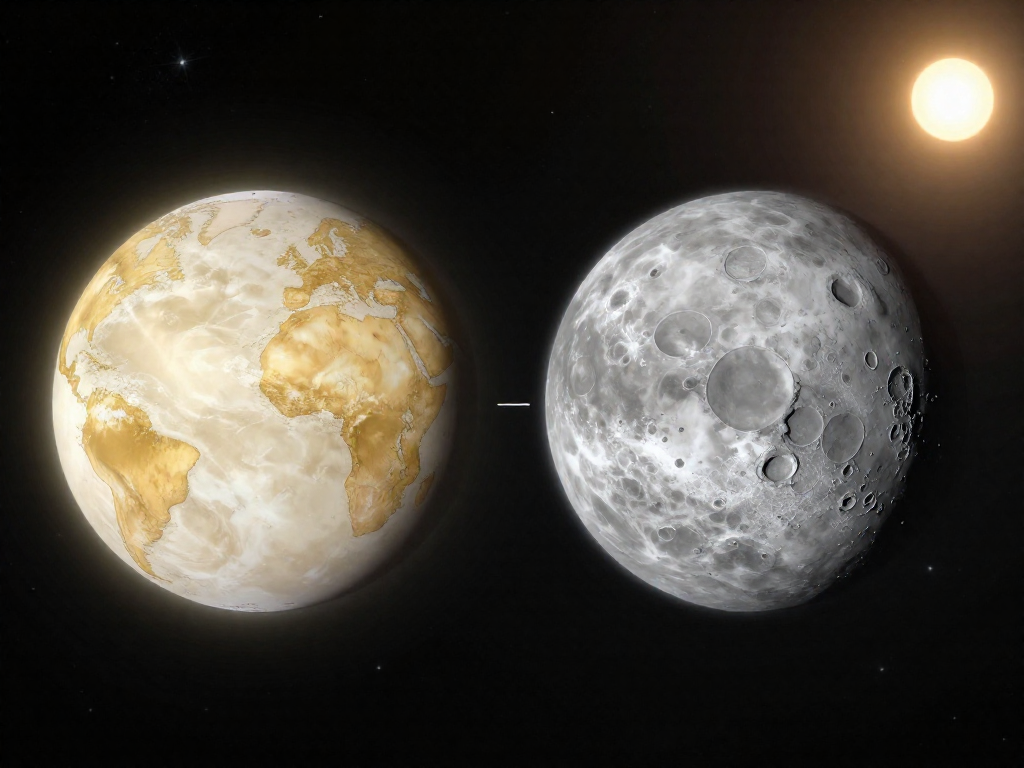
Here's the short version: Venus is the hottest planet in our solar system—not Mercury—even though Mercury sits closer to the Sun.
Venus bakes at a steady 465°C (870°F), hot enough to melt lead. Mercury, despite being the Sun's nearest neighbor, never gets that hot. Its temperature swings wildly: scorching during the day, then plunging to a freezing -180°C (-290°F) at night because it has almost no air to hold the heat in.
So if it isn't distance, what's going on? The answer is Venus's atmosphere—the thick layer of gas wrapped around the planet. Venus is smothered in a dense, heat-trapping blanket of carbon dioxide that locks warmth in and never lets it escape.
Think of it like a campfire. Mercury sits closest to the flames but wears no jacket. Venus stands a step back, bundled in a heavy blanket—and stays far warmer.
Quick takeaway: Venus is hotter than Mercury because its thick atmosphere traps heat like a blanket, not because of where it sits.
Distance Isn't the Whole Story

It feels obvious: the closer you stand to a campfire, the warmer you get. So shouldn't the planet nearest the Sun be the hottest? Mercury sits about 36 million miles from the Sun, while Venus orbits much farther out at roughly 67 million miles (NASA). If distance were the only thing that mattered, Mercury would win this contest without breaking a sweat.
But it doesn't. And the reason comes down to one thing Mercury almost completely lacks: an atmosphere—the blanket of gases that wraps around a planet.
Think of the Sun's energy like heat pouring into a room. Mercury is a room with the windows flung wide open. Sunlight streams in and warms the surface during the day, but with almost no atmosphere to trap it, that heat escapes straight back into space the moment the Sun goes down.
The result is wild temperature swings. Mercury's daytime side can roast at over 400°C, yet its nights plunge to around -180°C (NASA) because nothing holds the warmth in place. It's a planet of extremes precisely because it has no blanket.
So here's the key shift in thinking: how close a planet is to the Sun decides how much heat it receives, but its atmosphere decides how much heat it keeps. As we'll see, that second factor is where Venus changes everything.
Quick takeaway: Closeness brings in heat, but only an atmosphere can hold onto it—and Mercury barely has one.
Meet the Runaway Greenhouse Effect
So if distance doesn't explain it, what does? The answer is Venus's thick, suffocating blanket of air. More than 96% of its atmosphere is carbon dioxide—the same heat-trapping gas you breathe out, just in staggering amounts. This is the engine behind a process scientists call the greenhouse effect, and on Venus it has spun completely out of control.
Here's the basic idea in three steps:
- Sunlight gets in. Light passes through Venus's atmosphere and warms the rocky surface below, just like sunlight warms the ground on Earth.
- Heat tries to leave. The warm surface gives off that energy as heat, which should radiate back out into space.
- Heat gets trapped. The dense carbon dioxide acts like a one-way door—it lets sunlight in but blocks the heat from escaping. So instead of leaving, the heat builds up, day after day, with nowhere to go.
The car-on-a-sunny-day analogy
You've felt a smaller version of this yourself. Park a car in the sun with the windows rolled up, and the inside turns into an oven within minutes. Light pours in through the glass, warms the seats and dashboard, but the heat can't escape back through the windows. Venus's atmosphere is that car windshield—except it wraps the entire planet and never lets up.
Why "runaway"?
The word runaway points to a vicious cycle. As the planet heats up, that warmth releases even more heat-trapping gases into the air. More gases trap more heat, which releases still more gases—a self-reinforcing loop that feeds on itself. Long ago, scientists think, this spiral pushed Venus past a tipping point, boiling away any water it may have had and baking the surface to around 465°C (about 870°F)—hot enough to melt lead (NASA).
Quick takeaway: Venus isn't hot because it's close to the Sun. It's hot because its thick carbon dioxide atmosphere traps heat and won't let go.
How Venus's Atmosphere Compares to Earth's
If you could swap Earth's sky for Venus's, the difference would be staggering. Venus is wrapped in an atmosphere—the blanket of gas surrounding a planet—that's about 90 times thicker than ours. That's not a small bump; it's a completely different world to stand on.
How thick is "90 times thicker"? Imagine the crushing weight you'd feel diving roughly 900 meters (about 3,000 feet) underwater here on Earth. That's the kind of pressure pressing down on Venus's surface every second. You wouldn't just feel warm—you'd feel squeezed.
Here's the part that hits close to home: Earth has greenhouse gases too. These are gases like carbon dioxide that trap heat near the surface, the way a glass roof keeps a greenhouse warm even on a cold day. The crucial difference is amount. Venus's air is almost entirely carbon dioxide, while Earth's holds just a trace by comparison. Same ingredient, wildly different recipe.
That contrast is exactly why scientists at NASA and ESA keep studying Venus. It isn't a doomsday prediction for Earth—our planet is in no danger of becoming Venus. But it's a real, nearby example of how much a planet's climate can change when its atmosphere tips out of balance.
Quick takeaway: Venus has the same heat-trapping gas Earth does—just far, far more of it.
Why Mercury Can't Hold Heat
If distance were the only thing that mattered, Mercury—the closest planet to the Sun—would be the hottest. It isn't. The reason comes down to one thing Venus has and Mercury almost completely lacks: an atmosphere.
An atmosphere is simply the layer of gas wrapped around a planet, and it acts like a blanket. Mercury barely has one. With no blanket to trap, store, or spread warmth, heat escapes straight back into space the moment sunlight stops hitting the surface.
That creates wild extremes. According to NASA, Mercury's daytime side bakes to around 430°C (800°F), while its nighttime side plunges to about –180°C (–290°F). Same planet, but a swing of more than 600 degrees between day and night.
Venus, by contrast, stays a steady, scorching ~465°C almost everywhere, day or night, because its thick atmosphere traps and circulates the heat.
The takeaway: it's the atmosphere, not the distance, that decides which planet runs hottest.
The Takeaway: It's All About the Atmosphere
So here's the twist: being closer to the Sun isn't what makes a planet hot. Mercury is the Sun's nearest neighbor, yet Venus, farther out, runs hundreds of degrees hotter. The difference is the air.
Venus is wrapped in a thick blanket of carbon dioxide that traps the Sun's heat and won't let it escape—a greenhouse effect cranked to the extreme. Mercury, with almost no atmosphere, soaks up heat by day and lets it all leak away into space by night.
One sentence to remember: Venus traps heat, Mercury lets it escape.
Once you see it, the whole solar system gets more interesting. What is the sky like on Mars, or beneath the clouds of Jupiter? Every planet's atmosphere tells its own story—and you're now ready to read it.
See also
- A beginner's guide to all eight planets in the solar system
- What is the greenhouse effect and how does it work on Earth
- Why Mercury has such extreme day and night temperatures
- The hottest and coldest planets in the solar system, ranked
Related articles
Why Does Uranus Spin on Its Side?
Uranus is tilted a wild 98 degrees, rolling around the Sun like a ball. Discover the ancient collision that likely knocked it onto its side.
Jun 29, 2026 · 6 min read
Quick Facts About Every Planet, at a Glance
Key stats for all 8 planets in one scannable place: size, distance from the Sun, day length, moons, and what makes each world weird.
Jun 29, 2026 · 6 min read
How Big Is the Solar System Really? A Sense of Scale
The distances between planets are mind-bending. Use simple shrink-it-down analogies to finally grasp how vast our solar system truly is.
Jun 29, 2026 · 7 min read