Why Does Uranus Spin on Its Side?
Why is Uranus tilted so dramatically?
On this page
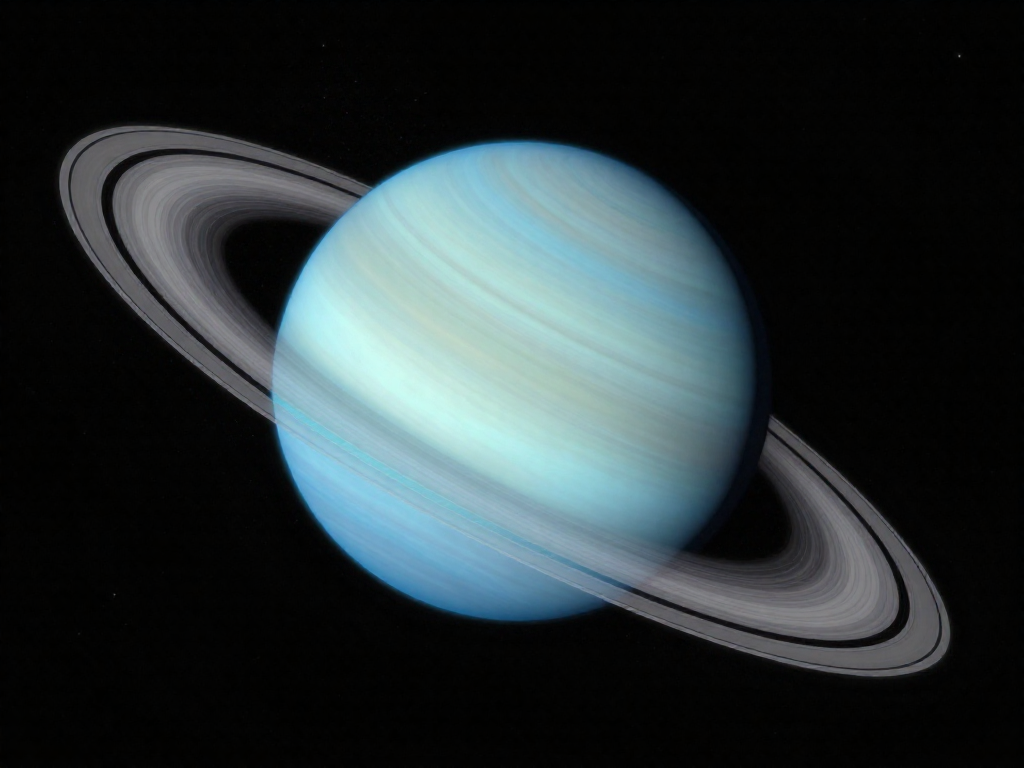
Meet the Planet That Spins Sideways
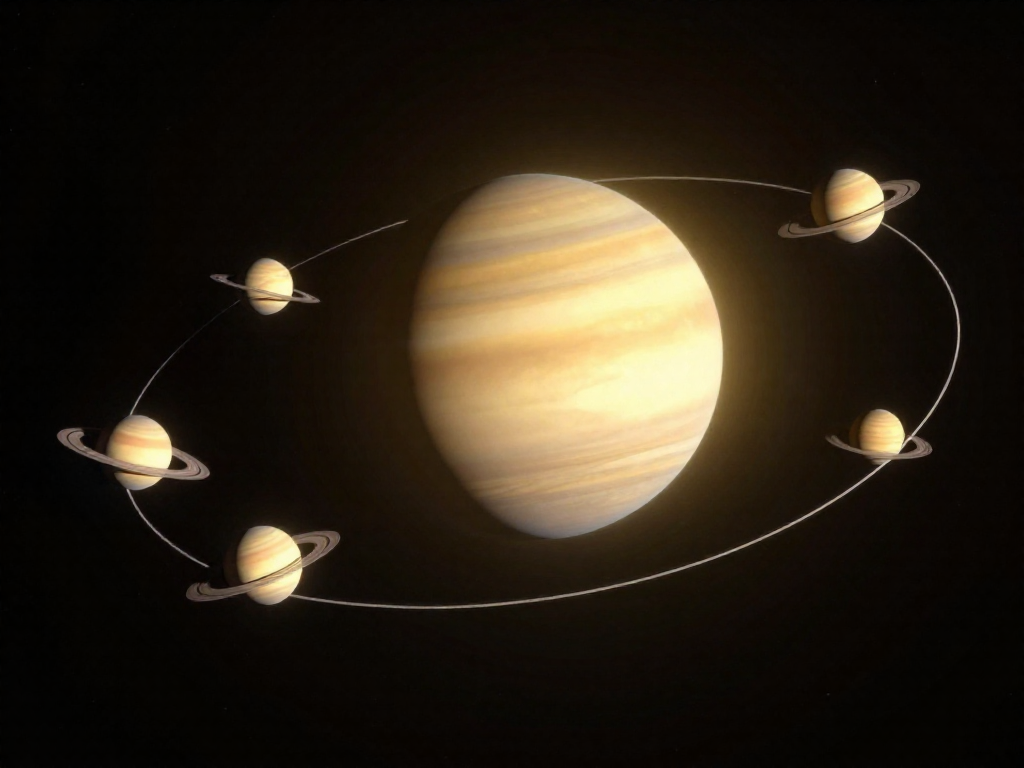
Picture every planet in our solar system as a spinning top. Earth twirls upright, leaning over just a little—about 23.5 degrees, which is what gives us our seasons. Mars, Saturn, and most of the others spin in roughly the same tidy, mostly-upright way.
Then there's Uranus.
Instead of spinning like a top, Uranus is tipped over by a staggering 98 degrees. That's so far past vertical that the planet is essentially lying on its side. (When astronomers talk about a planet's "tilt," they simply mean how far its spin is leaning compared to its path around the Sun.) Rather than standing up and twirling, Uranus rolls around the Sun like a bowling ball gliding down a lane, with its poles pointing nearly straight at—and away from—the Sun as it travels (NASA Solar System Exploration).
That single fact makes Uranus the great oddball of our cosmic neighborhood. Its sideways pose creates some of the strangest seasons anywhere, including decades-long stretches where one pole bakes in continuous sunlight while the other sits in total darkness.
So how did an entire planet end up knocked over like this? That's the mystery we'll unravel next.
Quick takeaway: Most planets spin upright like tops. Uranus is tilted about 98 degrees, so it rolls on its side—and figuring out why is one of astronomy's great puzzles.
What 'Spinning on Its Side' Actually Means
Every planet spins like a top, rotating around an invisible line called its axis (think of the pole that runs through the center of a spinning top, from top to bottom). But here's the thing: most tops don't spin perfectly upright. They lean a little. That lean is called axial tilt, and it's just the angle between a planet's spinning axis and "straight up."
Earth leans about 23 degrees. That gentle tilt is why we have seasons: as Earth circles the Sun, first one hemisphere leans toward the Sun (summer), then the other does (winter). A small lean, mild seasons.
Now picture a spinning top that has fallen over and is somehow still spinning on its side. That's basically Uranus. Its axis is tilted about 98 degrees, according to NASA, meaning it doesn't spin upright at all. It rolls around the Sun like a ball rolling along the ground rather than spinning like a normal top.
This extreme angle does something strange. At certain points in its orbit, one of Uranus's poles points almost directly at the Sun, while the other faces total darkness.
Because Uranus takes about 84 Earth years to orbit the Sun, each pole gets roughly 42 years of continuous sunlight, followed by 42 years of nonstop night. Imagine a single sunrise that doesn't set for four decades.
Quick takeaway: Axial tilt is how much a planet leans as it spins. Earth leans gently (23°); Uranus is knocked nearly flat (98°), so it rolls through its orbit and gives each pole 42-year-long days and nights.
The Leading Theory: A Giant Ancient Collision
So why is Uranus tilted so dramatically? The answer most scientists favor is wonderfully dramatic: a colossal crash.
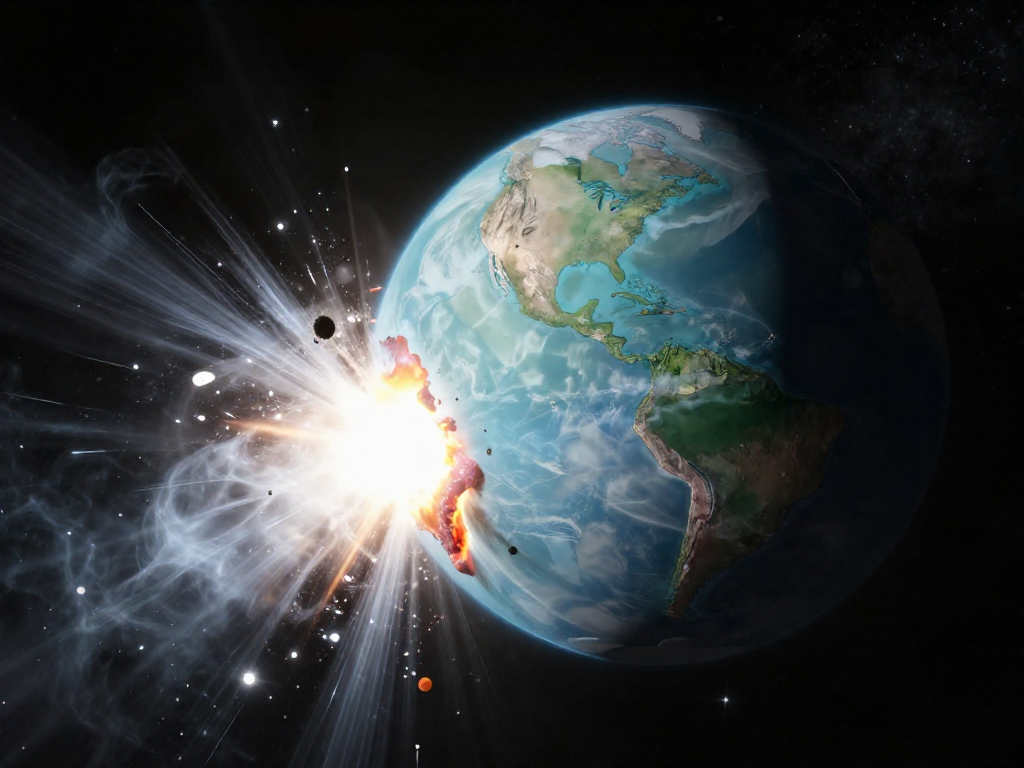
Billions of years ago, when our solar system was young and chaotic, space was crowded with leftover chunks of rock and ice—the building blocks of planets. According to the leading hypothesis (a hypothesis is a scientific explanation that fits the evidence but isn't yet 100% proven), one of these chunks was enormous: at least the size of Earth, possibly larger. It slammed into the young Uranus with staggering force.
Picture a spinning top on a table. Now imagine flicking it hard from the side—it doesn't stop spinning, it just topples over and keeps turning at a weird angle. That's essentially what happened to Uranus. The impact didn't shatter the planet; it knocked it almost completely onto its side, leaving it tilted by about 98 degrees, where it has stayed ever since.
Why do scientists think a collision is the culprit? A few clues point this way:
- The tilt is too extreme for gentle forces. The slow gravitational nudges from other planets can shift a tilt a little, but not flip a whole world over. Only a sudden, violent event fits.
- Uranus's moons orbit the "wrong" way too. They circle the planet's tipped-over equator rather than lining up with the rest of the solar system. A giant impact could have flung out debris that later clumped into these sideways-orbiting moons.
- Computer simulations back it up. Researchers, including teams highlighted by NASA, have modeled such collisions and found that a single massive strike—or possibly two smaller ones—can reproduce the tilt we see today.
It's important to be clear: this is the best-supported explanation, not settled fact. Scientists can't rewind time to watch it happen. But of all the ideas proposed, one giant ancient collision explains the most evidence with the simplest story.
Could It Have Been More Than One Hit?
The giant-collision idea is the leading explanation, but it may not be the whole story. Some researchers think the evidence fits better if Uranus was knocked over by two or more smaller impacts rather than a single colossal one. Picture nudging a spinning top: one hard shove can topple it, but a few well-placed taps can do the job too—and sometimes leave behind tidier clues.
One of those clues is Uranus's family of moons. They orbit neatly around the planet's tilted middle, almost like a spinning record laid flat. If a single violent smash had thrown everything into chaos, scientists would expect the moons to be more scattered. A series of gentler hits could explain how the planet got tipped over while its moons stayed in such orderly lanes.
So how do researchers test ideas about something that happened billions of years ago? They build computer simulations—virtual experiments that replay possible collisions and check whether the results match the real Uranus we see today.
Quick takeaway: Scientists agree Uranus was likely knocked sideways, but how many impacts did it is still debated. That unsettled mystery is exactly what makes it so fascinating.
How the Tilt Shapes Uranus Today
Tipping over on its side didn't just give Uranus a quirky pose—it changed almost everything about how the planet works.
1. Seasons that last for decades. Because Uranus is tilted nearly sideways, each pole spends years pointed almost straight at the Sun while the other sits in darkness. With one Uranian orbit taking about 84 Earth years, a single season drags on for roughly 21 years (NASA). Imagine 21 years of continuous daylight followed by 21 years of night.
2. Moons and rings that circle "vertically." A planet's moons and rings usually orbit around its equator. Since Uranus's equator is tipped on its side, its 13 known rings and its moons trace loops that look almost up-and-down from our point of view, like a giant target facing us.
3. A lopsided magnetic field. Most planets have a magnetic field roughly lined up with their center. Uranus's is tilted about 59 degrees from its spin axis and offset from the planet's middle (NASA), making it one of the strangest, most off-center magnetic fields in the solar system.
4. Hard to study. This odd geometry, combined with its enormous distance, means only one spacecraft—Voyager 2 in 1986—has ever visited, so much about Uranus remains a mystery.
Quick takeaway: The sideways tilt gives Uranus decade-long seasons, vertically orbiting moons and rings, a crooked magnetic field, and plenty of unanswered questions.
See also
- Why Does Venus Spin Backwards?
- How Do Planets Get Their Tilt and Seasons?
- Uranus and Neptune: The Ice Giants Explained
- What Is Axial Tilt and Why Does It Matter?
Related articles
Quick Facts About Every Planet, at a Glance
Key stats for all 8 planets in one scannable place: size, distance from the Sun, day length, moons, and what makes each world weird.
Jun 29, 2026 · 6 min read
How Big Is the Solar System Really? A Sense of Scale
The distances between planets are mind-bending. Use simple shrink-it-down analogies to finally grasp how vast our solar system truly is.
Jun 29, 2026 · 7 min read
What Are the Outer Edges of the Solar System Like?
Journey beyond Neptune into the Kuiper Belt and Oort Cloud, the frozen frontier where comets are born and the Sun's reach finally fades.
Jun 29, 2026 · 7 min read