How Stars Are Born: From Cosmic Clouds to Shining Suns
How does a star form?
On this page
Where Stars Come From: The Cosmic Nursery
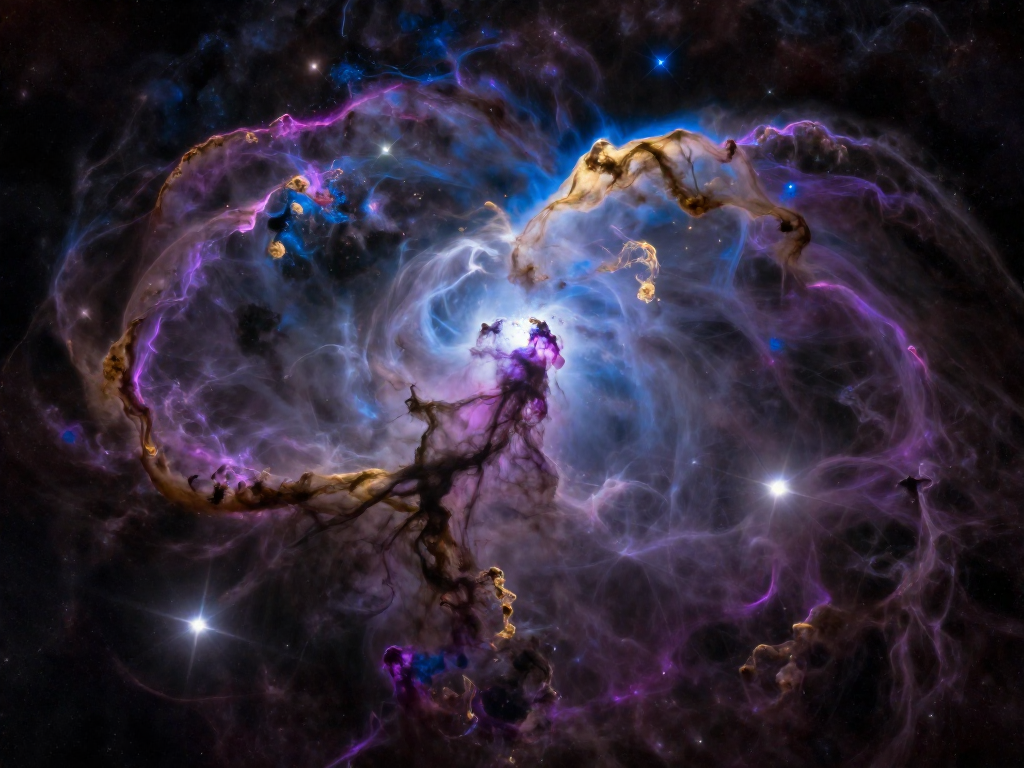
Every star you've ever seen began its life in the same kind of place: a giant cloud of gas and dust floating in space. Astronomers call these clouds nebulae (just a fancy word for "cosmic clouds"), and the star-forming ones are known as giant molecular clouds—"molecular" simply because the gas inside is cold enough for atoms to pair up into molecules.
These clouds are almost unimaginably huge, often stretching dozens of light-years across. (One light-year is the distance light travels in a year—about 6 trillion miles.) Yet despite their size, they're shockingly empty and cold. The air you're breathing right now is trillions of times denser than the gas in one of these clouds. If you could scoop up a handful, it would feel like the best vacuum ever made on Earth. They're also bitterly cold, hovering near –260°C (–440°F), not far above the coldest temperature possible.
What are they made of? Mostly hydrogen, the simplest and most common ingredient in the universe, sprinkled with a little helium and tiny grains of dust.
You may have seen one without realizing it. The famous Pillars of Creation, photographed by NASA's Hubble and James Webb telescopes, are towering columns of gas and dust inside the Eagle Nebula—a real stellar nursery where new stars are taking shape right now.
Here's the key idea: stars can only form in these cold, dense clouds. The chill and the gathered material are exactly what's needed for gravity to start pulling things together—which is where our story heads next.
Quick takeaway: Stars are born inside vast, cold, hydrogen-rich clouds called nebulae. They're enormous but emptier than air, and they're the only places in the universe where new stars can form.
The Trigger: What Makes a Cloud Collapse
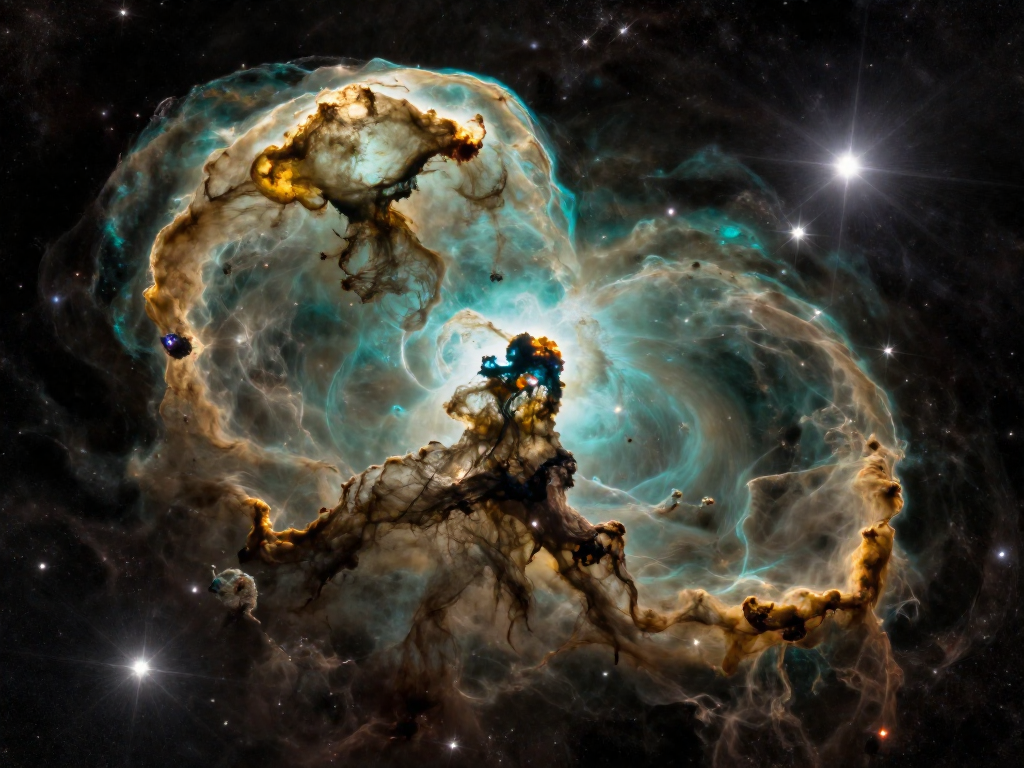
If giant clouds of gas and dust are the birthplaces of stars, here's a puzzle: these clouds can drift through space for millions of years without doing much of anything. So why does one suddenly start building stars now?
A Cloud in Balance
Picture a calm tug-of-war. On one side, gravity pulls all the gas inward, trying to squeeze the cloud into a tighter ball. On the other side, the gas itself pushes back—its particles are warm and moving, creating outward pressure, much like air filling a balloon. For long stretches of time, these two forces cancel out. The cloud just hangs there, stable and quiet.
Something Has to Tip the Scales
A star doesn't begin until something upsets that balance. Astronomers point to a few common "nudges":
- A nearby supernova. When a massive star dies, it explodes and sends out a shockwave—a wall of compressed gas racing through space. When that wave slams into a calm cloud, it squeezes the gas together (NASA).
- Colliding clouds. Two drifting clouds can crash into each other, piling up gas where they meet.
- Galaxy interactions. When whole galaxies pass close or merge, their gravity stirs and compresses the gas inside, sparking bursts of new stars (ESA).
Gravity Takes Over
Whatever the trigger, the result is the same: a dense pocket forms where gas is packed tighter than its surroundings. Once that pocket crosses a tipping point, gravity finally overpowers the outward pressure, and the region begins to collapse in on itself.
And it rarely happens just once. A single cloud usually fractures into many separate clumps, each collapsing on its own. That's why stars are almost always born in batches—a whole nursery of suns lighting up together rather than one lonely star at a time.
Quick takeaway: Clouds sit in a standoff between gravity and pressure. A trigger—often a supernova shockwave, a cloud collision, or a galaxy merger—tips the balance, and gravity does the rest, usually birthing many stars at once.
Gravity Takes Over: The Cloud Falls Inward
Once a cloud of gas and dust gets dense enough, gravity—the same force that keeps your feet on the ground—becomes the star of the show. It pulls all that material toward a central point, and the cloud begins to fall in on itself. This is called gravitational collapse: imagine a slow-motion avalanche, but instead of snow tumbling down a mountain, it's gas and dust tumbling inward from every direction at once.
As the cloud shrinks, something familiar happens. Just as a spinning ice skater speeds up when they pull their arms in, the collapsing cloud spins faster and faster as it gets smaller. That spin matters—it shapes everything that comes next.
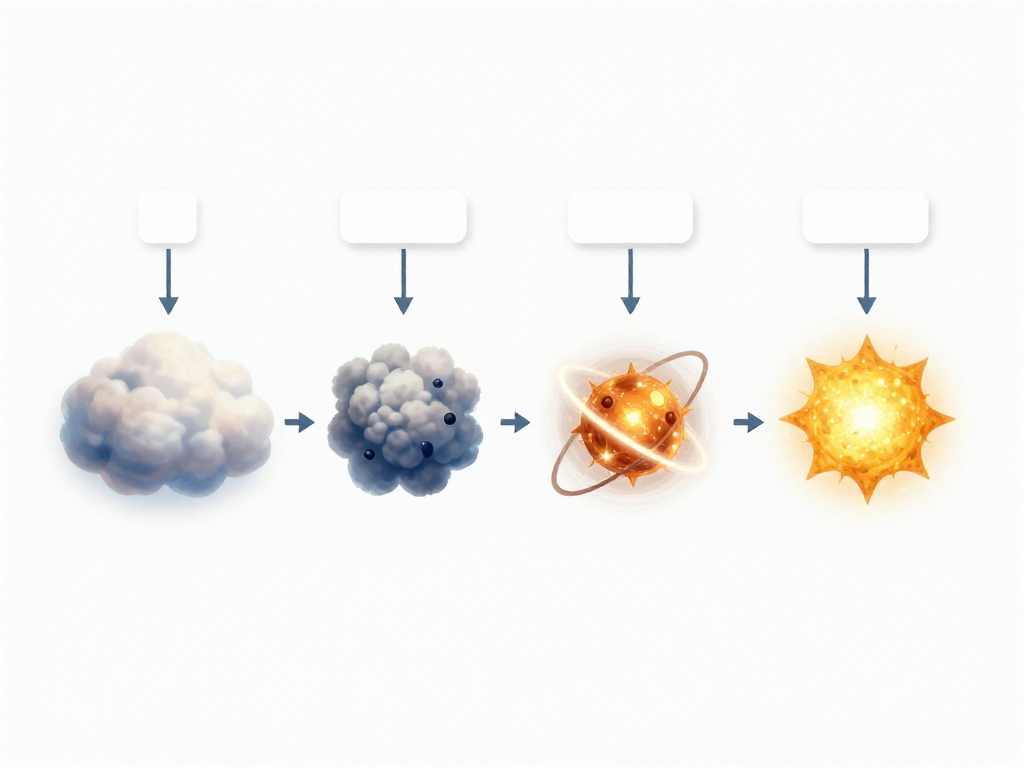
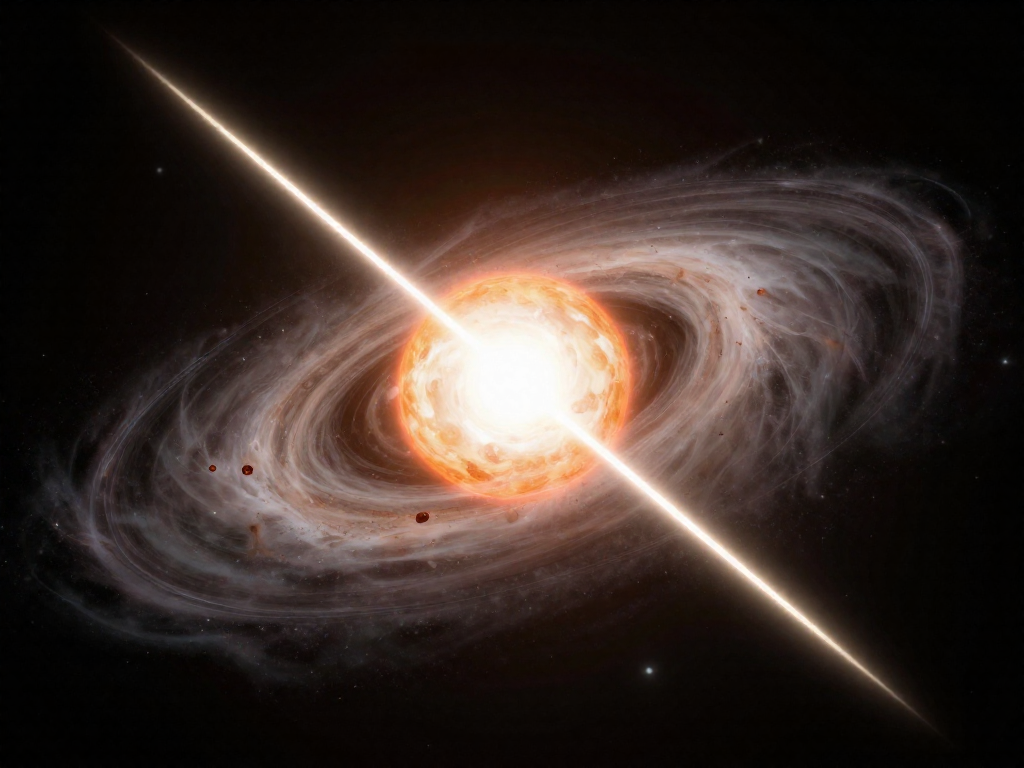
All that falling material has to go somewhere, and as it crashes together near the center, it heats up. (Think of how a bike pump gets warm when you squeeze air into it.) Eventually the center glows with heat, forming a protostar—literally a "baby star" that isn't shining by its own nuclear fire yet, but is hot enough to glow. For now it stays hidden, wrapped inside the thick cocoon of leftover gas and dust.
Because the whole system is spinning, the leftover material can't all fall straight in. Instead, it flattens into a swirling disk around the protostar, a bit like pizza dough spreading out when you spin it. This disk is important: it's the raw material from which planets may later form.
Finally, growing protostars often do something dramatic—they fire enormous jets of gas out from their north and south poles, like cosmic fountains shooting into space. Astronomers (including teams using NASA's telescopes) have photographed these glowing jets, giving us a direct look at stars in the making.
Quick takeaway: Gravity pulls the cloud inward, the spinning center heats into a glowing protostar, a planet-forming disk swirls around it, and jets blast from its poles.
Ignition: When a Protostar Becomes a True Star
By now, gravity has crushed a vast cloud of gas into a hot, dense ball called a protostar—think of it as a star-in-waiting, glowing but not yet truly "switched on." What happens next is the moment everything has been building toward.
The Core Keeps Getting Hotter
As the protostar's own weight presses inward, the material at its center is squeezed tighter and tighter. Squeezing gas makes it hotter—the same reason a bicycle pump warms up when you compress the air inside it. Only here, the scale is staggering: the core climbs past 10 million degrees Celsius (about 18 million °F), according to NASA.
The Switch Flips: Nuclear Fusion Begins
At those mind-bending temperatures, something remarkable happens. Hydrogen atoms—the simplest and most common ingredient in the universe—start slamming together so hard that they stick, merging to form a slightly heavier element called helium. This merging of atoms is nuclear fusion, and it's the engine that powers every star, including our Sun.
Here's the payoff: each tiny fusion reaction releases a burst of energy. Multiply that by countless reactions every second, and you get the light and heat that make a star shine.
A Perfect, Long-Lasting Balance
That outpouring of energy does something crucial—it pushes outward, finally counteracting the relentless inward pull of gravity. Picture a tug-of-war that settles into a perfect tie:
- Gravity pulls everything inward.
- Fusion energy pushes everything outward.
- The two forces lock into balance.
This steady standoff is the official birth of a star. The newborn settles into its long, stable adulthood—a phase our Sun has enjoyed for roughly 4.6 billion years and will continue for billions more.
Quick takeaway: A star is "born" the instant fusion ignites in its core, turning a collapsing cloud into a self-sustaining, shining sun balanced between gravity and its own light.
How Long It Takes and How Big Stars Get
Building a star is not a quick job. From the first slow squeeze of a gas cloud to the moment a true star switches on, the whole process takes anywhere from a few hundred thousand to several million years (NASA). That sounds enormous, but in cosmic terms it's the blink of an eye.
The biggest factor in how a star turns out is simple: how much gas it manages to gather. Think of it like a snowball rolling downhill. A star that scoops up only a little material ends up small, cool, and reddish. One that piles on huge amounts becomes a giant that glows hot and blue.
That size sets the whole life story. Massive stars are like sports cars with the gas pedal floored — they burn incredibly bright but run out of fuel fast, sometimes in just a few million years. Small, dim "red dwarf" stars sip their fuel so slowly they can shine for trillions of years, far longer than the universe has existed so far (ESA).
Our own Sun? It's a steady, middle-of-the-road star, born about 4.6 billion years ago.
Quick takeaway: More gas means a bigger, hotter, shorter-lived star — and our Sun sits comfortably in the average range.
The Bigger Picture: Why Star Birth Matters to You
Here's the part that turns star formation from a distant spectacle into something deeply personal: stars are the universe's factories for the elements that make up everything around you—and inside you.
When the universe began, it held mostly the two simplest ingredients, hydrogen and helium. Almost everything else—the carbon in your cells, the oxygen you breathe, the iron in your blood, the calcium in your bones—was forged in the searing cores of stars (NASA). A star spends its life fusing simple atoms into heavier ones, building the periodic table from the inside out.
Then comes the recycling. When a massive star dies, often in a spectacular explosion called a supernova, it scatters those freshly made elements across space. That enriched material drifts into existing gas clouds—the same kind of "cosmic nurseries" we met earlier—seeding the next generation of stars and planets. In other words, dying stars give birth to new ones.
This is what astronomer Carl Sagan meant by the famous phrase "we are made of star stuff." It's not poetry—it's established science.
Quick takeaway: The atoms in your body were cooked inside ancient stars. And right now, across the universe, new stars are still being born in exactly the same way.
See also
- What Is a Nebula? A Beginner's Guide to Cosmic Clouds
- The Life Cycle of a Star, Explained Simply
- What Happens When a Star Dies? Supernovas and Beyond
- How Big Is Our Sun Compared to Other Stars?
- What Are Galaxies and How Did They Form?
Related articles
Neutron Stars: The Densest Things in the Universe
What is a neutron star? Discover how a teaspoon can weigh a billion tons, how these cosmic objects form, and why they're the densest things we know of.
Jun 29, 2026 · 8 min read
Will the Universe Ever End? Possible Cosmic Futures
Will the universe ever end? Explore the Big Freeze, Big Rip, Big Crunch, and other possible cosmic fates explained simply for beginners—no equations needed.
Jun 29, 2026 · 9 min read
The Colors of Stars: What Red, Blue, and White Tell Us
Why are stars different colors? Discover how red, blue, and white reveal a star's temperature—explained in plain, jargon-free language for beginners.
Jun 29, 2026 · 6 min read