Will the Universe Ever End? Possible Cosmic Futures
How might the universe end?
On this page
First, the Reassuring Part: We're Talking Unimaginably Far Away
Before we explore how the universe might end, take a deep breath: none of this is happening anytime soon. We're talking about events billions to trillions of years in the future. To put that in perspective, our own Sun won't burn out for roughly another 5 billion years (NASA)—and every cosmic ending in this article unfolds long, long after that. This is not a forecast for your lifetime, or your great-great-grandchildren's.
So why do scientists even wonder about this? Because the universe isn't sitting still—it's expanding, meaning galaxies are drifting farther apart over time, like raisins spreading out in a loaf of rising bread. Once you know everything is moving, it's natural to ask: where does it all lead?
Here's the honest truth: nobody knows for sure. These aren't predictions written in stone—they're educated possibilities based on the physics we understand today, and scientists openly debate them.
Much of the uncertainty comes down to dark energy, a mysterious force that seems to be pushing the universe to expand faster. Because we don't fully understand it yet, the universe's ultimate fate stays an open question.
Quick takeaway: These cosmic endings are deep-future hypotheses, not warnings—so stay curious, not worried.
Why the Universe's Fate Depends on Dark Energy
Here's the single idea that decides every possible ending: how the universe expands over time.
We know the universe is expanding—galaxies are slowly drifting away from one another, like dots on the surface of a balloon spreading apart as it inflates. A tastier way to picture it: imagine a loaf of raisin bread dough rising in the oven. The raisins don't move through the dough on their own, yet every raisin ends up farther from every other one as the dough swells between them. Galaxies are the raisins; space itself is the dough.
Now the twist. That expansion isn't just coasting along—it's actually speeding up. The mysterious something behind this acceleration is what scientists call dark energy: an unseen pressure that seems to push space apart. We can measure its effects, but we still don't know what it truly is, which is one of the biggest open questions in astronomy today (NASA).
So the whole future of the cosmos comes down to a single question about dark energy:
- Does it stay constant? The expansion keeps accelerating steadily.
- Does it get stronger over time? Expansion runs wild and tears everything apart.
- Does it weaken or reverse? Expansion could slow, stop, or even collapse inward.
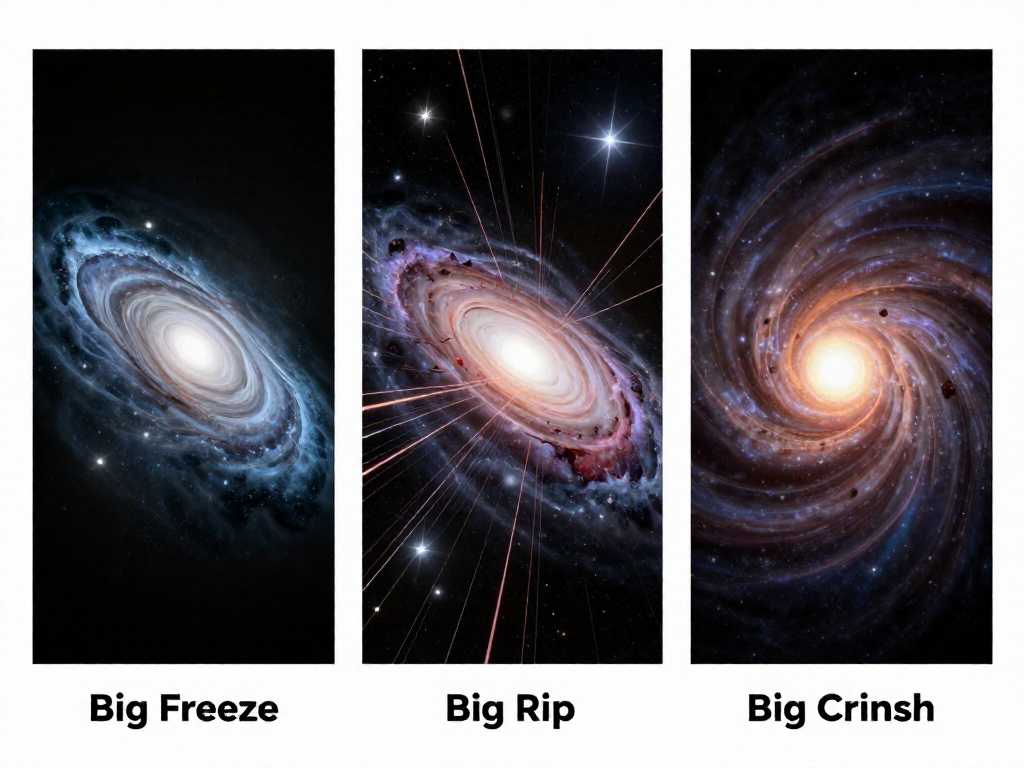
Each answer leads to a completely different ending—names you'll meet shortly, like the Big Freeze, the Big Rip, and the Big Crunch.
Quick takeaway: The universe is expanding faster and faster thanks to dark energy. Whether that force holds steady, intensifies, or fades determines how everything ends.
It's worth being honest here: while the accelerating expansion is well-established science, the long-term behavior of dark energy is still genuinely uncertain.
The Big Freeze (Heat Death): The Universe Fades to Cold and Dark
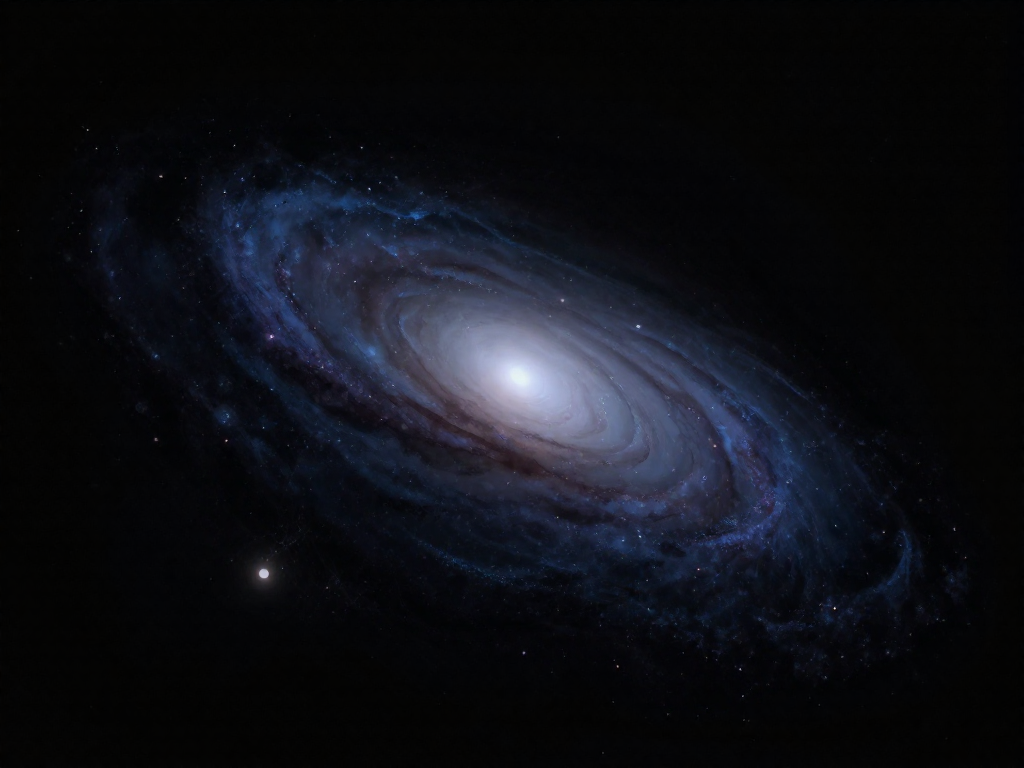
If the universe has a most likely ending, this is it. Scientists call it the Big Freeze (or heat death), and despite the dramatic name, it's the opposite of a fiery finale. Picture a campfire slowly burning down to embers, then to ash, then to cold gray dust—except the campfire is everything that exists.
Here's how the story unfolds.
-
Expansion never stops. The universe has been growing ever since the Big Bang, and thanks to dark energy—a mysterious push that drives galaxies apart faster and faster—that growth looks set to continue forever. Everything keeps spreading out, getting more thinly scattered, like a single drop of ink diffusing through an endless ocean.
-
The stars go out. Stars shine by burning fuel, and that fuel is finite. Over unimaginable stretches of time, existing stars burn out, and the gas needed to make new ones runs low. One by one, the lights switch off.
-
Galaxies vanish from view. As space stretches, distant galaxies drift so far away that their light can no longer reach us. The night sky—if anyone were left to look—would grow emptier and darker.
-
Even black holes disappear. Black holes seem permanent, but physicist Stephen Hawking showed they very slowly "evaporate," leaking away their energy over almost incomprehensible timescales. Eventually, even these go too.
What's left is a cold, dark, near-empty cosmos: no stars, no warmth, no activity—just thinly spread particles drifting in the dark.
Why scientists favor it: Current measurements from missions like NASA's WMAP and ESA's Planck satellite suggest dark energy is real and dominant, which points toward endless expansion. That makes the Big Freeze the front-runner among possible cosmic futures—though it remains a projection, not a certainty.
Quick takeaway: The universe most likely won't end with a bang. It ends with a whisper—a slow, quiet fade to black over timescales so vast they make a human lifetime look like the blink of an eye.
The Big Rip: Everything Torn Apart
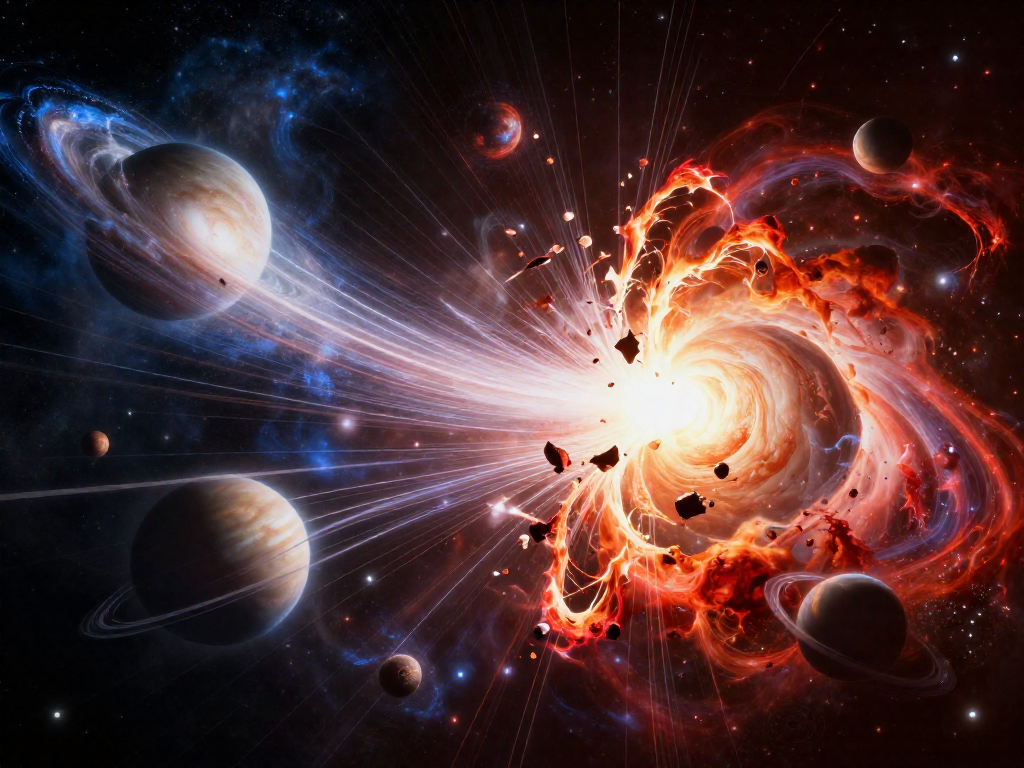
Of all the ways the universe might end, the Big Rip is the most cinematic. Picture the cosmos not slowly fading away, but being violently pulled to pieces from the inside out.
Here's the idea. The universe is expanding—every galaxy is drifting away from every other one, like dots on a balloon that's being inflated. What's driving that expansion is something scientists call dark energy: a mysterious push that fills empty space and makes the universe stretch faster over time. We can measure its effects, but we don't yet know exactly what it is.
In most scenarios, dark energy stays roughly steady. But in the Big Rip, it does something more sinister: it grows stronger and stronger without limit. If that happens, the gentle outward stretch becomes an unstoppable tearing force.
And it wouldn't stop at the largest scales. The destruction would work its way down like a countdown:
- Galaxies get ripped apart, scattering their stars.
- Solar systems unravel as planets are torn from their stars.
- Planets themselves come apart.
- In the final fraction of a second, even atoms—the tiny building blocks of everything—are pulled to shreds.
That cascading, clockwork quality is what makes the Big Rip so haunting. It's not a quiet fade to black; it's a literal countdown to nothing.
So how likely is it? Honest answer: this is speculation, not established science. Whether the Big Rip can happen depends entirely on how dark energy behaves over billions of years—and that's one of the biggest open questions in cosmology. Current observations from missions like NASA's and ESA's surveys actually favor calmer endings, so most scientists consider the Big Rip possible but unlikely.
Quick takeaway: The Big Rip imagines dark energy turning into a runaway force that shreds the universe, atom by atom. Dramatic, yes—but more a "what if" than a forecast.
The Big Crunch: The Universe Collapses Back In
Imagine the universe as a ball thrown straight up into the air. So far, we've explored futures where it keeps drifting outward forever—getting colder (the Big Freeze) or being torn apart (the Big Rip). But what if gravity wins instead, and the ball comes crashing back down? That's the Big Crunch.
In this scenario, the universe's expansion eventually slows, stops, and then reverses. Galaxies that have spent billions of years rushing apart begin falling back toward one another. Over immense stretches of time, everything draws closer, temperatures climb, and matter is squeezed tighter and tighter—until the entire cosmos collapses into a single, blazing-hot, super-dense point. In other words, it's a bit like watching the Big Bang play in reverse.
Why scientists now think it's unlikely: For a Big Crunch to happen, gravity would need to overpower the universe's expansion. But observations from NASA and ESA show the opposite is happening—the expansion is actually speeding up, driven by a mysterious force called dark energy (the unknown "push" stretching space apart). With expansion accelerating rather than slowing, a collapse looks increasingly improbable.
The poetic twist—the "Big Bounce": This is speculation, not established science, but some physicists wonder whether a Big Crunch might not be an ending at all. What if that final crushing point "bounced" and triggered a brand-new Big Bang—a fresh universe born from the ashes of the old one?
Quick takeaway: The Big Crunch is the Big Bang in reverse, ending in a hot, dense collapse. Current evidence makes it unlikely, but the idea of a rebirthing "Big Bounce" remains a tantalizing maybe.
The Long-Shot Endings: Big Slurp and Beyond
Beyond the three big scenarios we've covered, there's a wilder, far more speculative idea that scientists treat as a long shot: the "Big Slurp", also known as vacuum decay.
Here's the gist. Empty space might not be as "settled" as it looks. Imagine a ball that seems to be resting at the bottom of a valley—but there's an even deeper valley nearby it could roll into. If our universe is the ball, a tiny bubble of "truer," more stable space could one day appear and expand outward at nearly the speed of light, rewriting the laws of physics inside it as it goes. Anything it swept over would be fundamentally changed.
Sounds terrifying? It does—but take a breath. This is highly speculative, not established science. There's no evidence one is coming, and if it ever did, it would arrive without warning, so there's genuinely nothing to lose sleep over.
What this scenario really highlights is humility: our understanding of the universe is still growing. New discoveries from observatories like NASA's and ESA's telescopes could reshape these predictions entirely.
Quick takeaway: The "Big Slurp" is a fascinating thought experiment—more a reminder of how much we've yet to learn than a forecast to fear.
So Which Ending Is Most Likely?
If you're hoping for a single confident answer, here's the honest truth: scientists lean toward one scenario, but nobody is closing the case just yet.
Right now, the Big Freeze (also called heat death—the slow fade to cold and dark we covered earlier) is the front-runner. It best fits what we currently observe: a universe expanding faster and faster, with no sign of slowing down or reversing. NASA and ESA observations of distant supernovae and the cosmic background "afterglow" of the Big Bang both point this way.
But here's the catch, and it's a big one. The whole prediction hinges on dark energy—the mysterious push driving that accelerating expansion. We can measure its effects, yet we genuinely don't know what it is. If dark energy behaves differently over time than we assume, the door reopens to a Big Rip or even stranger fates.
To me, that uncertainty isn't depressing—it's thrilling. It means the universe still has secrets, and the people who unlock them may be alive today. Maybe even reading this.
Quick takeaway: The Big Freeze is the leading hypothesis, but it's not settled science. Our biggest unknown, dark energy, could change everything.
And step back for a second: we live on one small planet, yet we can sketch the universe's whole story—a beginning, a long middle, and an ending. Knowing that arc exists is part of the awe.
See also
- What Is Dark Energy? A Beginner's Guide
- How Did the Universe Begin? The Big Bang Explained Simply
- What Happens When a Star Dies?
- How Big Is the Universe, Really?
- What Are Black Holes and How Do They Work?
Related articles
Neutron Stars: The Densest Things in the Universe
What is a neutron star? Discover how a teaspoon can weigh a billion tons, how these cosmic objects form, and why they're the densest things we know of.
Jun 29, 2026 · 8 min read
The Colors of Stars: What Red, Blue, and White Tell Us
Why are stars different colors? Discover how red, blue, and white reveal a star's temperature—explained in plain, jargon-free language for beginners.
Jun 29, 2026 · 6 min read
Why Do Stars Twinkle but Planets Don't?
Stars twinkle and planets don't—here's the simple reason why, explained without the jargon. It all comes down to our atmosphere and how light reaches your eyes.
Jun 29, 2026 · 5 min read