Best Times and Places to See the Milky Way With Your Own Eyes
When and where can I see the Milky Way?
On this page
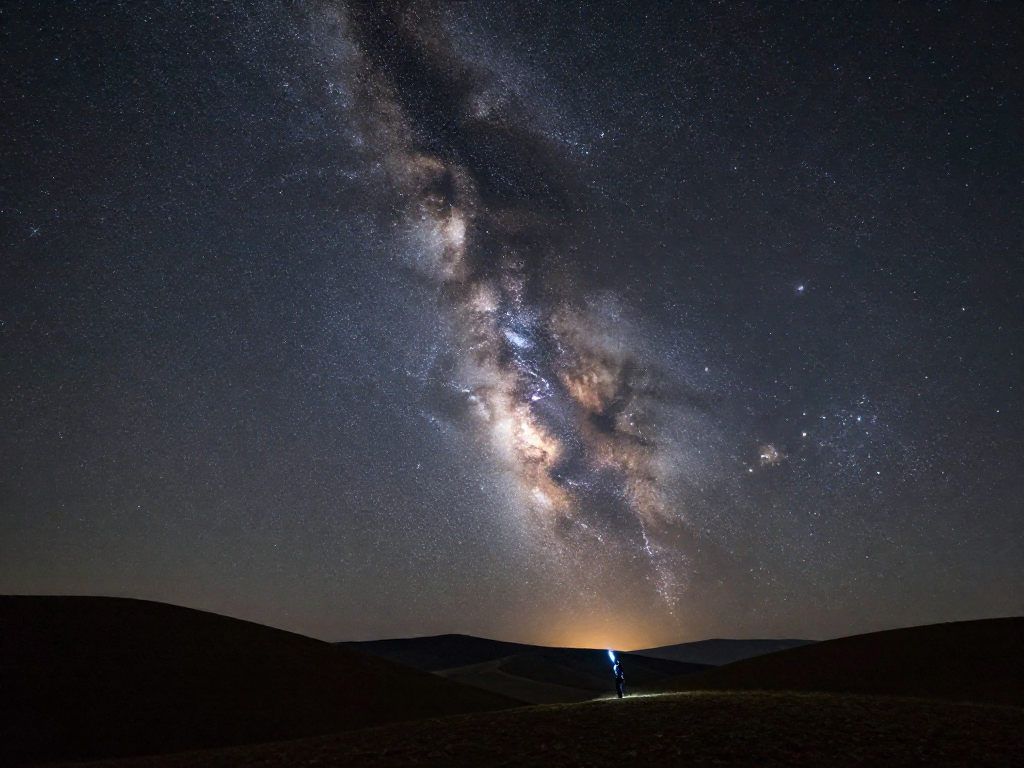
What You're Actually Looking For
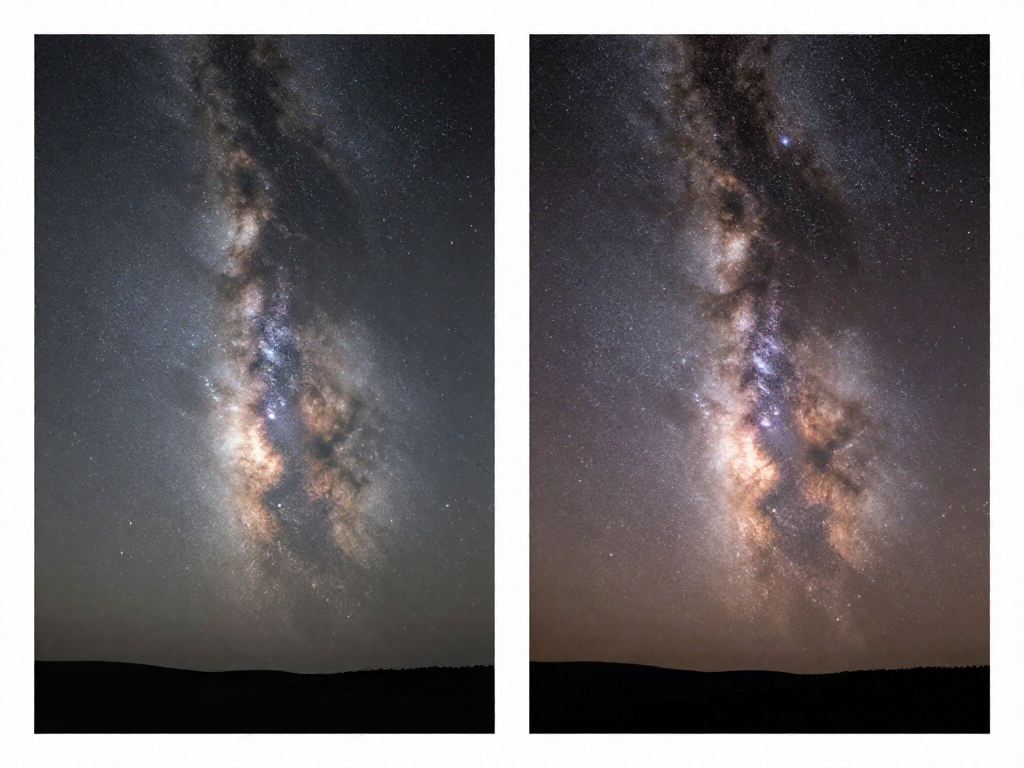
Forget the swirling, neon-purple spiral you've seen in photos. To your naked eyes, the Milky Way looks like a faint, hazy band of pale light arching across a dark sky—a bit like a streak of thin cloud that somehow never drifts or changes shape. That "cloud that doesn't move" is your first clue you've found it: real clouds blow past, but this glowing ribbon stays put among the stars all night.
Here's the wonder behind it: you're looking edge-on into our own galaxy. Picture a dinner plate full of hundreds of billions of stars, and you're standing inside it, near the rim. Look toward the plate's flat edge and the stars pile up so thickly they blur into that soft glow.
Your eyes can absolutely see this band on a dark night—but they can't gather light over time the way a camera does. Those vivid colors and detailed spiral arms in photos come from long exposures, where a camera's shutter stays open for seconds or minutes to soak up light your eyes capture in an instant.
Quick takeaway: Expect a subtle, glowing arch—not a postcard. Spotting it at all is the real thrill.
The Best Time of Year to See the Milky Way
You can see some part of the Milky Way on almost any clear, dark night. But there's a catch: the part most people are chasing—the bright, glowing galactic core—is only visible for part of the year.
Think of our galaxy as a giant pinwheel of stars, and we live out in one of the arms, looking inward. The "core" is the dense, crowded center, and it's the showstopper: a thick, cloudy band packed with stars and dark dust lanes. The rest of the year, you're looking outward toward the thinner edge, where the band is faint and easy to miss.
Northern Hemisphere core season: roughly late spring through early fall. The sweet spot is June, July, and August, when the core rises high enough after dark to really stand out.
Why winter disappoints: in winter, the core sits below the horizon during the night. You can still spot a softer stretch of the galaxy, but it's the dim outer region—pretty, but not the jaw-dropping view from summer.
Southern Hemisphere bonus: if you're south of the equator, you win. The core passes nearly overhead and stays visible longer, making it brighter and easier to see. Its prime months run from about April to September.
Quick month-by-month cheat sheet (Northern Hemisphere)
- Jan–Feb: Faint outer band only; core not visible.
- Mar–Apr: Core begins rising in pre-dawn hours.
- May: Core visible late at night.
- Jun–Aug: Peak season—core bright and well-placed after dark.
- Sep: Still good early in the evening.
- Oct–Dec: Core sets early or is gone; outer band only.
Quick takeaway: For the dramatic glowing core, aim for June–August in the north (April–September in the south).
Seasonal visibility based on the Milky Way's position as described by NASA and astronomy education resources.
The Best Time of Night (and the Moon Matters Most)
Picking the right night matters even more than picking the right spot. The single biggest thing that washes out the Milky Way isn't city lights—it's the Moon. A bright Moon floods the sky with light the same way a streetlamp drowns out faint stars, so your goal is to catch the sky when the Moon is out of the way.
Plan around the new moon. The "new moon" is the phase when the Moon sits between Earth and the Sun, so its lit side faces away from us and the night sky stays dark. Aim for the few nights on either side of it. A free moon-phase calendar (try NASA's Daily Moon Guide or a stargazing app) shows exactly which nights are darkest—look for the new-moon symbol, then pick a clear-forecast date close to it.
Wait for true darkness. After sunset, the sky stays faintly lit for a while during twilight—the in-between glow before full night. The Milky Way only shows its detail during astronomical darkness, the deepest stage that begins roughly 90 minutes to two hours after sunset, once the Sun is far enough below the horizon that its glow is gone.
Best hours by season: In summer (Northern Hemisphere), the bright galactic core rises in the late evening and shines through the small hours. In spring and fall, you'll often get the best view in the pre-dawn hours before sunrise.
Let your eyes adjust. Give yourself 20–30 minutes away from all white light so your eyes fully dark-adapt—the Milky Way slowly fades into view like a photo developing. One glance at a phone screen resets the clock, so use red light if you need it.
Quick takeaway: New moon + no twilight + dark-adapted eyes = the Milky Way at its best.
The Best Places: Escaping Light Pollution
Here's the hard truth most beginners discover the hard way: you can pick the perfect moonless summer night and still see nothing but a few stars. The culprit is almost always light pollution — the glow from streetlights, buildings, and cities that washes out the sky like a flashlight shining on a movie screen. It is the single biggest reason people never see the Milky Way, and the good news is it's also the easiest to fix. You just have to drive away from it.
To find true darkness, astronomers use the Bortle scale, a simple 1-to-9 rating of how dark a night sky is. Think of it like a brightness dial: Bortle 1 is pitch-black wilderness where the Milky Way casts faint shadows, while Bortle 9 is a city center where you're lucky to spot the Moon and a handful of stars. For your first real view, aim for Bortle 4 or darker. At that level, the Milky Way appears as a soft, glowing band arching overhead.
The simplest way to find a good spot is a free dark-sky map like the Light Pollution Map or the website of the International Dark-Sky Association, which lists certified Dark Sky Parks — protected areas specifically kept free of artificial light. These are the gold standard.
As a rough rule, you typically need to get at least 30 to 60 miles (about 50 to 100 km) from a large city to reach Bortle 4 skies. Once you arrive, face the darkest part of your horizon, away from any distant city glow, and give your eyes 20 to 30 minutes to adjust.
Quick takeaway: Light pollution is the #1 barrier. Use a dark-sky map, target Bortle 4 or darker (ideally a certified Dark Sky Park), drive 30–60 miles from the city, and look toward the darkest horizon.
A Simple Step-by-Step Plan for Your First Night
Ready to actually do this? Here's a five-step checklist that pulls together everything above into one easy plan.
-
Pick a new-moon week. The Milky Way shows best from late spring through early fall (in the Northern Hemisphere). Within that window, choose the week around a new moon—the phase when the Moon is hidden in the Sun's glare and the sky stays truly dark. A bright full Moon washes out the faint Milky Way like a streetlight drowning out candlelight.
-
Check the clear-sky forecast. Even one thin layer of cloud can ruin the view. Look up your date on a weather app, or use a stargazing forecast like Clear Outside, and aim for a night that's predicted to be cloud-free.
-
Find a dark spot. Open a light-pollution map (Light Pollution Map or the dark-sky finder from DarkSky International) and head toward the darkest area you can reach—usually well outside city limits. The darker the sky, the more stars appear.
-
Arrive before dark and go red. Get there before nightfall, then give your eyes 20–30 minutes to fully adjust. Use only a red flashlight or your phone's red-light mode, since white light resets that adjustment instantly.
-
Look south toward Sagittarius. The brightest, most detailed part of the Milky Way—its glowing core—sits in the direction of the constellation Sagittarius.
Quick takeaway: New moon + clear sky + dark location + adjusted eyes + look south = your first real glimpse of our galaxy.
Free Tools and Apps to Make It Easy
You don't need to spend a cent to plan a great Milky Way night. A few free tools handle the guesswork for you:
- Light-pollution maps (like the Light Pollution Map website) show you where the sky is darkest—think of them as a brightness heatmap. Aim for the green, blue, or gray zones, far from city glow.
- Stargazing apps (such as Stellarium Mobile or Sky Tonight) let you point your phone at the sky to find the "galactic core," the bright, busy center of the Milky Way and the best part to see.
- Moon-phase and clear-sky forecast tools (like Clear Outside) tell you when the Moon is out of the way and the clouds will cooperate.
- A red-flashlight app swaps harsh white light for dim red, which keeps your eyes adjusted to the dark so faint stars stay visible.
Quick takeaway: Dark spot, no Moon, clear skies, red light—four free apps cover all four.
FAQ
Can you see the Milky Way with the naked eye?
Yes. Under a truly dark sky, far from city lights, the Milky Way appears as a soft, glowing band of milky light stretching across the sky—which is exactly how it got its name. That faint glow is the combined light of hundreds of billions of distant stars in our own galaxy. You don't need any equipment; your eyes just need about 20–30 minutes in the dark to fully adjust before the band becomes obvious.
What month is best to see the Milky Way?
For most people in the Northern Hemisphere, the brightest and most striking part of the Milky Way—the dense core toward the galaxy's center—is best seen from roughly June through August, when it rises high in the night sky. Spring offers earlier-morning views, and fall still shows it in the evening. In the Southern Hemisphere, the core sits even higher overhead and is spectacular during the same period. Whatever the month, pick nights around the new moon for the darkest skies.
Do I need a telescope to see the Milky Way?
No. The Milky Way is best enjoyed with just your eyes, because its beauty is that wide, sweeping band across the whole sky—something a telescope's narrow view can't capture. Telescopes and binoculars are great for zooming in on individual targets like star clusters or nebulae (glowing clouds of gas and dust), but to take in the galaxy as a whole, your unaided eyes under a dark sky are the perfect tool.
Why can't I see the Milky Way from my backyard?
The most likely culprit is light pollution—the artificial glow from streetlights, buildings, and homes that brightens the night sky and washes out faint objects. The Milky Way's gentle glow simply can't compete with that brightness. According to NASA and dark-sky researchers, a large share of people worldwide now live under skies too bright to see it at all. The good news: the Milky Way is still there—you just need to get away from the lights to reveal it.
How far from the city do I need to go to see the Milky Way?
It depends on how big and bright your city is, but a useful rule of thumb is to drive far enough that the sky glow on the horizon mostly disappears—often 1 to 2 hours (roughly 50–100 miles) from a major metro area. A handy shortcut is to use a light pollution map (free online tools that color-code sky brightness) and aim for the darker green, blue, or gray zones. Officially designated Dark Sky Places, certified for their excellent night skies, are ideal if there's one near you.
Does the full moon affect seeing the Milky Way?
Yes, a lot. A full or nearly full moon acts like a giant natural floodlight, brightening the whole sky and drowning out the Milky Way's faint glow—much like how a bright lamp makes it hard to see a candle. For the best view, plan your trip for the nights around the new moon, when the moon is absent from the night sky, or go out during a window when the moon has set or hasn't yet risen.
See also
- Understanding light pollution and the Bortle scale
- Beginner's guide to dark-sky stargazing
- What is the Milky Way galaxy?
- How to read moon phases for stargazing
- Best meteor showers to watch this year
Related articles
How to Photograph the Night Sky With Just a Phone
Yes, you can take stunning night sky photos with just a phone. Learn beginner-friendly settings, gear, and tricks to capture stars, the Moon, and the Milky Way.
Jun 29, 2026 · 11 min read
What Causes the Northern Lights, and Can Beginners See Them?
Curious about the Northern Lights? Learn what causes auroras in plain language, where and when to see them, and realistic tips for total beginners.
Jun 29, 2026 · 8 min read
A Beginner's Sky-Watching Calendar: Events Worth Looking Up For
A simple year-round sky-watching calendar for beginners. Discover meteor showers, eclipses, and planet sightings worth looking up for—no telescope needed.
Jun 29, 2026 · 5 min read