The Colors of Stars: What Red, Blue, and White Tell Us
Why are stars different colors?
On this page
The Big Idea: Star Color Is a Temperature Gauge
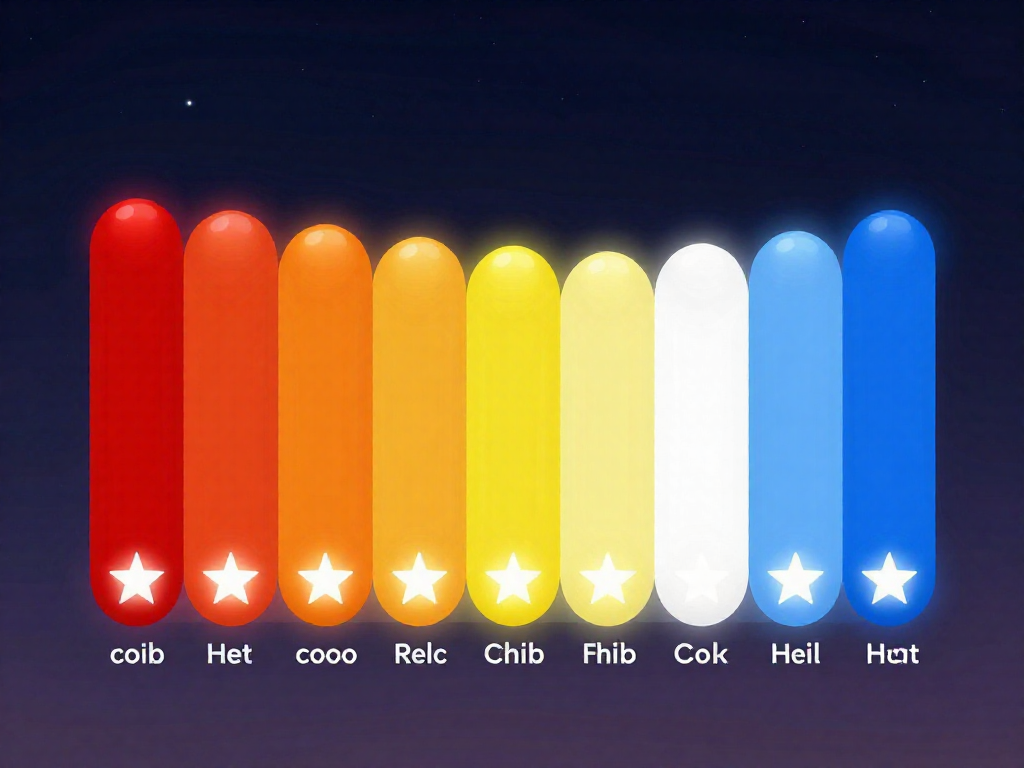
Here's the whole secret in one sentence: a star's color tells you how hot its surface is. That's it. When you look up and notice that one star glows faintly red while another shines icy blue-white, you're really reading a giant thermometer in the sky.
Now for the part that surprises almost everyone. On Earth, we think of red as "hot" (think of a stop sign or a hot stove warning). But for stars, the rule flips:
- Blue stars are the hottest.
- White and yellow stars sit in the middle.
- Red stars are the coolest.
If that feels backwards, you've already spotted the one tricky bit—and once it clicks, the rest is easy.
A simple comparison makes it stick. Picture a metal poker left in a fire. At first it glows a dull red. Heat it more and it brightens to orange, then yellow, then a brilliant white-hot. Push the temperature even higher and the glow shifts toward blue-white. Stars do the exact same thing, just on an enormous scale and for billions of years.
The best part? This one idea works for every star you can see. The faint red dot, our own yellow-white Sun, the dazzling blue beacons of winter—all of them follow this single rule. Keep it in mind, and the rest of this article is just the fun details.
Why Hotter Means Bluer (Not Redder)
Here's the part that trips almost everyone up: we tend to think of red as "hot" and blue as "cool." Your bathroom faucet uses red for hot water. Warning lights are red. So it feels natural to assume red stars are the scorching ones. With starlight, it's the exact opposite—and you've actually seen the proof in your own kitchen.
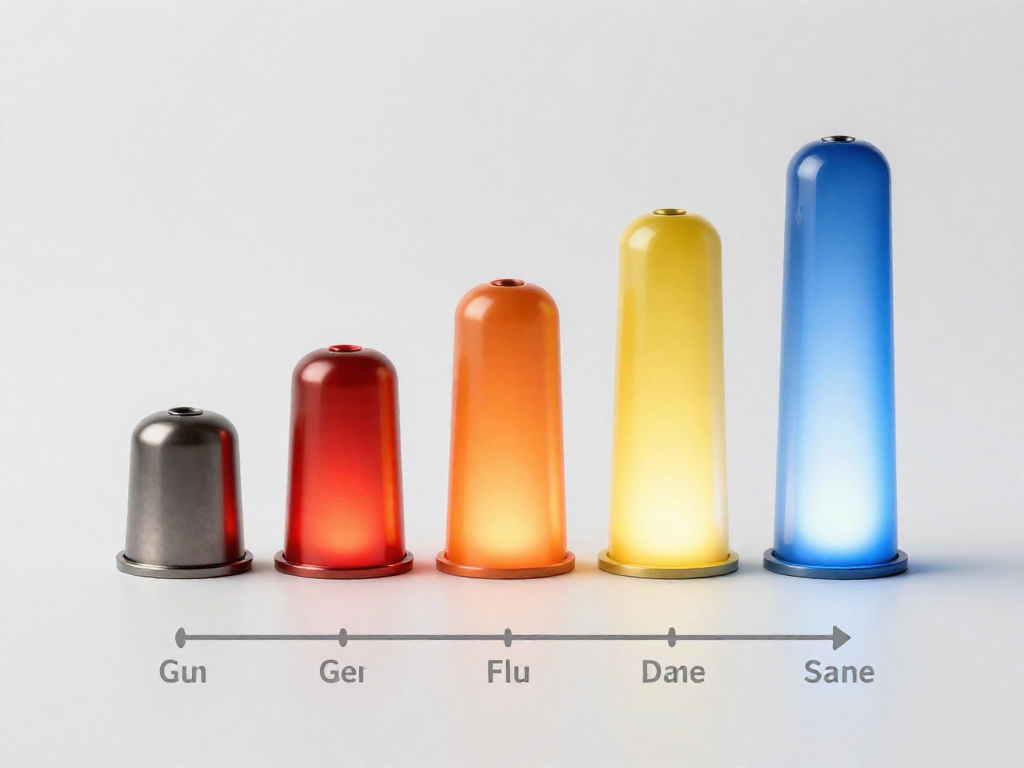
Picture an electric stovetop coil switching on. At first it stays dark, then it creeps to a dull, deep red. Leave it longer and that red brightens to orange. A blacksmith's iron does the same trick: it glows red, then orange-yellow, then a brilliant near-white as the forge gets hotter and hotter. The pattern is simple—the hotter something glows, the more its color climbs from red toward blue.
Why does it go that direction? When an object is relatively cool, the light it gives off leans toward the red end of the rainbow. As it heats up, it starts throwing off more and more of the bluer light too, and the overall color shifts that way. Think of red as the "just getting started" glow and blue-white as the "absolutely roaring" glow.
Stars follow this same everyday rule, just at temperatures far beyond any stovetop. So a red star is actually the cooler one in the lineup, while a blue-white star is a blazing furnace by comparison.
Quick takeaway: Hotter = bluer, cooler = redder. The campfire and stovetop you already know show you the pattern—no equations required.
A Color-by-Color Tour of the Stars
Here is the surprising part: a star's color is really a thermometer reading. The hue you see tells you how hot the star's surface is—the glowing outer layer that sends light our way. Let's take that tour, from coolest to hottest.
Red stars — the cool embers (~3,000°C). Red is the calmest color a star can glow, like the dim, reddish heat of dying campfire coals. Famous examples are Betelgeuse in the constellation Orion and Antares in Scorpius. "Cool" is relative, of course—3,000°C would vaporize anything on Earth—but in star terms, these are the gentle giants.
Orange and yellow stars — the comfortable middle. Step up the heat and the color warms toward orange, then yellow-white. Our own Sun lives here, at roughly 5,500°C. We often picture it as plain "yellow," but seen from space it looks closer to white (NASA). The yellowish tint we notice from the ground comes from Earth's atmosphere scattering its light.
White stars — hot and dazzling. Hotter still, and a star burns white, blending all colors together. Sirius, the brightest star in our night sky, and Vega both shine this way—crisp, brilliant, and unmistakable.
Blue stars — the blazing champions (over 10,000°C). The hottest stars glow blue, like the hottest part of a gas flame. Rigel, also in Orion, is a stunning example, with a surface several times hotter than the Sun's.
One important note: these numbers are surface temperatures, not the star's core. Cores are millions of degrees—that's the furnace. But it's the surface we see, so the surface is what paints the color.
Quick takeaway: Red = coolest, blue = hottest, with orange, yellow, and white in between. Color is the star showing you its temperature.
Wait—Why Does the Sun Look Yellow (or White)?
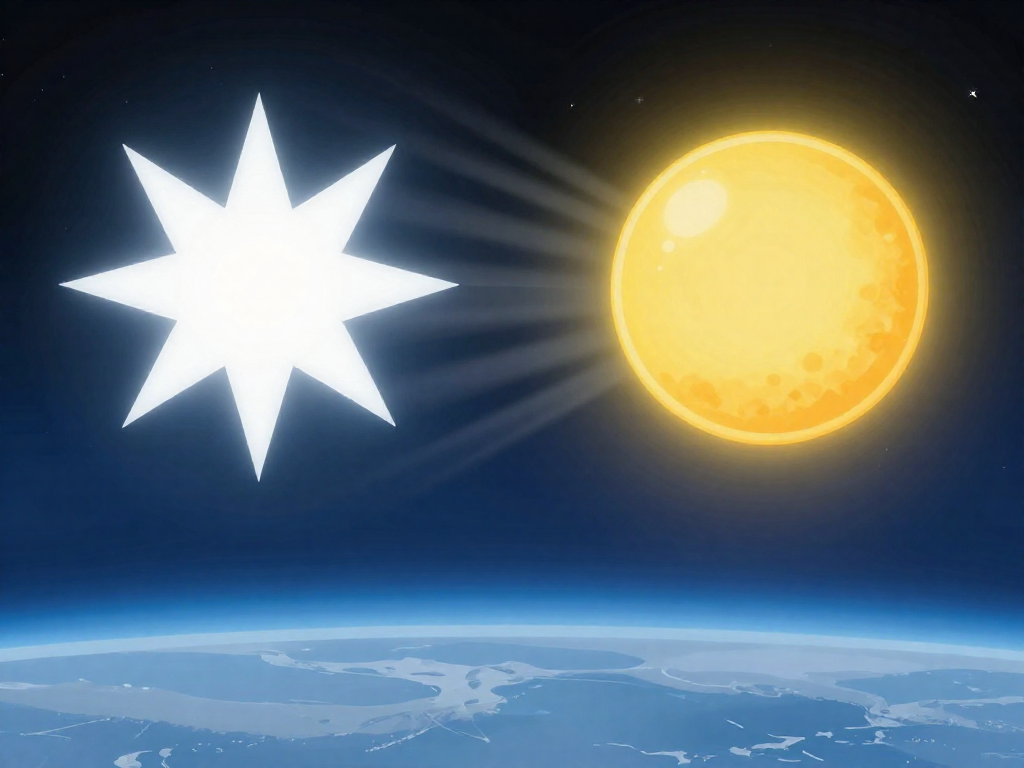
Here's a surprise: the Sun is actually white. If you could float above Earth's atmosphere and look (you'd need protection, of course), it would shine as a clean, brilliant white—a balanced mix of every color at once.
So why does it look yellowish from the ground? Blame the air. Our atmosphere is better at scattering short, bluish wavelengths of light than long, reddish ones. As sunlight passes through it, some of that blue gets bounced away in every direction, leaving the Sun looking slightly warmer and more golden than it really is.
That same scattering explains two everyday sights:
- A blue sky. The blue light bounced out of the Sun's beam spreads across the whole sky, so it glows blue overhead (NASA).
- Red sunsets. Near the horizon, sunlight travels through much more air, scattering away nearly all the blue and leaving fiery reds and oranges.
It also explains twinkling. Pockets of moving air bend starlight slightly as it arrives, making stars shimmer—and stars low on the horizon can even flash brief colors as that thick, restless air splits their light.
Quick takeaway: The Sun is truly white; our atmosphere does the yellow-tinting, the blue sky, and the red sunsets.
What Color Also Hints About a Star's Life
Here's the part that turns stargazing into time travel: a star's color doesn't just tell you how hot it is—it whispers clues about its size, age, and ultimate fate.
Take blue giants. These are the rock stars of the galaxy: enormous, blazing hot, and impossibly bright. But living fast comes at a cost. They burn through their fuel so quickly that they last only a few million years—a blink compared to other stars—before going out in dramatic fashion.
At the opposite end are red dwarfs, the slow and steady survivors. They're small, cool, and dim, sipping their fuel so gently that they can shine for trillions of years. In fact, every red dwarf ever born is still alive today, because the universe (about 13.8 billion years old, per NASA) simply hasn't existed long enough for any to die.
Then there are red giants—not young stars, but old ones. These are aging suns that have puffed up and cooled as they near the end of their lives. Our own Sun will become one someday, billions of years from now.
Quick takeaway: Color isn't just a snapshot of heat. It's a clue to a star's whole story—how big it is, how old, and how it will end.
How to Spot Star Colors Yourself Tonight
Here's the fun part: you can see star colors with just your eyes. The trick is giving them the right conditions to shine.
- Find dark skies. Get away from city lights if you can—those bright streetlights wash out subtle colors. Then let your eyes adjust for about 15–20 minutes (no peeking at your phone). This "dark adaptation" makes faint colors far easier to notice.
- Aim for Orion. This famous constellation is the perfect training ground. Look for Betelgeuse, a warm orange-red star marking Orion's shoulder, and Rigel, a cool-looking blue-white star at his foot. Side by side, the contrast is striking.
- Grab binoculars. Even a cheap pair makes subtle tints pop, gathering more light than your eye alone.
- Compare two stars. Your brain reads color best by comparison, so bounce your gaze between two nearby stars to train your eye.
Quick takeaway: Dark skies, adjusted eyes, and Orion's Betelgeuse vs. Rigel are all you need to start seeing the universe in color.
See also
- The Life Cycle of a Star, Explained Simply
- What Is a Red Giant and What Will Happen to Our Sun?
- How to Find Orion in the Night Sky
- Why Is the Sky Blue? (And Sunsets Red)
- Beginner's Guide to Stargazing Without a Telescope
Related articles
Neutron Stars: The Densest Things in the Universe
What is a neutron star? Discover how a teaspoon can weigh a billion tons, how these cosmic objects form, and why they're the densest things we know of.
Jun 29, 2026 · 8 min read
Will the Universe Ever End? Possible Cosmic Futures
Will the universe ever end? Explore the Big Freeze, Big Rip, Big Crunch, and other possible cosmic fates explained simply for beginners—no equations needed.
Jun 29, 2026 · 9 min read
Why Do Stars Twinkle but Planets Don't?
Stars twinkle and planets don't—here's the simple reason why, explained without the jargon. It all comes down to our atmosphere and how light reaches your eyes.
Jun 29, 2026 · 5 min read