The Life and Death of a Star, Explained Simply
What happens to a star over its lifetime?
On this page
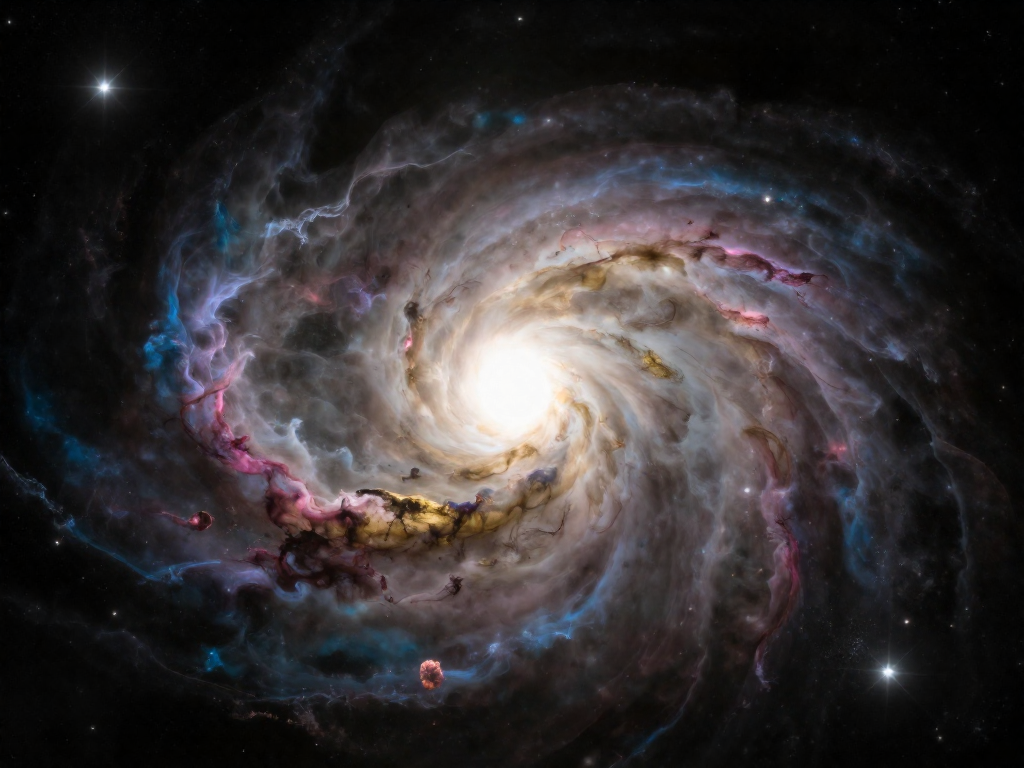
Stars Are Born, Live, and Die (Yes, Really)
Here's something that sounds like science fiction but is solidly established science: stars are not permanent. They aren't fixed lights bolted to the sky. Each one has a beginning, a long middle, and an end—a life cycle, the same phrase we use for living things, even though a star isn't alive in any biological sense. We borrow the term simply because stars change dramatically over time, the way a living thing does.
Those timescales are almost impossible to picture. Depending on its size, a star can shine for a few million years or for trillions—far longer than the universe has even existed so far (about 13.8 billion years, according to NASA). Compared to that, a human lifetime is a single blink.
And now the payoff that gives this whole topic its wonder: you are made of dead stars. The calcium in your bones and the iron in your blood were forged inside stars that lived and died before our Sun was born. Quite literally, you are stardust.
No math required—just curiosity. Here's the journey we'll follow:
- Birth — how a star ignites
- Main life — its long, steady glow
- Old age — when things swell and change
- Death — the dramatic finale
Let's start at the very beginning.
Step 1: Birth in a Cloud of Gas and Dust
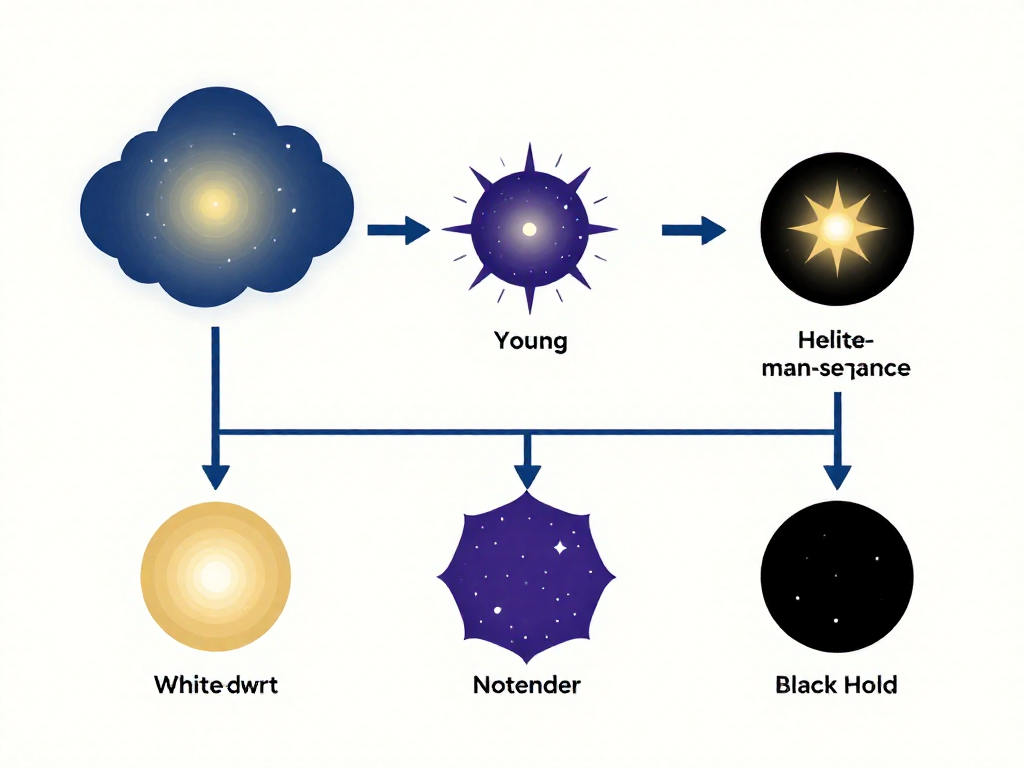
Every star begins its life inside a nebula — a giant, cold cloud of hydrogen gas and dust drifting through space. Think of it as a cosmic nursery, vast enough to stretch across many light-years (a single light-year is about 6 trillion miles). These clouds are mostly hydrogen, the simplest and most common ingredient in the universe.
So how does a shapeless cloud become a glowing star? The answer is gravity — the same force that keeps your feet on the ground. Inside the nebula, gravity slowly pulls clumps of gas together. As more gas piles in, the clump grows denser and starts to shrink, or collapse, under its own weight. Squeezing all that material into a smaller space causes it to heat up, the same way a bike pump gets warm when you compress air inside it.
At this stage, the hot, swirling ball of gas is called a protostar — basically a "baby star" that isn't shining yet. It glows faintly from heat, but it hasn't truly "switched on." That moment comes when the core gets unbelievably hot: around 10 million degrees Celsius, according to NASA.
At that temperature, something remarkable happens called nuclear fusion — hydrogen atoms in the core slam together hard enough to merge into helium, releasing enormous amounts of energy. This is the spark that lights the star. Fusion is what makes our Sun shine and keeps it stable for billions of years. The protostar has officially become a true star.
One last surprise: stars rarely form alone. Because nebulae are huge, gravity tends to collapse many clumps at once, so stars are typically born in clusters — groups of dozens, hundreds, or even thousands of stellar siblings.
Quick takeaway: Gravity squeezes a cold cloud of hydrogen until its core gets hot enough for fusion to ignite — and a star is born, usually alongside many others.
Step 2: The Main Sequence (A Star's Long, Stable Adulthood)
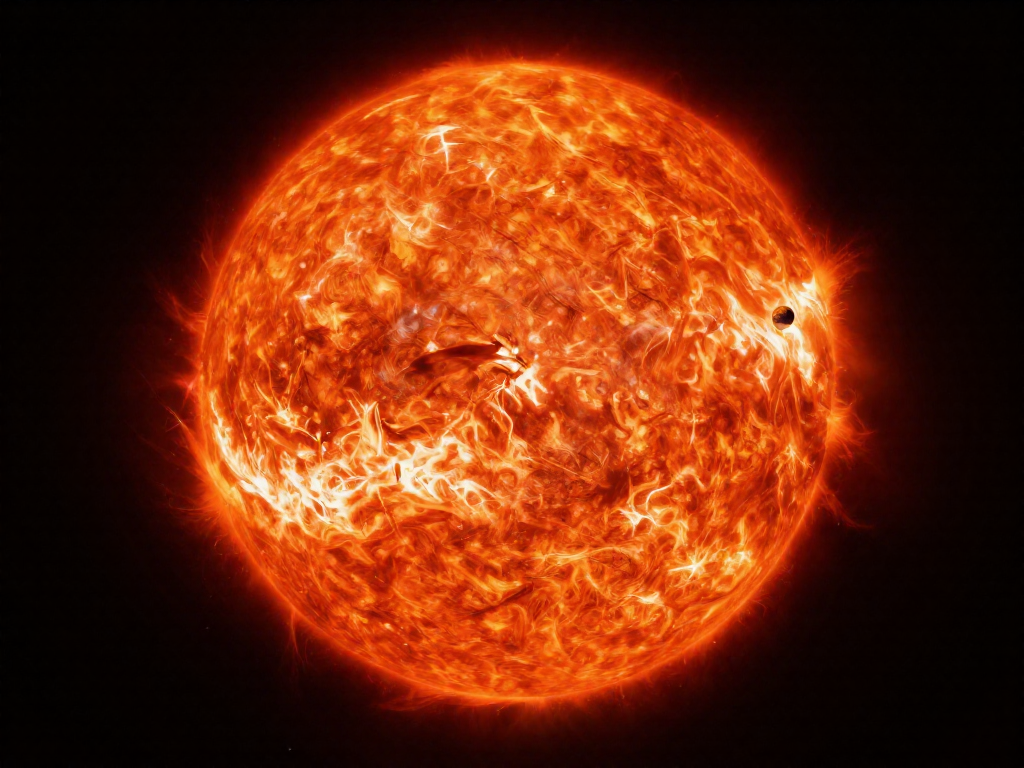
Once a star switches on, it settles into the calmest, longest chapter of its life: the main sequence. Think of it as a star's adulthood—steady, dependable, and lasting an astonishingly long time.
A cosmic tug-of-war that keeps things steady
Every star is locked in a constant struggle between two opposing forces.
- Gravity is always trying to crush the star inward, squeezing all that gas toward the center.
- Fusion—the process where hydrogen atoms slam together in the core to form helium, releasing enormous energy—pushes outward, like heat rising from a furnace.
When these two forces perfectly balance, the star holds a stable size. Scientists call this hydrostatic equilibrium, but you can picture it as a tug-of-war where both teams are exactly evenly matched, so the rope never moves. That standoff is what keeps a star shining quietly for billions of years.
Why this phase lasts so long
Because a star has a vast supply of hydrogen fuel and burns it at a steady rate, the main sequence takes up roughly 90% of a star's entire life. Everything else—the dramatic birth and the spectacular death—happens in the remaining sliver of time.
Our Sun, right now
Our own Sun is a main-sequence star sitting comfortably in middle age. According to NASA, it's about 4.6 billion years old and will keep fusing hydrogen for roughly another 5 billion years—meaning it's about halfway through its estimated ~10-billion-year life. The sunlight warming your skin today comes from this exact balancing act.
Bigger isn't better (for living long)
Here's the surprising twist: massive stars live shorter lives, not longer ones. A heavyweight star has more fuel, but it burns through it at a furious pace to fight off its own stronger gravity. The biggest stars may last only a few million years, while small, cool stars can shine steadily for tens of billions—far longer than the universe has even existed so far.
What gives a star its color
A star's color is simply a temperature readout. Hot stars glow blue-white, while cooler stars shine red or orange—the same way a flame's hottest part looks blue and its cooler edges look orange.
Quick takeaway: During the main sequence, gravity and fusion balance perfectly, letting a star shine steadily for most of its life. Bigger stars burn hotter, brighter, and faster—and a star's color simply reveals how hot it is.
Step 3: Running Out of Fuel and Swelling Up
For most of its life, a star burns hydrogen in its core—squeezing hydrogen atoms together to make helium, a process called fusion (think of it as the star's engine). But the core only holds so much hydrogen. When it's gone, the engine sputters. This is what astronomers mean by a star "running out of fuel": not the whole star emptying out, but the central tank specifically.
Here's the surprising part—the star doesn't shrink. It does the opposite.
The core squeezes, the outside balloons
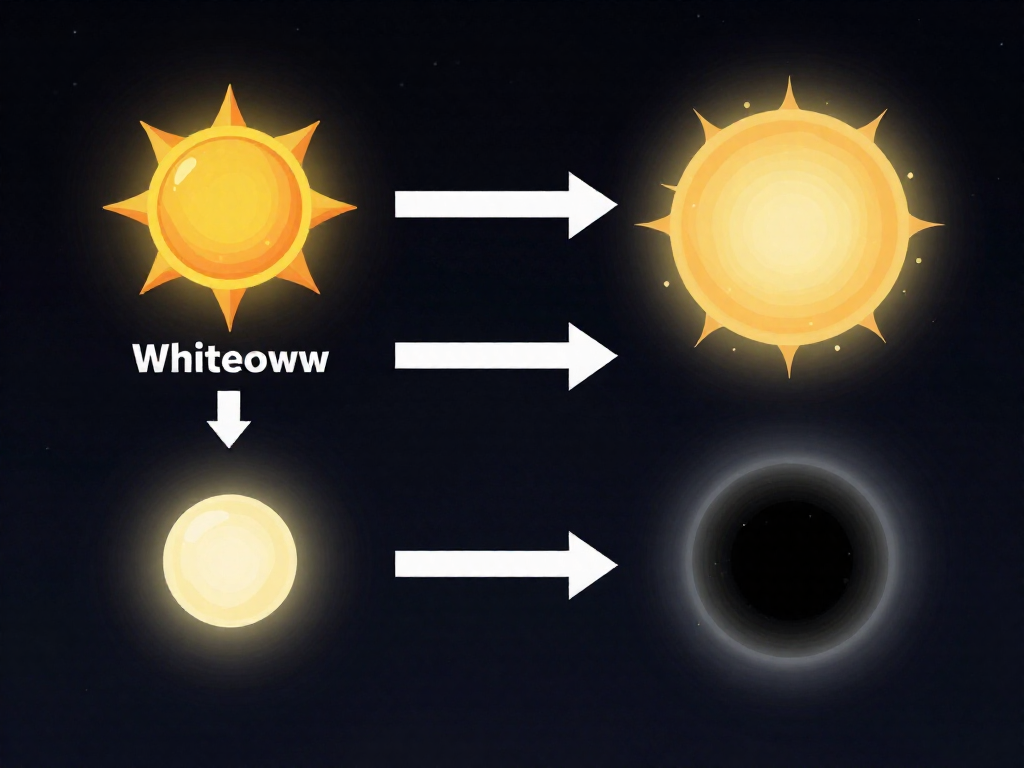
With no fusion pushing outward, gravity wins and the core contracts, getting hotter and denser. That intense heat ignites fusion in a shell around the core, and the extra energy puffs the star's outer layers outward—way outward. The surface cools as it spreads, glowing red instead of white-hot. The star becomes a red giant: bloated, cooler, and enormous.
A second act of fusion
The squeezed core eventually gets hot enough to fuse helium (the "ash" left over from burning hydrogen) into carbon and oxygen. For bigger stars, the process keeps going—fusing heavier and heavier elements in layered shells, like an onion. This is, quite literally, where many of the atoms in your body were forged.
What about Earth?
Our Sun will reach this stage in roughly 5 billion years. According to NASA, it will swell large enough to engulf Mercury and Venus, and possibly Earth. Even if our planet isn't swallowed, the oceans will have long since boiled away. The good news: this is unimaginably far in the future.
Big stars do it differently
The red giant phase isn't one-size-fits-all:
- Small and medium stars (like the Sun) puff up, fuse helium, and then gently stall—they can't burn anything heavier.
- Massive stars keep fusing element after element, building toward a far more dramatic ending (more on that next).
Quick takeaway: When a star's core hydrogen runs out, gravity squeezes the core while the outer layers swell into a red giant. New fusion begins—and for our Sun, this spells the end of Earth as we know it.
Step 4: How a Star Dies Depends on Its Size
Here's the secret to a star's destiny: it all comes down to mass—how much "stuff" the star is made of. A star isn't free to choose how it dies. Its size at birth essentially writes the ending in advance. Think of it like the difference between a candle burning out and a stick of dynamite going off: both run out of fuel, but they finish in wildly different ways.
Let's follow the two main paths.
Small and Medium Stars: A Gentle Goodbye
Stars about the size of our Sun (and anything up to roughly 8 times the Sun's mass) go out quietly. After swelling into a red giant, the dying star simply puffs its outer layers off into space, like a cosmic smoke ring drifting away. This glowing shell is called a planetary nebula—a confusing name, since it has nothing to do with planets. (Early astronomers thought the round, fuzzy shapes looked like planets through their small telescopes, and the name stuck.)
What's left behind is the star's exposed, burned-out core: a white dwarf. This is an incredibly dense ember, roughly the size of Earth but containing the mass of a star. It no longer burns fuel—it just slowly cools and fades over billions of years. This is the fate awaiting our own Sun.
Massive Stars: Going Out with a Bang
Stars much heavier than the Sun (more than about 8 times its mass) die violently. When their core finally collapses, it triggers a supernova—one of the most powerful explosions in the universe. For a few weeks, a single exploding star can outshine an entire galaxy of billions of stars (NASA).
What remains after the blast depends, once again, on mass:
- Neutron star: For heavier stars, the crushed core becomes a neutron star—matter so tightly packed that a single sugar-cube-sized piece would weigh about as much as all of humanity combined.
- Black hole: For the most massive stars of all, gravity wins completely. The core collapses into a black hole, a region where gravity is so strong that not even light can escape.
Quick Rule of Thumb by Mass
| Star's starting mass | How it dies | What's left behind |
|---|---|---|
| Up to ~8× the Sun | Puffs into a planetary nebula | White dwarf |
| ~8–20× the Sun | Supernova explosion | Neutron star |
| More than ~20× the Sun | Supernova explosion | Black hole |
(These mass cutoffs are approximate—the exact boundaries are still an active area of research.)
Quick takeaway: Mass is destiny. Lightweight stars fade away as white dwarfs; heavyweight stars explode as supernovae and leave behind either a neutron star or a black hole.
Why Dead Stars Matter to You
Here's the part that gives most people goosebumps: when a massive star dies, it doesn't just vanish. It explodes as a supernova—a blast so bright it can briefly outshine an entire galaxy of billions of stars—and flings its contents across space.
Those contents aren't just simple gas. Inside a star's furnace, and especially in the violence of its death, lighter ingredients get forged into heavier ones: carbon, oxygen, iron, gold, and more. A supernova acts like a cosmic sneeze, scattering these heavy elements far and wide.
So where do they go? They drift into vast clouds of gas and dust called nebulae (think of them as cosmic nurseries). Over time, gravity pulls these enriched clouds together to form new stars—and the leftover material clumps into new planets. The very atoms a star created get recycled into the next generation.
This is what astronomer Carl Sagan meant by the famous line, "We are made of star stuff." It's not poetry—it's literal. The calcium in your bones, the iron in your blood, and the oxygen you're breathing right now were all cooked inside stars that died long before the Sun existed. According to NASA, nearly every element heavier than hydrogen and helium was born this way.
The loop comes full circle: stars die, seed space with their ingredients, and those ingredients build new stars, new planets, and eventually—you.
Quick takeaway: Dying stars recycle their elements into new worlds. You're literally made of ancient stardust.
Quick Recap: A Star's Life in One Glance
Here's the whole journey, start to finish:
The basic path every star follows:
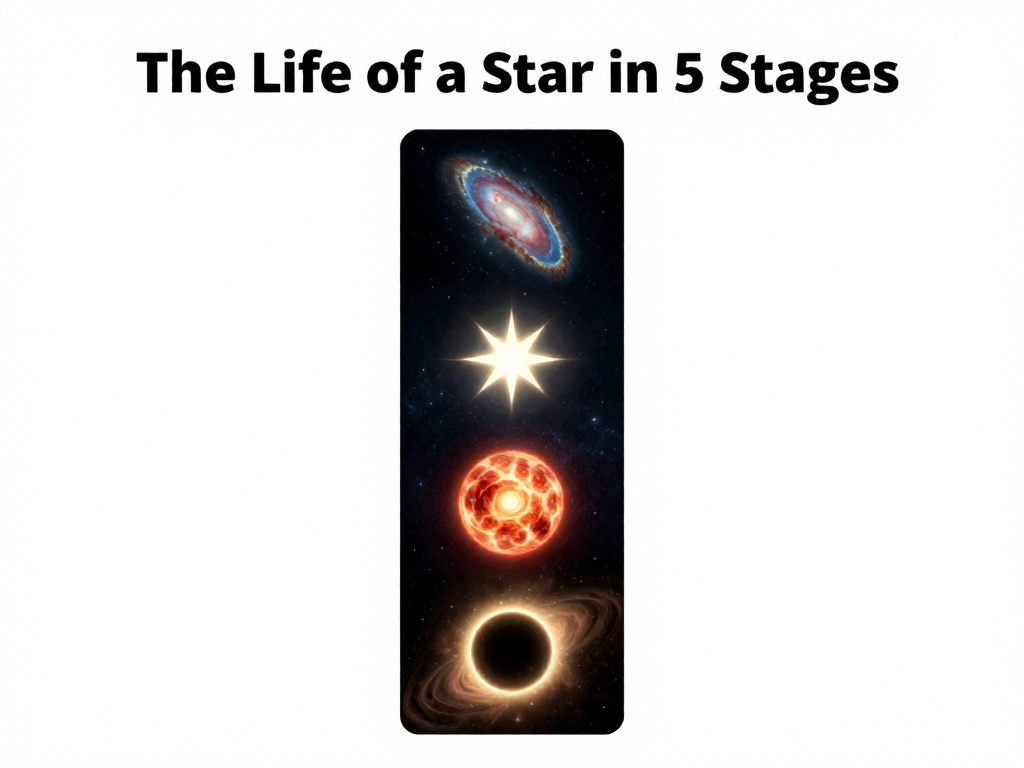
- Nebula — a giant cloud of gas and dust (think of it as cosmic raw material).
- Protostar — gravity pulls that cloud together into a hot, glowing ball-in-progress.
- Main sequence — the star "switches on" and shines steadily for most of its life.
- Giant — fuel runs low, and the star swells up enormously.
- End state — what's left after the star dies.
The fork in the road (it all comes down to mass):
- Small-to-medium stars (like our Sun) gently puff away their outer layers and leave behind a white dwarf — a hot, Earth-sized ember.
- Massive stars explode as a supernova, then collapse into either a neutron star (a city-sized ball so dense a teaspoon weighs billions of tons) or a black hole (gravity so strong not even light escapes).
Timescales at a glance:
- Small stars: tens of billions of years.
- Massive stars: just a few million years — they burn bright and die fast.
Takeaway: A star's mass decides everything—how long it lives and how dramatically it dies. (NASA)
See also
- What Is a Nebula? A Beginner's Guide
- How Big Is Our Sun, Really?
- What Is a Black Hole, Explained Simply
- The Difference Between Stars and Planets
- What Is a Supernova and Why Does It Matter?
Related articles
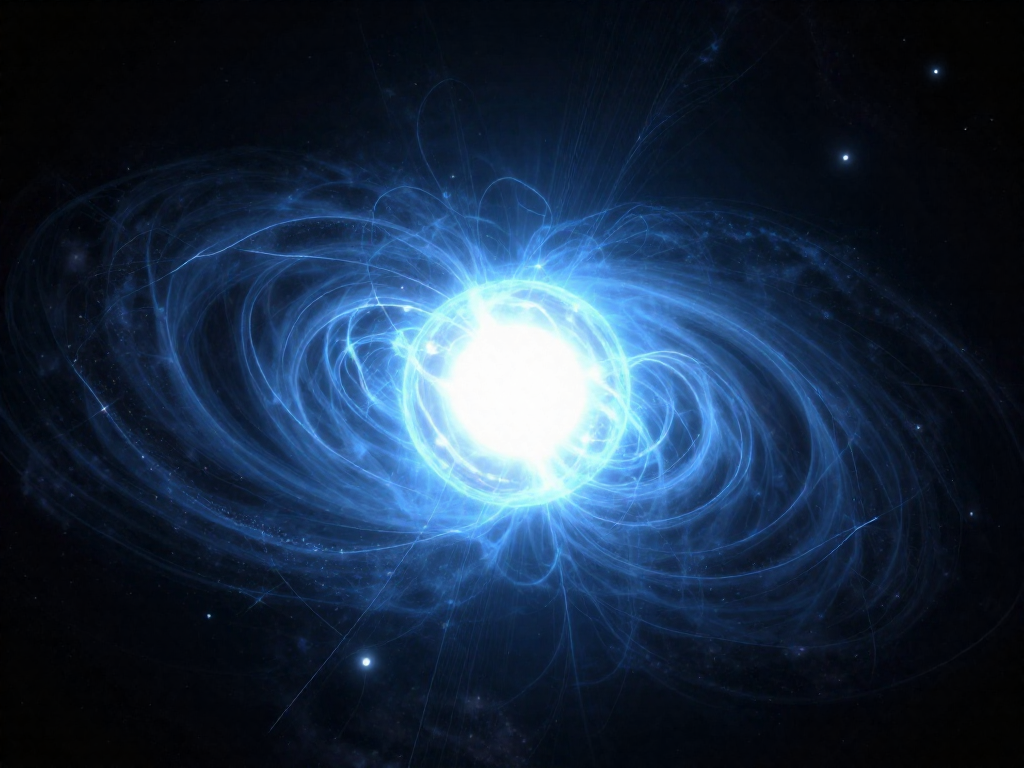
Neutron Stars: The Densest Things in the Universe
What is a neutron star? Discover how a teaspoon can weigh a billion tons, how these cosmic objects form, and why they're the densest things we know of.
Jun 29, 2026 · 8 min read
Will the Universe Ever End? Possible Cosmic Futures
Will the universe ever end? Explore the Big Freeze, Big Rip, Big Crunch, and other possible cosmic fates explained simply for beginners—no equations needed.
Jun 29, 2026 · 9 min read
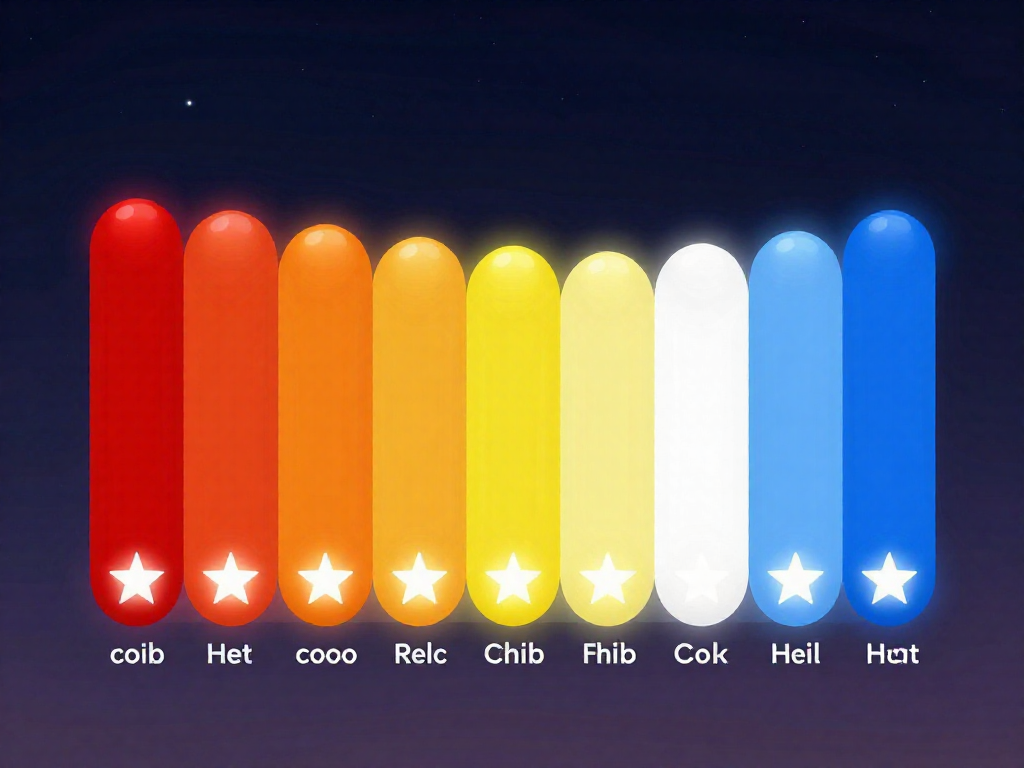
The Colors of Stars: What Red, Blue, and White Tell Us
Why are stars different colors? Discover how red, blue, and white reveal a star's temperature—explained in plain, jargon-free language for beginners.
Jun 29, 2026 · 6 min read