What Is a Supernova? When a Star Explodes
What is a supernova and why does it happen?
On this page
What Is a Supernova, in Plain Words
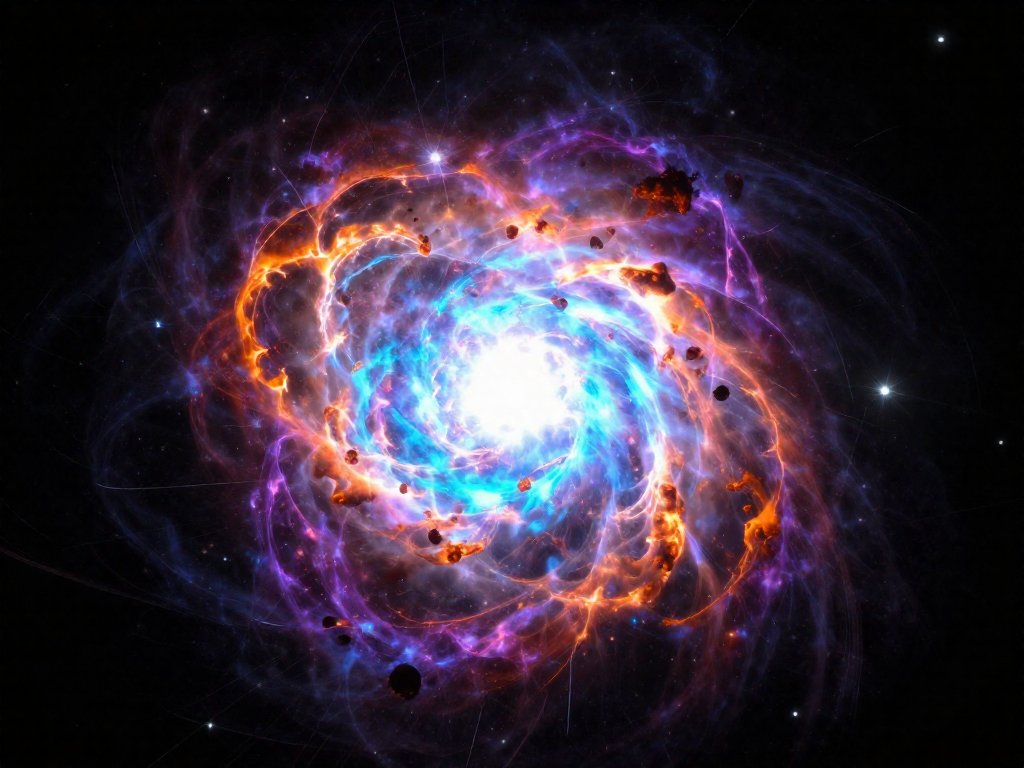
A supernova is the explosive death of a star—a single, colossal blast that can briefly shine brighter than an entire galaxy of billions of stars combined. For a short window, one dying star can outglow everything around it.
Here's the wild part about the energy involved. In a single supernova, a star can release more energy than our Sun will give off across its entire 10-billion-year lifetime. Imagine packing ten billion years of sunshine into one cosmic flash.
The explosion itself is fast. The actual "boom" plays out over seconds to a few days. But because space is so vast and the blast is so bright, we on Earth (or our telescopes) can keep seeing its glow fade for weeks or even months afterward—like watching the afterglow of a firework that's unimaginably far away.
One important thing to set straight: not every star ends this way. Supernovas only happen to specific kinds of stars—either very massive ones that collapse, or certain stars that pull in too much material from a companion. Smaller, average stars like our Sun retire much more gently. We'll unpack exactly which stars explode, and why, in the sections below.
Quick takeaway: A supernova is the brilliant, explosive death of certain stars—momentarily outshining whole galaxies and releasing more energy in moments than the Sun will in its whole life.
(Source: NASA's overview of supernovae.)
Why Do Stars Explode? The Battle Inside a Star
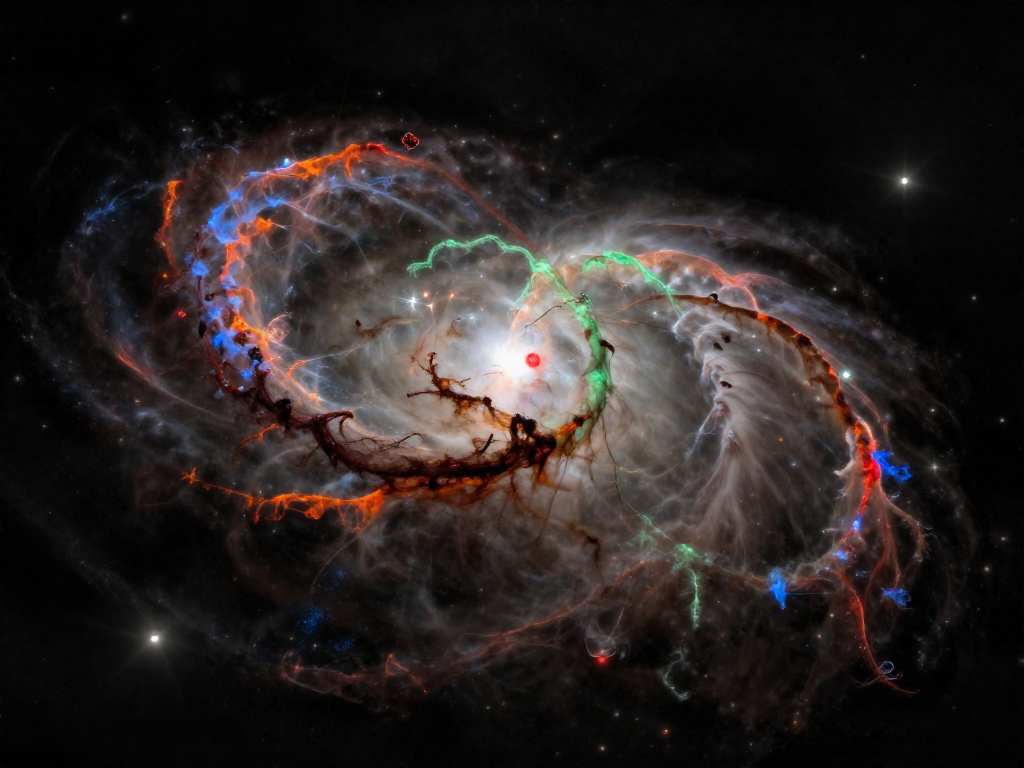
Every star you see is locked in a quiet, lifelong tug-of-war. Understanding that struggle is the key to understanding why some stars end their lives in a spectacular blast.
Two forces, perfectly matched
A star is held together by gravity — the same force that keeps your feet on the ground, just on a colossal scale. Gravity is always pulling the star's material inward, trying to crush it into the center.
Fighting back is nuclear fusion, the process in the star's core that smashes lightweight atoms (mostly hydrogen) together to make heavier ones, releasing enormous amounts of energy. That energy pushes outward as heat and pressure.
For most of a star's life, these two forces are evenly matched:
- Gravity pulls in.
- Fusion pushes out.
- The star stays a stable, glowing ball — for millions or even billions of years.
Think of it like a balloon. The air pressure inside pushes the rubber outward, while the stretched rubber squeezes inward. As long as they balance, the balloon holds its shape.
When the fuel runs out
Fusion needs fuel, and no star has an infinite supply. When a massive star burns through its hydrogen and then its heavier fuels, the outward push suddenly weakens — like letting the air out of that balloon.
With nothing left to resist it, gravity wins. The core collapses inward in a fraction of a second, falling faster than you can blink.
That collapse doesn't just stop quietly. The center becomes so dense that the in-falling material slams into it and violently rebounds, like a ball bouncing off concrete. This rebound sends a shockwave tearing outward through the star, blowing its outer layers into space. That is the supernova — the explosion that ends the battle.
Quick takeaway: A star is a balance between gravity (pulling in) and fusion (pushing out). When the fuel runs out, gravity wins, the core collapses and rebounds, and the star explodes.
Sources: NASA, European Space Agency (ESA).
The Two Main Types of Supernovae
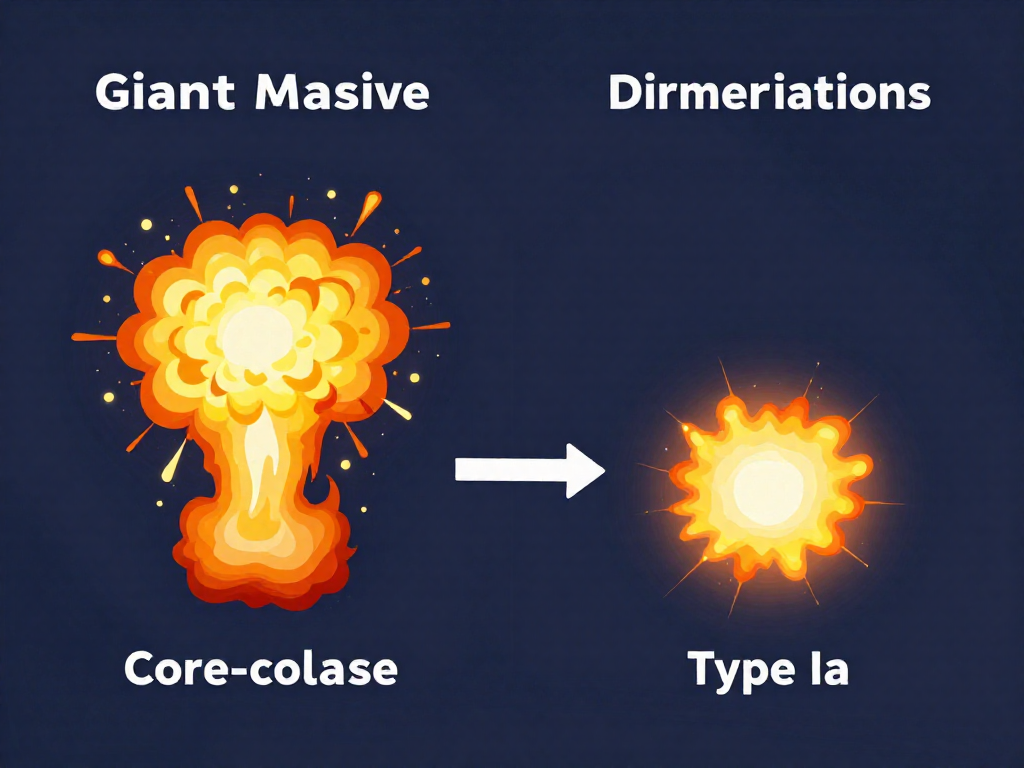
Not all star explosions happen for the same reason. Astronomers sort most supernovae into two big families, and telling them apart is easier than it sounds.
1. Core-collapse supernovae (the giant's last breath)
These come from massive stars — ones far heavier than our Sun, often 8 times its mass or more. For millions of years, a star survives by fusing lighter elements into heavier ones, which releases energy and pushes outward against its own crushing gravity. When the star finally runs out of usable fuel, that outward push vanishes. In less than a second, the core collapses under its own weight and then rebounds in a colossal explosion. What's left behind is usually a neutron star (a city-sized ball of incredibly dense matter) or a black hole.
2. Thermonuclear supernovae (Type Ia)
These start with a white dwarf — the small, dead core left over after a Sun-like star has gently burned out. If that white dwarf is orbiting a companion star, it can siphon off gas like a cosmic thief. Once it gathers enough stolen matter and crosses a critical weight limit, it detonates in a runaway nuclear blast that tears it completely apart.
A simple rule of thumb: a huge living star dying alone gives you a core-collapse supernova; a small dead star feeding off a partner gives you a Type Ia.
One reason Type Ia supernovae matter so much: because they ignite at nearly the same tipping point, they shine with a remarkably consistent brightness. Astronomers call them "standard candles" and use them like distance markers to measure how far away galaxies are across the universe (NASA).
Quick takeaway: Big star collapses inward → core-collapse. Dead star steals fuel and explodes → Type Ia.
What a Supernova Leaves Behind
A supernova is one of the most violent events in the universe, but the explosion isn't the end of the story. The blast leaves behind some of the strangest objects astronomers have ever found.
It all comes down to the star's leftover core—the dense center that survives the explosion. If that core is heavy enough, gravity crushes it into a neutron star: a city-sized ball so tightly packed that a single teaspoon of it would weigh about as much as a mountain (NASA). If the core is even more massive, gravity wins completely and squeezes it into a black hole, a region where the pull is so strong that not even light can escape.
Meanwhile, the outer layers of the star get flung into space at incredible speeds. This expanding cloud of gas and dust forms a nebula—a glowing, colorful shell. The famous Crab Nebula is the wreckage of a star that exploded in the year 1054, an event so bright that Chinese astronomers recorded seeing it during the day (NASA).
These shockwaves do more than destroy. As they ram into nearby gas clouds, they can squeeze that material together and spark the birth of brand-new stars.
And sometimes? A supernova scatters the star so completely that almost nothing recognizable is left behind—just enriched gas seeding the next generation of stars.
Quick takeaway: A supernova can leave a neutron star, a black hole, a glowing nebula—or nothing at all.
Why Supernovae Matter to You
Here's the part that gives most people goosebumps: a supernova isn't just a faraway fireworks show. It helped build you.
When a star explodes, it acts like a cosmic factory and delivery truck rolled into one. The crushing heat and pressure forge heavy elements—the kind ordinary stars can't make on their own—and the blast scatters them across space. We're talking about real, everyday stuff:
- Iron in your blood, carrying oxygen through your body.
- Calcium in your bones and teeth.
- Gold in a ring or necklace you might be wearing right now.
Astronomer Carl Sagan famously said, "We are made of star stuff," and he meant it almost literally. Nearly every atom heavier than hydrogen was cooked inside stars and spread by their explosive deaths (NASA).
It goes further. Those enriched clouds of gas and dust drift through space, slowly collapsing into new stars and planets. Our own Sun, Earth, and oceans formed from such a seeded cloud—meaning a supernova set the stage for life itself.
So the next time you look up, remember: the universe didn't just happen around you. Pieces of it became you.
Quick takeaway: Supernovae forge and spread the heavy elements in your body and our planet—you're made of recycled stardust.
Can We See a Supernova From Earth?
Yes—and people have, with nothing but their eyes. In 1054 AD, Chinese and Arab skywatchers recorded a "guest star" so bright it was visible in daylight for weeks; today we see its leftover cloud as the Crab Nebula. Astronomers Tycho Brahe and Johannes Kepler logged their own dazzling examples in 1572 and 1604.
Naked-eye supernovae are rare, though. Most are now found by telescopes and automated sky surveys—robotic cameras that scan the night sky and flag anything that suddenly brightens, catching hundreds each year in distant galaxies.
The star to watch is Betelgeuse, the reddish shoulder of the constellation Orion. It's a massive, aging star considered "overdue" to explode—but in cosmic terms, that could mean tomorrow or 100,000 years from now (this timing is an estimate, not a prediction). When it goes, it should shine as bright as a half-moon for weeks.
Are we in danger? No. At roughly 640 light-years away, Betelgeuse is far too distant to harm Earth.
Quick takeaway: Supernovae are visible from Earth, occasionally even to the naked eye—and the next great show may come from Betelgeuse, safely far away.
Sources: NASA, ESA.
See also
- What Is a Black Hole? A Beginner's Guide
- The Life Cycle of a Star, Explained Simply
- What Is a Nebula? Cosmic Clouds of Gas and Dust
- What Are Neutron Stars and Pulsars?
- Why Are We Made of Star Stuff?
Related articles
Neutron Stars: The Densest Things in the Universe
What is a neutron star? Discover how a teaspoon can weigh a billion tons, how these cosmic objects form, and why they're the densest things we know of.
Jun 29, 2026 · 8 min read
Will the Universe Ever End? Possible Cosmic Futures
Will the universe ever end? Explore the Big Freeze, Big Rip, Big Crunch, and other possible cosmic fates explained simply for beginners—no equations needed.
Jun 29, 2026 · 9 min read
The Colors of Stars: What Red, Blue, and White Tell Us
Why are stars different colors? Discover how red, blue, and white reveal a star's temperature—explained in plain, jargon-free language for beginners.
Jun 29, 2026 · 6 min read