What Are the Outer Edges of the Solar System Like?
What lies beyond Neptune in the Kuiper Belt and Oort Cloud?
On this page
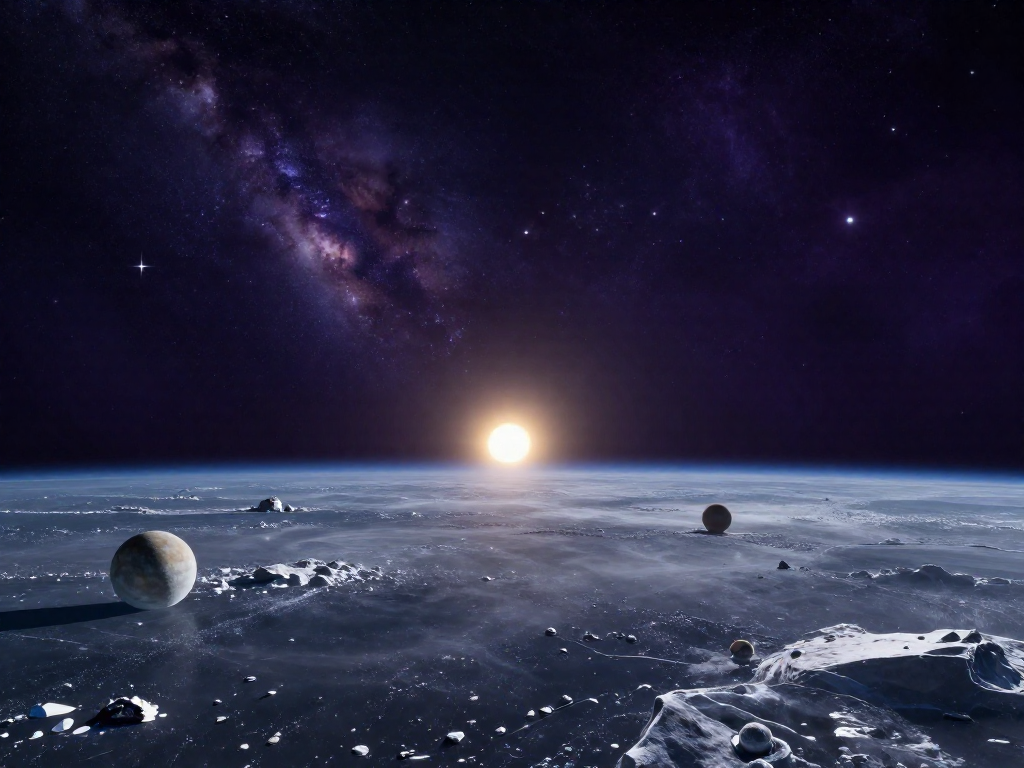
Where Does the Solar System Actually End?
Here's the surprising truth: the solar system doesn't have a tidy edge. There's no signpost, no wall, no line in space that says "you are now leaving." Instead, the boundary is fuzzy, and astronomers use a few different definitions depending on what they're measuring.
Neptune is the last of the major planets, but the Sun's reach stretches far, far beyond it. Sunlight, gravity, and the steady stream of particles the Sun blows outward (called the solar wind) all fade away at different distances — which is exactly why there's more than one answer to "where does it end?"
To make the journey easier, it helps to picture three rough zones beyond Neptune:
- The Kuiper Belt — a wide ring of icy worlds and leftover rubble.
- The scattered disc — a sparser, more chaotic region overlapping and reaching past the belt.
- The Oort Cloud — a vast, shadowy shell thought to wrap around everything, far in the distance.
We'll tour each one in turn.
One quick tool before we go. Space distances are huge, so astronomers use a shortcut called the astronomical unit, or AU. One AU is simply the distance from the Earth to the Sun. So when we say something sits at 30 AU, that means it's 30 times farther out than we are. Keep that ruler handy — out here, the numbers get big fast.
Quick takeaway: The solar system fades out gradually through three zones — the Kuiper Belt, the scattered disc, and the Oort Cloud — and "the edge" depends on whether you mean light, gravity, or solar wind.
Source: NASA Solar System Exploration.
The Kuiper Belt: A Ring of Frozen Worlds
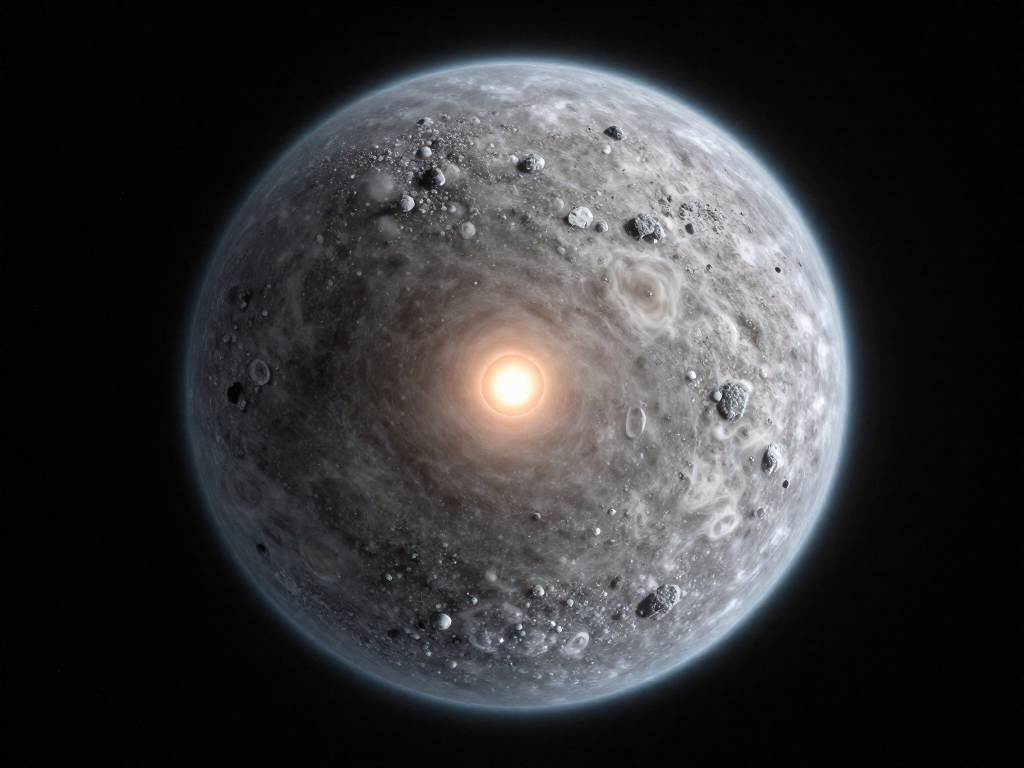
Just past Neptune, the solar system doesn't simply stop — it fades into a vast, frozen ring called the Kuiper Belt (pronounced "KY-per"). Picture a giant cosmic doughnut of icy debris circling the Sun, beginning around 30 AU and stretching out to about 50 AU. (One AU, or astronomical unit, is just the distance from the Earth to the Sun — about 93 million miles — so this region sits 30 to 50 times farther out than we are.)
This belt is home to thousands of small icy worlds, and you already know its most famous resident: Pluto. It shares the neighborhood with other dwarf planets — bodies big enough to be round but too small to clear other debris from their path — including Eris, Haumea, and Makemake. Eris is so similar in size to Pluto that its discovery in 2005 forced astronomers to ask a tricky question: if Pluto is a planet, why isn't Eris?
That question is exactly why Pluto was reclassified as a dwarf planet in 2006. It wasn't a demotion so much as a recognition that Pluto is one of many similar objects out here, not a lone oddball. In other words, the Kuiper Belt is crowded.
What are these worlds made of? Mostly rock mixed with frozen ices — not just frozen water, but also frozen methane and ammonia, gases that on Earth we'd never think of as "ice." Out here, where sunlight is faint and temperatures hover near –230°C, they stay solid as stone.
Perhaps the most wonderful part: these frozen bodies are leftover building blocks from the solar system's birth, roughly 4.6 billion years ago. Studying them is like reading the solar system's oldest, best-preserved scrapbook.
Quick takeaway: The Kuiper Belt is a ring of icy leftovers beyond Neptune, home to Pluto and other dwarf planets — frozen time capsules from our solar system's beginning.
Sources: NASA Solar System Exploration; International Astronomical Union (IAU).
The Scattered Disc and Where Comets Come From
Out past the Kuiper Belt lies a wilder, messier neighborhood called the scattered disc — a region of icy worlds whose orbits look like they've been knocked off course. And they have.
Picture a calm pond where every ripple moves in neat circles. Now imagine someone tossing a heavy stone in: the smooth pattern breaks into stretched, lopsided waves. That "stone" is Neptune, the outermost giant planet. Over billions of years, Neptune's gravity has flung countless icy bodies into long, stretched-out, tilted paths. Instead of circling the Sun in tidy loops, these scattered disc objects swing far out into deep space and then come racing back.
How an icy rock becomes a glowing comet
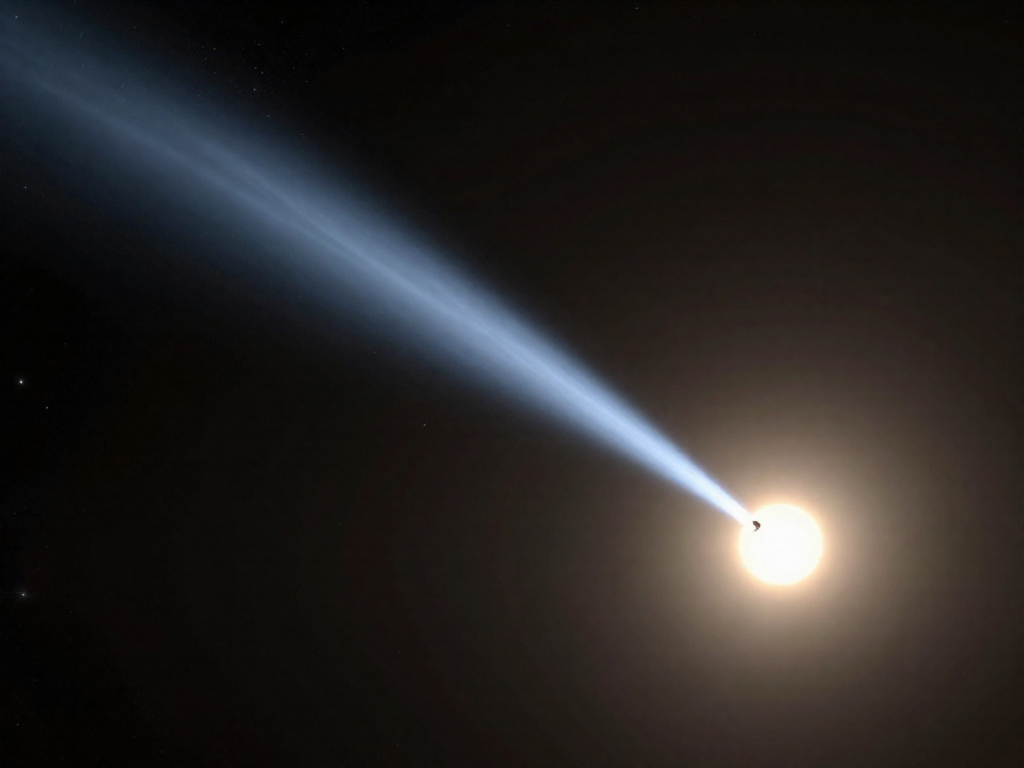
Most of these objects are just dark, frozen chunks of ice and dust — silent and invisible. But every so often, a passing tug of gravity nudges one toward the Sun. As it falls inward and warms up, its surface ice turns straight from solid to gas (a process called sublimation — think of dry ice "smoking" on a stage). That escaping gas and dust forms the glowing head and sweeping tail we recognize as a comet. Many short-period comets — ones that return every couple hundred years, like the famous Halley's Comet — are believed to originate here.
Kuiper Belt vs. scattered disc, in plain terms
- Kuiper Belt objects travel in fairly flat, roughly circular orbits — the calm ripples.
- Scattered disc objects travel in stretched, steeply tilted orbits — the disturbed waves.
Quick takeaway: The scattered disc is Neptune's "splash zone" of icy castaways, and it's a major birthplace of the comets that occasionally light up our skies.
(Sources: NASA Solar System Exploration; ESA.)
The Oort Cloud: The Sun's Distant Shell
Imagine wrapping the entire solar system inside a giant bubble made of icy debris. That's the Oort Cloud — not a flat ring like the Kuiper Belt we just explored, but a vast spherical shell that surrounds the Sun in every direction, above and below and all around. Astronomers picture it as a frozen cocoon holding trillions of icy chunks left over from the birth of the planets.
Just how far away is it?
Far. Astonishingly far. Distances out here are measured in AU (astronomical units), where 1 AU is the distance from the Earth to the Sun — about 93 million miles. The Oort Cloud is thought to begin a couple of thousand AU out and stretch to roughly 100,000 AU from the Sun (NASA).
To put that in relatable terms: if the distance from the Earth to the Sun were the width of a single step, the outer Oort Cloud would be about 100,000 steps away — a journey of more than 50 miles. At that distance, the Sun would look like just another bright star. In fact, the Oort Cloud may reach nearly a quarter of the way to Proxima Centauri, the next nearest star.
The home of long-period comets
The Oort Cloud is believed to be the source of long-period comets — comets on enormous orbits that take thousands, even millions, of years to loop around the Sun once.
Here's the honest part: we have never directly seen the Oort Cloud. It's too faint and too distant for any telescope. Everything we think we know is inferred — pieced together from where these slow comets seem to fall from. So while the science behind it is well-reasoned, the Oort Cloud remains a hypothesis, not a confirmed sight.
Quick takeaway: The Oort Cloud is a giant, unseen spherical shell of icy objects wrapping the whole solar system, possibly stretching a quarter of the way to the next star — and it's where our longest-traveling comets are born.
The Heliosphere: Where the Sun's Wind Stops
The Sun does more than shine. It constantly streams out a flow of charged particles called the solar wind — think of it as a never-ending cosmic breeze blowing in every direction. That breeze inflates a giant protective bubble around the entire solar system, and we call this bubble the heliosphere.
The edge of that bubble has a name too: the heliopause. This is the point where the Sun's outward wind finally runs out of push and meets the thin gas drifting between the stars — what astronomers call interstellar space. Picture the Sun's breath fading until it can no longer hold back the wind from the rest of the galaxy.
Remarkably, we've actually been there. NASA's twin Voyager 1 and Voyager 2 spacecraft, launched in 1977, are the only human-made objects to cross the heliopause — Voyager 1 in 2012 and Voyager 2 in 2018 (NASA).
So why isn't this the edge of the solar system? Because the heliopause marks where the Sun's wind stops, not where its gravity stops. The Oort Cloud lies far beyond it, still held by the Sun's pull. They're simply two different ways of asking, "Where does the Sun's reach end?"
Quick takeaway: The heliosphere is the Sun's wind-blown bubble; its edge, the heliopause, has only been crossed by the two Voyagers.
Why the Frozen Frontier Matters
Out at the cold edge of the Sun's neighborhood, almost nothing has changed in billions of years. Because it's so far from the Sun's warmth, this region acts like a deep-freeze time capsule, preserving the same icy leftovers from when the planets first formed. Studying these objects is a bit like reading the solar system's birth certificate.
There's a more personal connection, too. Many scientists think comets—icy visitors from these distant zones—may have helped deliver water and some of the basic ingredients for life to the early Earth (NASA). In other words, part of you might trace back to the frozen frontier.
What's most humbling is how little we actually know. We've explored only a sliver of it, and much remains educated guesswork rather than settled fact.
Quick takeaway: The outer solar system is ancient, mysterious, and a reminder of just how small and cozy our patch of planets really is.
See also
- Why Is Pluto No Longer a Planet?
- What Is a Comet and How Does It Form a Tail?
- A Beginner's Tour of the Eight Planets
- How Big Is the Solar System, Really?
- What Is the Solar Wind?
Related articles
Why Does Uranus Spin on Its Side?
Uranus is tilted a wild 98 degrees, rolling around the Sun like a ball. Discover the ancient collision that likely knocked it onto its side.
Jun 29, 2026 · 6 min read
Quick Facts About Every Planet, at a Glance
Key stats for all 8 planets in one scannable place: size, distance from the Sun, day length, moons, and what makes each world weird.
Jun 29, 2026 · 6 min read
How Big Is the Solar System Really? A Sense of Scale
The distances between planets are mind-bending. Use simple shrink-it-down analogies to finally grasp how vast our solar system truly is.
Jun 29, 2026 · 7 min read