How Big Is the Solar System Really? A Sense of Scale
How vast are the distances between planets?
On this page
Why Every Solar System Picture You've Seen Is a Lie

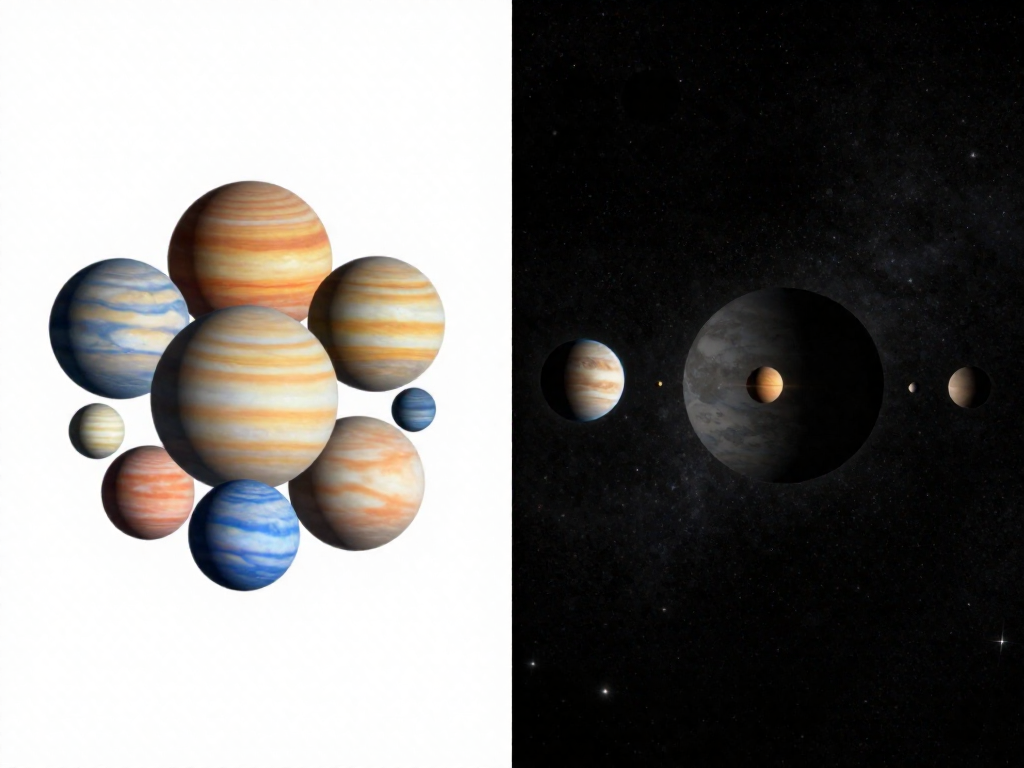
Picture the solar system in your head. Chances are you're seeing the Sun on one side and a tidy row of planets bunched up beside it, each one big, colorful, and close enough to touch its neighbor. That image is wrong—and it's not your fault.
Every textbook diagram cheats. It has to. The real distances are so enormous that an honest drawing simply won't fit on a page or a screen. So artists squish the planets together and blow up their sizes just to make them visible.
How extreme is the cheat? If you shrank the solar system down to fit on a normal sheet of paper at true scale, the planets would become near-invisible specks—and they'd be spread so far apart that some would land in another room, or another building entirely.
So before we build a better picture, do this: erase the one you have. The crowded, cozy lineup isn't real. The truth is far emptier, far stranger, and far more awe-inspiring.
The One Unit That Makes Space Distances Make Sense
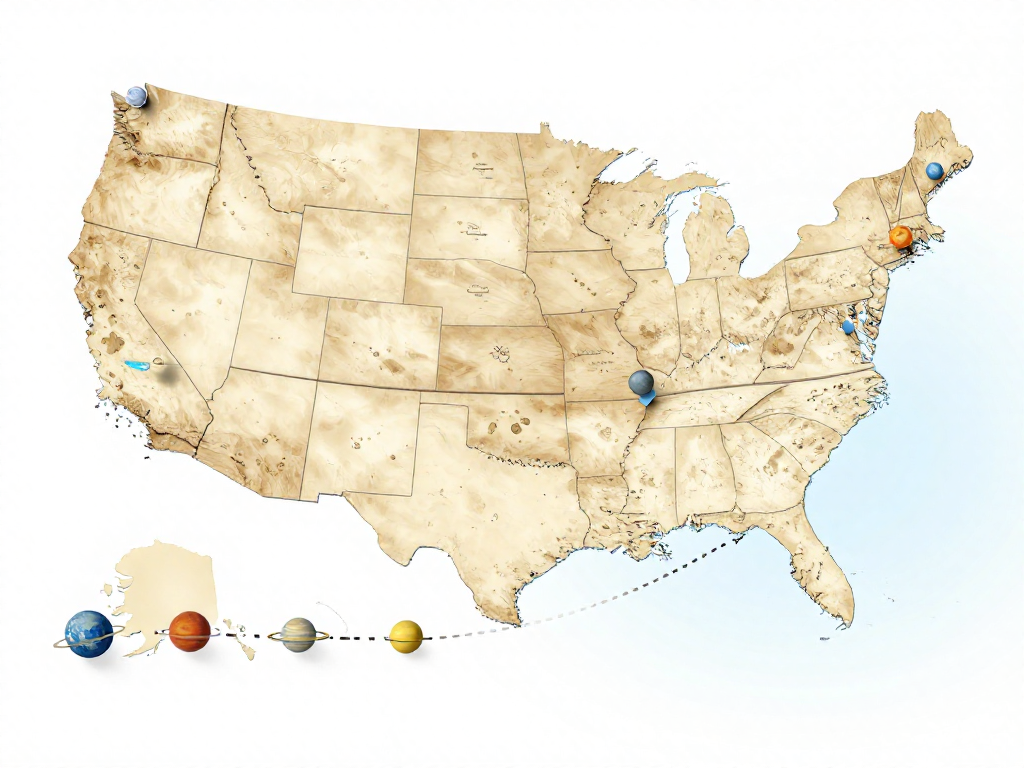
Once you leave Earth behind, miles and kilometers stop being helpful. The numbers get so enormous that your brain just glazes over. So astronomers invented a friendlier measuring stick: the astronomical unit, or AU for short.
One AU is simply the distance from the Earth to the Sun — about 93 million miles (150 million kilometers), according to NASA. That's it. It's the cosmic equivalent of measuring a road trip in "days of driving" instead of counting every inch.
Why bother? Because saying Neptune is "2.8 billion miles away" means almost nothing to most of us. But saying Neptune sits 30 AU from the Sun instantly tells you it's 30 times farther out than we are. Suddenly the scale clicks.
Here's a quick reference for where each planet sits, in AU from the Sun:
- Mercury — 0.4 AU
- Venus — 0.7 AU
- Earth — 1 AU
- Mars — 1.5 AU
- Jupiter — 5.2 AU
- Saturn — 9.5 AU
- Uranus — 19 AU
- Neptune — 30 AU
Quick takeaway: 1 AU = Earth to the Sun. Keep that number in your pocket, and the rest of this article will make a lot more sense.
Shrink the Solar System to a Football Field
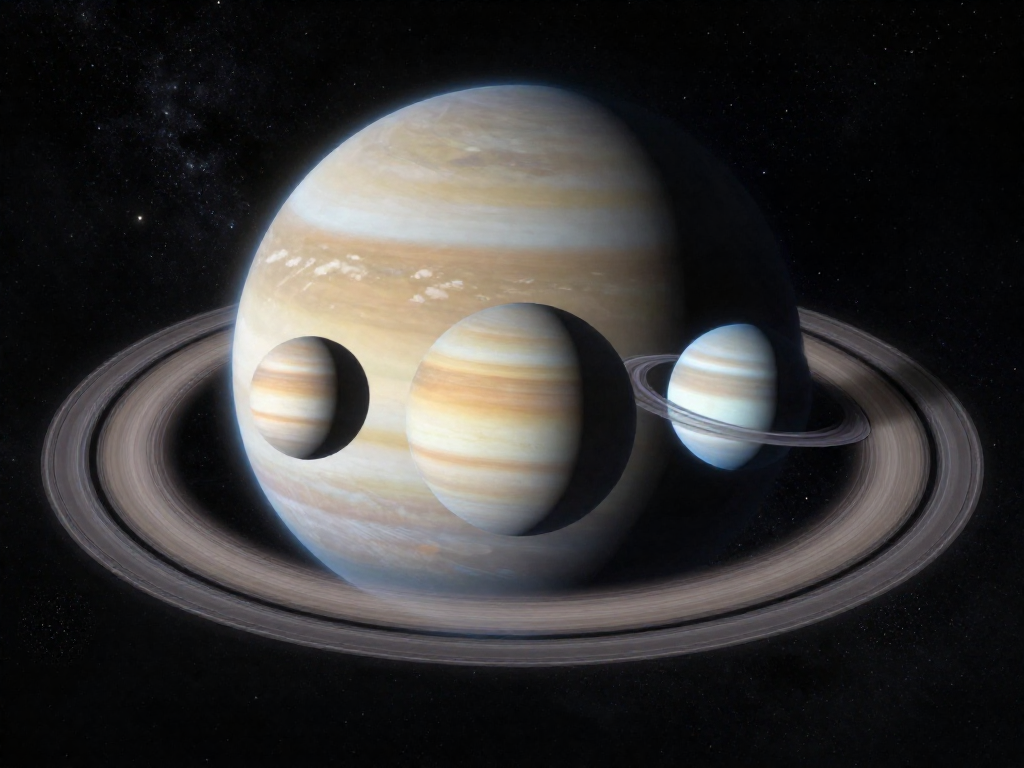
Numbers like "4.5 billion kilometers" are impossible to feel. So let's cheat: shrink the entire Solar System down until it fits on a football field, with the Sun sitting at one end zone. Now we can simply walk the planets out, step by step, and feel the distances instead of just reading them.
Take a few small steps from the Sun and you reach the four rocky inner planets — Mercury, Venus, Earth, and Mars. (Rocky just means they're solid worlds you could, in theory, stand on.) On our field, Earth is barely off the goal line. The whole crowded inner neighborhood is packed into the first chunk of the field.
Then something strange happens: nothing. You walk, and walk, and walk across a vast empty stretch before Jupiter — the largest planet — finally shows up near midfield. That long quiet gap is the real surprise of the Solar System. Most of it is simply space, with planets scattered far apart like a handful of seeds tossed across a parking lot.
Keep going. Saturn, Uranus, and the gas giants (huge planets made mostly of gas, with no solid ground) stretch toward the far end. Neptune, the most distant true planet, waits all the way out at the opposite goal line.
Here's the part that humbles everyone: on this field, every planet is smaller than a grain of sand or a pea. The Solar System isn't a tidy lineup of big colorful balls — it's mostly emptiness, with tiny specks drifting through it.
Quick takeaway: Inner planets cluster near the Sun; a huge empty gap separates them from the gas giants, and every planet is minuscule compared to the space around it.
Scale based on NASA planetary distance data.
Now Picture It as a Cross-Country Road Trip
Football fields are great, but some of us think in drive time. So let's hit the road. Imagine you're cruising from New York to Los Angeles at a steady highway speed of 60 mph, and the whole trip stands in for a journey from the Sun out to Neptune.
Here's the thing that surprises almost everyone: the four inner planets—Mercury, Venus, Earth, and Mars—are all crammed into the first few minutes of the drive. You'd pass them before you finished your coffee, still rolling through the suburbs. They're neighbors, practically sharing a driveway.
Then comes the long, quiet stretch. After Mars, you'd drive for hours across empty interstate before reaching Jupiter, then more hours to Saturn. By the time you reached Uranus and Neptune, your road trip companions would be asleep and the gas tank would need refilling several times over. The outer planets aren't just far from the Sun—they're staggeringly far from each other.
That gap between "crowded inner cluster" and "lonely outer reaches" is the real lesson. Most of the solar system is empty road.
Quick takeaway: The inner planets huddle together near the Sun, while the outer planets are separated by vast, mostly empty distances—like a few houses on one block, then hundreds of miles of open highway.
How Long Light and Spacecraft Actually Take to Cross It
Light is the fastest thing in the universe—it zips along at about 186,000 miles per second. Nothing we know of moves quicker. So if even light takes a long time to cross the solar system, you know the distances are staggering.
Here's how light's journey from the Sun stacks up:
- To Earth: about 8 minutes. The sunlight warming your face left the Sun before you sat down to read this.
- To Neptune: more than 4 hours. By the time that same light reaches the outer planets, your whole afternoon could be gone.
Now swap light for an actual machine. NASA's two Voyager spacecraft—robotic probes launched in 1977—are among the fastest objects humans have ever built. Yet it took them decades to reach the edge of our cosmic neighborhood, where the Sun's influence fades into deep space. They're still traveling today, and they didn't cross into interstellar space until 2012 and 2018.
Quick takeaway: Light crosses the solar system in hours; our fastest spacecraft need decades. When even the universe's speed limit feels slow, you're getting a true sense of just how vast this place really is.
Source: NASA, Voyager mission and planetary fact sheets.
Wait — The Solar System Doesn't End at Neptune
Here's the twist most maps never show you: Neptune isn't the finish line. It's barely the suburbs.
Just past Neptune sits the Kuiper Belt — a vast ring of icy worlds and frozen leftovers from the Solar System's birth. Pluto lives here, which is part of why it got reclassified: it's one of many icy bodies in this zone, not a lonely outlier. Think of it as a frozen junkyard of building blocks that never quite became planets.
But even the Kuiper Belt is just the porch light. Surrounding everything, astronomers believe, is the Oort Cloud — a giant spherical shell of icy chunks thought to be the source of long-period comets. It may stretch out nearly a light-year, the distance light travels in a year (about 5.9 trillion miles). To be clear, the Kuiper Belt has been directly observed, while the Oort Cloud is still a well-supported hypothesis — we infer it from the comets that fall inward from it.
Remember our football-field model? Neptune sits near the far end zone. The true edge of the Solar System would be miles past the stadium.
Quick takeaway: The Solar System is far bigger than the planets suggest — most of it is empty, icy space we rarely picture.
Sources: NASA Solar System Exploration; ESA.
The Takeaway: Mostly Empty, Almost Unimaginably Big
Here's the thing to hold onto: the solar system is overwhelmingly empty space. The planets, moons, and everything we've ever explored are just tiny specks scattered across an enormous, mostly vacant stage.
Quick takeaway: Remember the football field. If the Sun sits on one goal line as a marble, Earth is a grain of sand a few yards away, and Neptune is a smaller speck near the far end zone — with nothing but emptiness in between. That single picture captures the truth better than any number could.
And yet, this is only the beginning. As vast as our solar system feels, the gaps between stars dwarf it completely. The next planet you can imagine reaching is nothing compared to the next star.
So keep that curiosity burning — we're about to take an even bigger leap outward.
See also
- The Order of the Planets Explained Simply
- What Is the Kuiper Belt? Pluto's Neighborhood
- How Far Away Are the Stars? The Next Leap in Scale
- What Is a Light-Year (and Why It Measures Distance, Not Time)
- Why Pluto Isn't a Planet Anymore
Related articles
Why Does Uranus Spin on Its Side?
Uranus is tilted a wild 98 degrees, rolling around the Sun like a ball. Discover the ancient collision that likely knocked it onto its side.
Jun 29, 2026 · 6 min read
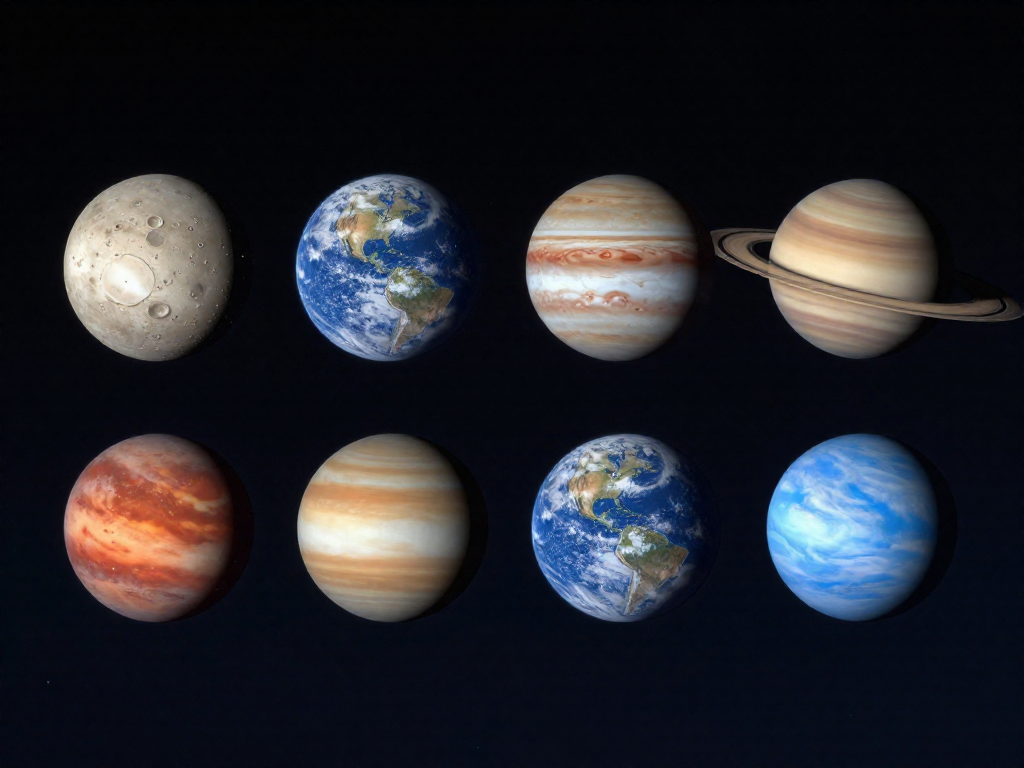
Quick Facts About Every Planet, at a Glance
Key stats for all 8 planets in one scannable place: size, distance from the Sun, day length, moons, and what makes each world weird.
Jun 29, 2026 · 6 min read
What Are the Outer Edges of the Solar System Like?
Journey beyond Neptune into the Kuiper Belt and Oort Cloud, the frozen frontier where comets are born and the Sun's reach finally fades.
Jun 29, 2026 · 7 min read