Quick Facts About Every Planet, at a Glance
What are the key stats for each planet in one place?
On this page
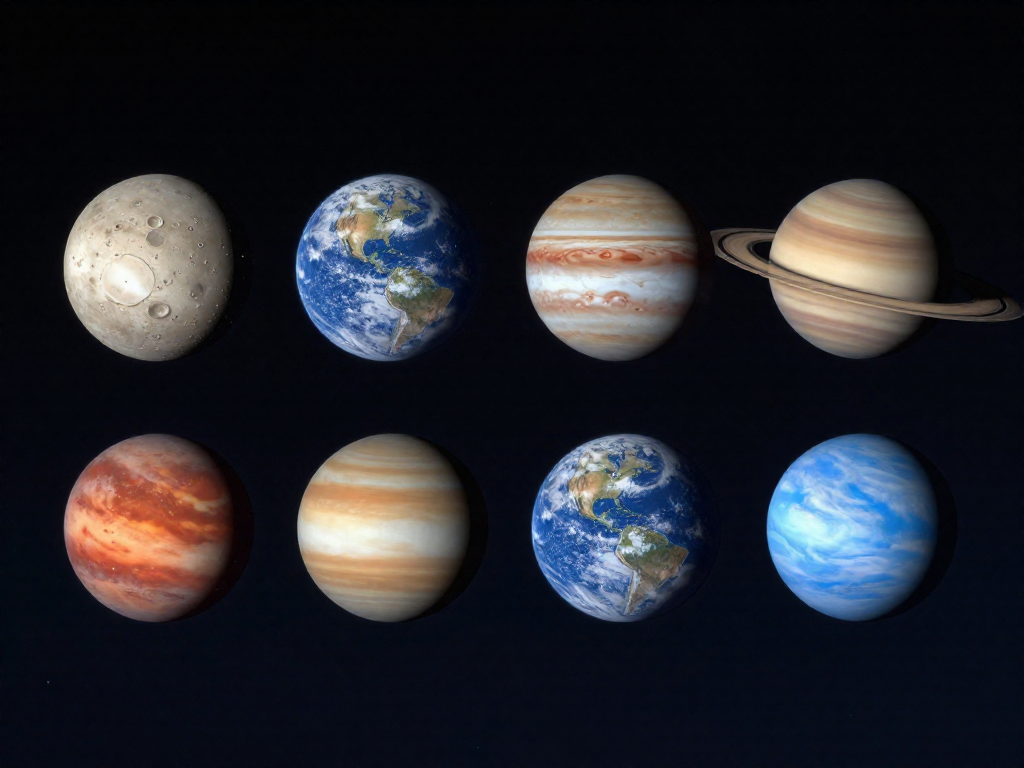
How to Read This Planet Cheat Sheet
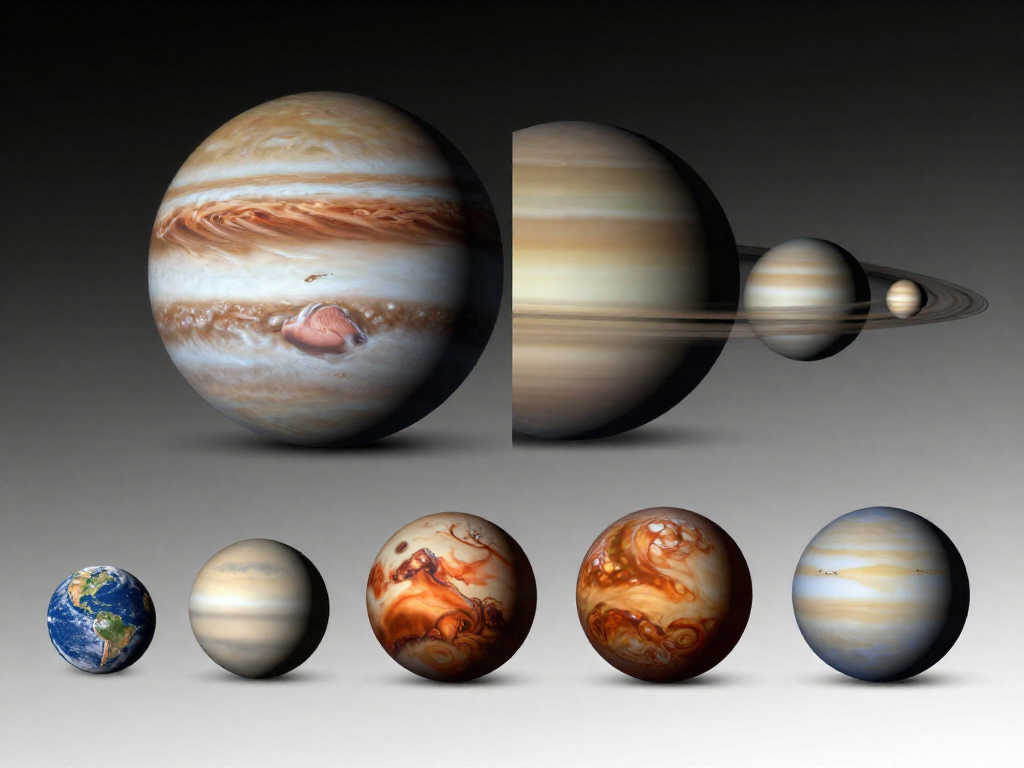
Before you dive in, here's how everything below is organized so you can find what you need at a glance.
- The order: Planets run from the Sun outward, Mercury first and Neptune last—the same path you'd take on a road trip leaving home.
- What each stat means, in plain words:
- Distance — how far the planet sits from the Sun.
- Day — how long one full spin takes (sunrise to sunrise).
- Year — how long one trip around the Sun takes.
- Moons — how many natural satellites circle it.
- Earth as a yardstick: Days and years are compared to Earth's, so "2 Earth years" just means twice as long as ours—no math required.
- Two families: The first four are small, solid rocky planets you could stand on; the outer four are huge gas giants with no real surface.
Quick takeaway: Read top to bottom, lean on Earth for comparison, and remember the rocky-versus-gas split.
Mercury: The Speedy Little Furnace
Mercury is the smallest planet and the Sun's closest neighbor, racing around our star faster than any other world. Here's the snapshot:
- Size & spot: The tiniest planet, hugging the Sun on the inside lane.
- Weird time quirk: A single year on Mercury (one trip around the Sun) is actually shorter than two of its own days. It zips around the Sun quickly but spins on its axis very slowly.
- Wild temperatures: With almost no atmosphere (the thin blanket of gas that traps heat), days scorch and nights freeze.
- Moons: Zero.
Quick takeaway: Small, fast, and a place of brutal extremes. (Source: NASA)
Venus: Earth's Toxic, Backwards Twin
Venus is almost Earth's size, which is why it's often called our twin—but it's a twin you'd never want to visit. It's the hottest planet in the solar system, baking at around 465°C (about 870°F), hot enough to melt lead. The culprit is a thick, toxic atmosphere that traps heat like a sealed greenhouse, so even Mercury, which sits closer to the Sun, stays cooler.
Venus is also the oddball of the planets: it spins backwards and so slowly that a single day there lasts longer than its entire year. And moons? It has zero.
Quick takeaway: Earth-sized, hellishly hot, spins the wrong way, and has no moons.
Source: NASA Solar System Exploration.
Earth: The Only Known Living World
Earth is our home base—and the ruler we measure every other planet against. When we say a day or a year, we mean Earth's: 1 day (one spin) and 1 year (one trip around the Sun). It also has 1 moon.
What makes Earth special? It sits in the "just-right" zone—not too hot, not too cold—so water stays liquid on the surface. So far, it's the only planet we know of with surface oceans and life (NASA).
Quick takeaway: Earth is the yardstick. Every other planet's days, years, and temperatures are easiest to grasp by comparing them back to ours.
Mars: The Cold, Rusty Red Planet
Mars glows a warm orange-red for a surprisingly down-to-earth reason: its soil is full of iron that has literally rusted, the same chemistry that reddens an old nail left out in the rain. Despite that rusty face, it's a frigid world, with average temperatures far below freezing.
It's also the planet that feels weirdly familiar. A Martian day lasts about 24 hours and 39 minutes, just a touch longer than ours (NASA).
But Mars goes big. It hosts Olympus Mons, the tallest volcano in the solar system, and Valles Marineris, a canyon so vast it would stretch across the entire United States. Two tiny moons, Phobos and Deimos, orbit alongside it.
Quick takeaway: Earth-like days plus record-breaking landscapes make Mars our favorite exploration target.
Jupiter: The Giant That Rules Them All
Jupiter is the heavyweight champion of our solar system. It's a gas giant (a planet made mostly of gas, with no solid surface to stand on) so massive that all the other planets could fit inside it with room to spare.
Despite its size, Jupiter spins faster than any other planet, whirling around once in about 10 hours. That's the shortest "day" in the solar system.
Its most famous feature is the Great Red Spot, a swirling storm wider than the entire Earth that has raged for centuries.
Jupiter also hosts dozens of moons, including the four large "Galilean" moons first spotted by Galileo in 1610.
Quick takeaway: Biggest planet, fastest spin, Earth-sized storm, and a crowd of moons.
Source: NASA.
Saturn: The Ringed Showstopper
Saturn is the solar system's poster child, wrapped in a dazzling set of rings made mostly of countless ice and rock chunks, ranging from grains to house-sized boulders (NASA). It's the second-largest planet and, like Jupiter, a gas giant—a world with no solid surface to stand on, just deepening layers of gas. Here's the fun part: Saturn is so lightweight for its size that it would float if you could find a bathtub big enough. It also hosts dozens of moons, including Titan, a giant moon bigger than the planet Mercury.
Quick takeaway: Saturn = the ringed, float-in-water gas giant with a planet-sized moon, Titan.
Uranus: The Sideways Ice Giant
Uranus is an ice giant—a planet built mostly from slushy materials like water, ammonia, and methane rather than rock. That methane gives it a soft, pale blue-green glow.
Its strangest trick? Uranus is tipped almost completely on its side, so it doesn't spin upright like a top—it rolls around the Sun like a ball. This extreme tilt creates wild seasons, where one pole can bask in sunlight for about 21 Earth-years while the other sits in darkness (NASA).
It also sports faint, dark rings and at least 27 known moons.
Quick takeaway: A chilly blue-green world that orbits lying down.
Neptune: The Windy Blue Frontier
Neptune is the farthest planet from the Sun—so distant that sunlight there is over 900 times dimmer than on Earth. It's an "ice giant," meaning it's a huge ball of slushy water, ammonia, and methane gas rather than solid rock. That methane gives it a deep blue color, and its atmosphere whips up the fastest winds of any planet, racing faster than a jet plane. Being so far out, it takes about 165 Earth years to circle the Sun once. Neptune also has faint rings and 14 known moons, including icy Triton.
Quick takeaway: The cold, blue, wind-blasted edge of our planetary neighborhood. (Source: NASA)
All Planets Side by Side
Here's the whole solar system on one screen. The planets are listed in order from the Sun outward.
| # | Planet | Type | Day (one spin) | Year (one orbit) | Moons |
|---|---|---|---|---|---|
| 1 | Mercury | Rocky | 59 Earth days | 88 Earth days | 0 |
| 2 | Venus | Rocky | 243 Earth days | 225 Earth days | 0 |
| 3 | Earth | Rocky | 24 hours | 365 days | 1 |
| 4 | Mars | Rocky | 25 hours | 687 Earth days | 2 |
| 5 | Jupiter | Gas giant | 10 hours | 12 Earth years | 95 |
| 6 | Saturn | Gas giant | 11 hours | 29 Earth years | 146 |
| 7 | Uranus | Ice giant | 17 hours | 84 Earth years | 28 |
| 8 | Neptune | Ice giant | 16 hours | 165 Earth years | 16 |
Smallest to largest: Mercury, Mars, Venus, Earth, Neptune, Uranus, Saturn, Jupiter. Jupiter is so big that all the others could fit inside it with room to spare.
Rocky vs. giant: The first four are small, solid worlds you could (in theory) stand on. The outer four are huge balls of gas and ice with no real surface.
What about Pluto? In 2006 astronomers reclassified it as a dwarf planet—a round world too small to clear other objects from its orbit. It's still out there, just in a different club.
Quick takeaway: Four small rocky planets sit close to the Sun; four giants circle far out. Moon counts grow with size.
Figures: NASA Solar System Exploration.
See also
- The Order of the Planets, Explained Simply
- Why Pluto Is No Longer a Planet
- Gas Giants vs. Rocky Planets: What's the Difference?
- How Long Is a Day on Each Planet?
- What Are Moons and How Many Does Each Planet Have?
Related articles
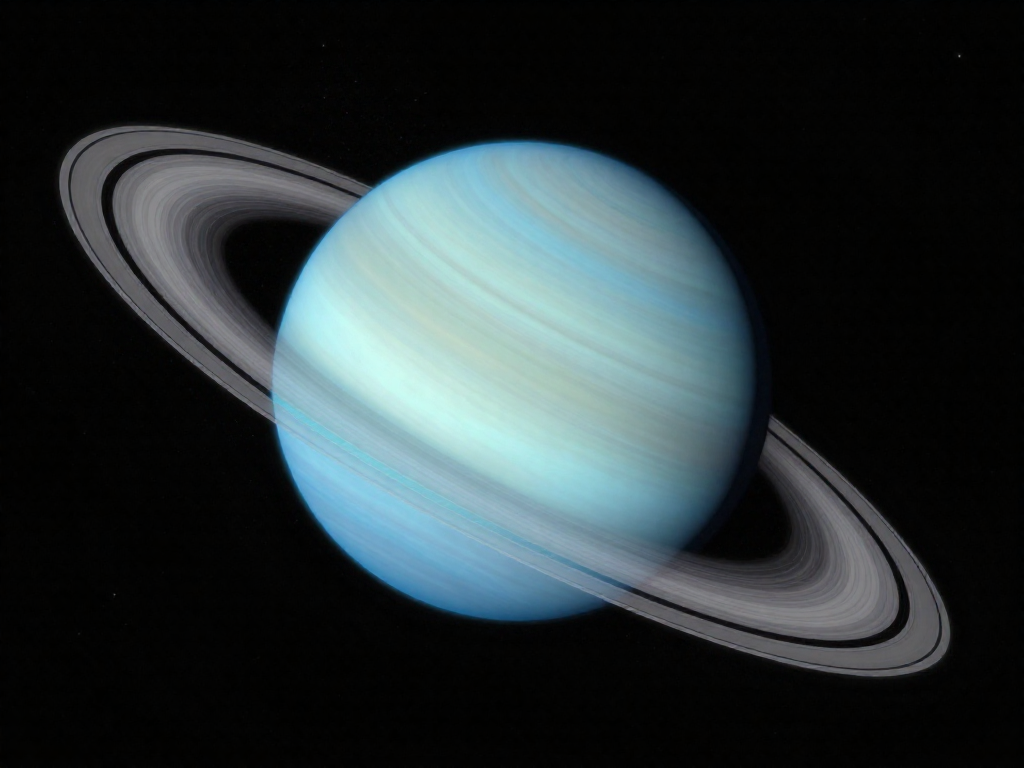
Why Does Uranus Spin on Its Side?
Uranus is tilted a wild 98 degrees, rolling around the Sun like a ball. Discover the ancient collision that likely knocked it onto its side.
Jun 29, 2026 · 6 min read
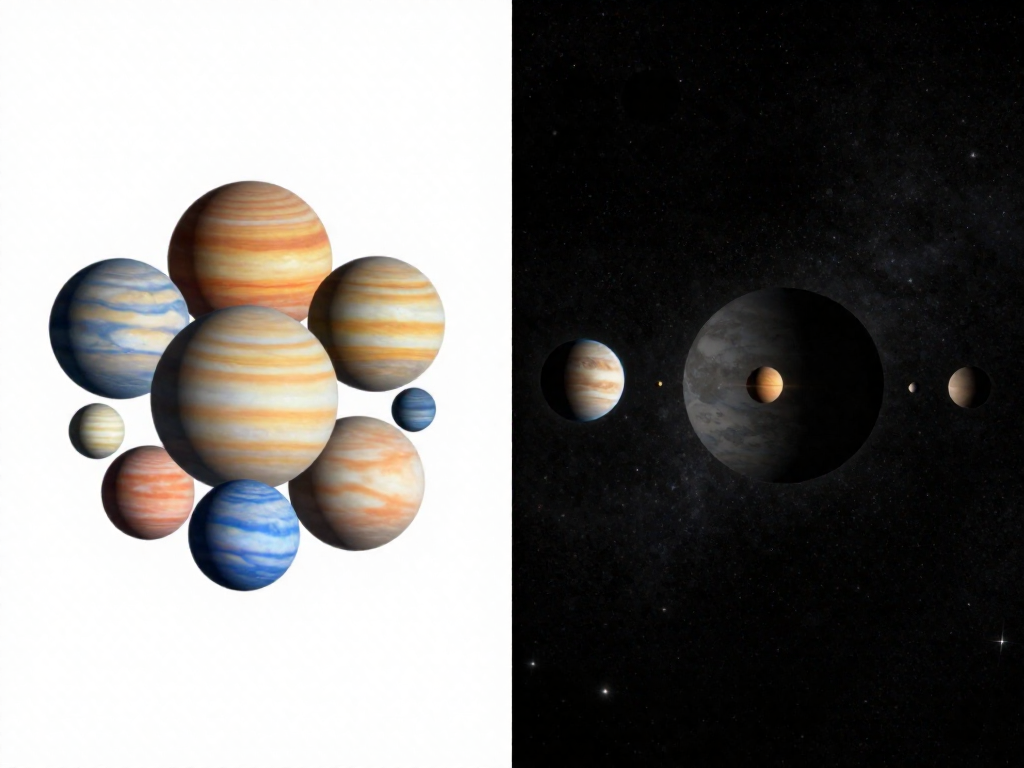
How Big Is the Solar System Really? A Sense of Scale
The distances between planets are mind-bending. Use simple shrink-it-down analogies to finally grasp how vast our solar system truly is.
Jun 29, 2026 · 7 min read
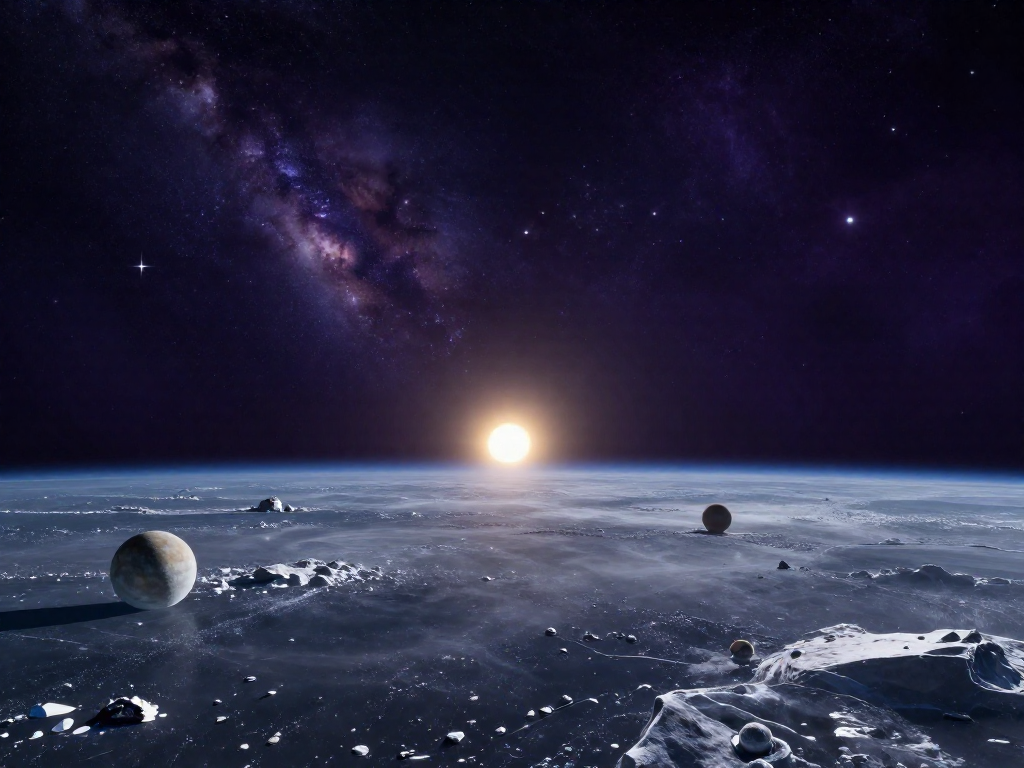
What Are the Outer Edges of the Solar System Like?
Journey beyond Neptune into the Kuiper Belt and Oort Cloud, the frozen frontier where comets are born and the Sun's reach finally fades.
Jun 29, 2026 · 7 min read