Moons of the Solar System: 7 That Are Stranger Than Planets
Which moons are the most fascinating and why?
On this page
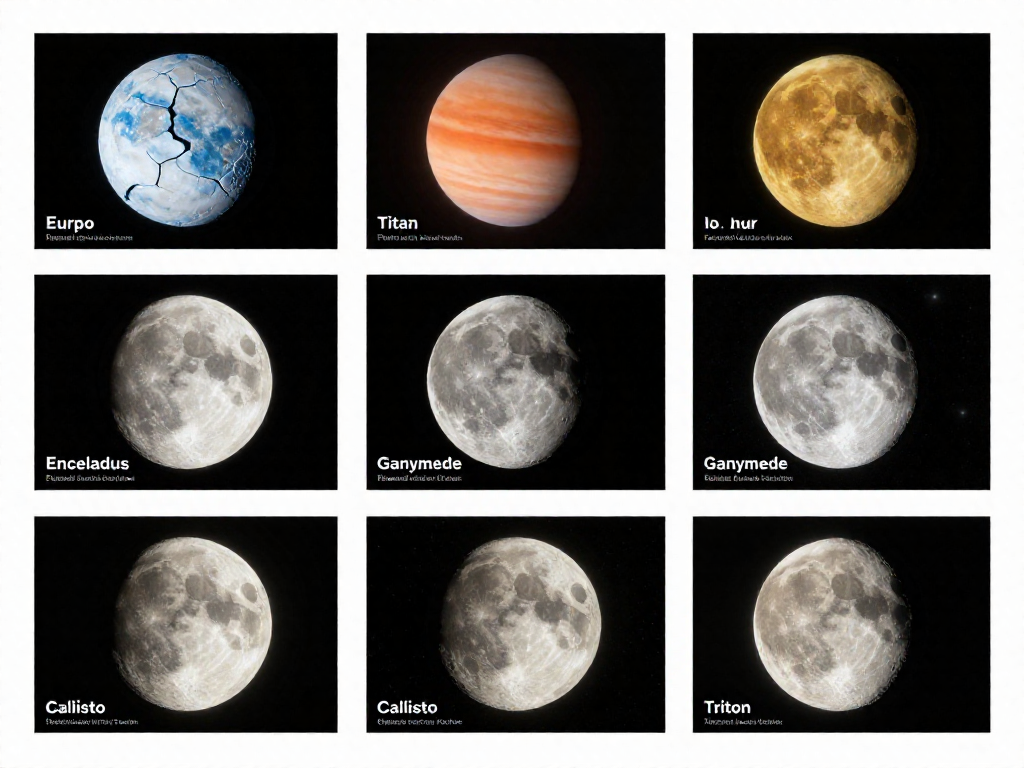
Why Moons Can Be Stranger Than Planets
When we picture the solar system, the planets usually steal the spotlight. But circling those planets are more than 290 known moons (NASA's current count), and many of them are far more than dull gray rocks. Some are full-fledged worlds in their own right.
Take Ganymede, a moon of Jupiter that is actually bigger than the planet Mercury. Or consider the handful of moons that scientists believe hide vast oceans of liquid water beneath their icy shells—oceans that, in a few cases, could potentially host life (this remains a hypothesis, not a confirmed fact).
That's the surprise: the planets get the fame, but the moons hold some of the strangest secrets in the neighborhood.
So here's the promise. Below are 7 moons, each with one jaw-dropping fact to make you see them in a whole new light.
Quick takeaway: Moons aren't sidekicks—they're some of the most fascinating places in the solar system.
Europa: The Moon With a Hidden Ocean
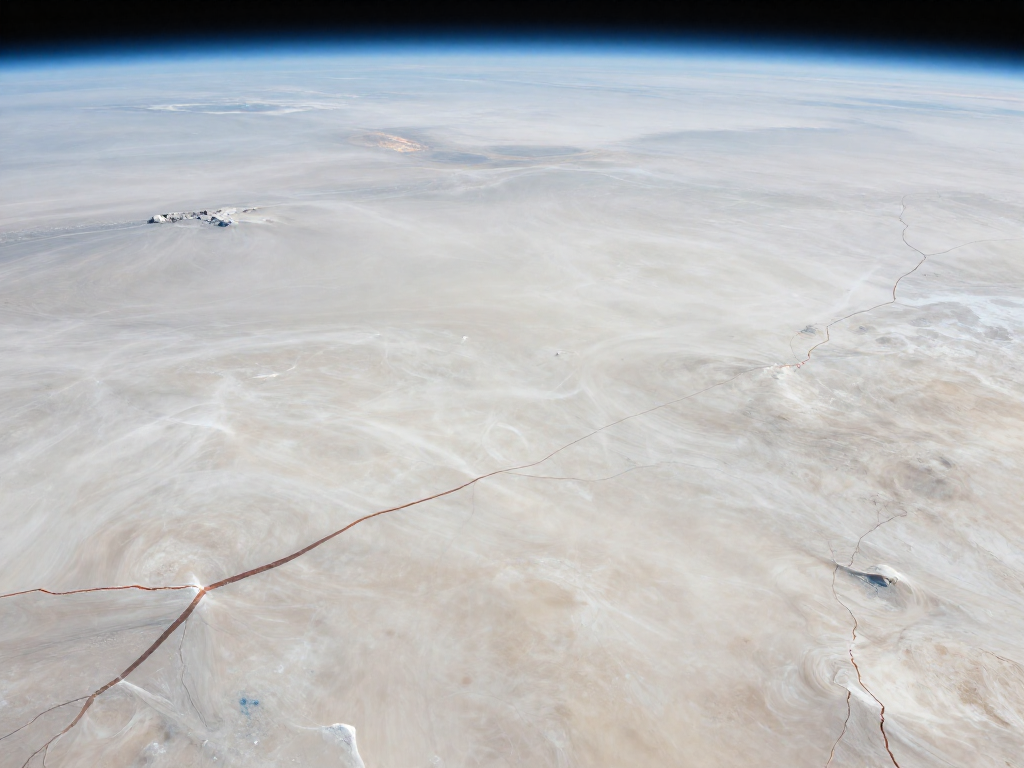
Picture a frozen pond on a winter morning—smooth, pale, and laced with cracks. Now blow that pond up to the size of a small planet and hang it in orbit around Jupiter. That's Europa, one of Jupiter's largest moons and easily one of the strangest worlds we know.
Europa's surface is a shell of ice, scarred by long reddish cracks where the crust has shifted and split. But the real wonder is what's underneath.
Wow-fact: Beneath that icy crust, scientists believe there's a vast saltwater ocean—and it may hold more than twice as much water as all of Earth's oceans combined (NASA). The ice keeps it hidden, but tugs from Jupiter's gravity flex and warm Europa's interior, likely keeping the water liquid.
Why does that matter? On Earth, wherever we find liquid water, we tend to find life. Europa offers three of life's key ingredients: water, energy (from that gravitational flexing), and the right chemical building blocks. To be clear, no life has been found—this is a hypothesis, not a discovery.
To investigate, NASA launched the Europa Clipper mission in 2024, which will make repeated flybys to study the ice and the ocean below (NASA).
Quick takeaway: Europa hides a giant saltwater ocean under its icy shell, making it one of the best places to search for life beyond Earth.
Titan: A Moon With Rivers, Rain, and Lakes
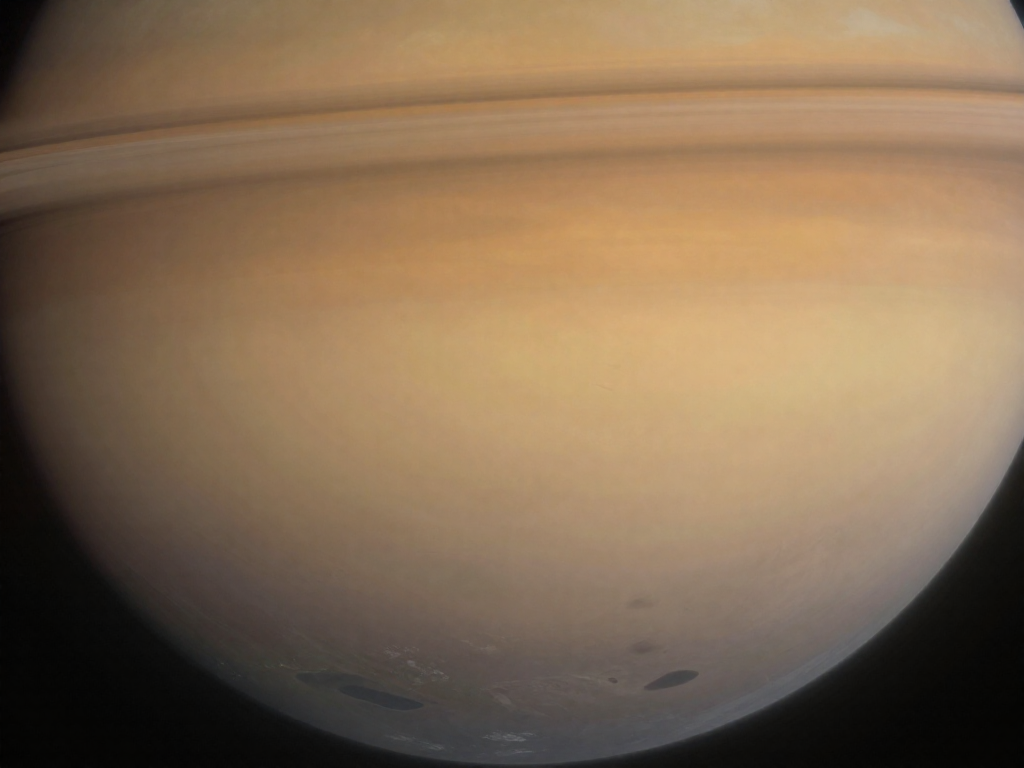
Imagine standing on a world where the rain isn't water but gasoline-like fuel, and the rivers carve through dunes under a hazy orange sky. That's Titan, Saturn's largest moon—and the only place in the solar system besides Earth known to have stable liquid pooling on its surface (NASA).
Titan is wrapped in a thick atmosphere (the blanket of gases around a world), even denser than Earth's. It's so hazy and orange that for decades we couldn't see the ground at all, until NASA's Cassini mission and its Huygens probe peered through in the 2000s.
Here's the wow-fact: instead of a water cycle, Titan has a methane cycle. Methane—the same gas we burn for heat on Earth—gets so cold there (around −290°F) that it turns liquid. So it rains liquid methane, which fills genuine lakes and feeds flowing rivers (ESA/NASA Cassini-Huygens).
Titan is also huge. It's actually bigger than the planet Mercury, making it more like a small world than a typical moon.
Quick takeaway: Titan is an eerie Earth-twin where the weather runs on liquid methane instead of water—and it's the only other place with stable surface liquid.
Io: The Most Volcanic World in the Solar System
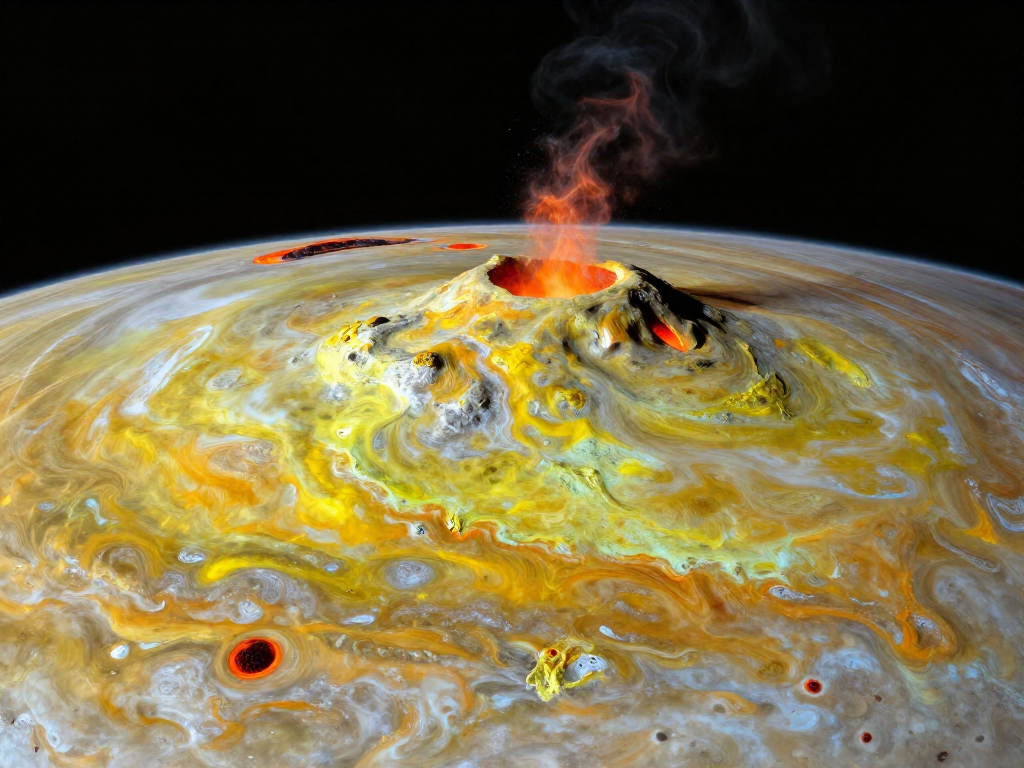
If Europa is a frozen ocean world, Jupiter's moon Io is the exact opposite: a sizzling, sulfur-stained ball covered in hundreds of active volcanoes. At any given moment, dozens of them are erupting. Nowhere else in the solar system is so violently, constantly alive.
How violent? Some of Io's volcanic plumes blast material as high as 250 miles (400 km) into space — tall enough to reach the edge of where Earth's atmosphere fades out. NASA's spacecraft have watched these fountains erupt in real time.
So what powers all this fury? It comes down to tidal heating. Jupiter is enormous, and its gravity constantly tugs on Io. As Io orbits, it gets squeezed and stretched like a stress ball flexed over and over in your hand. All that flexing creates friction deep inside, and friction makes heat — enough to melt rock.
The result is a surface that never stays still. Fresh lava keeps repaving Io, erasing craters and giving it a smooth, ever-changing face.
Quick takeaway: Io is the solar system's volcanic furnace, kept molten by Jupiter's relentless gravitational squeeze.
Enceladus: The Moon That Sprays Ice Into Space
If Saturn's moon Enceladus showed up in a science fiction movie, you might call it unrealistic. This tiny world—only about 310 miles (500 km) across, small enough to fit inside a single country—is one of the brightest objects in the solar system. Its surface is fresh, snow-white ice that reflects almost all the sunlight hitting it, like a freshly cleaned mirror.
But the real showstopper is at its south pole. Through long cracks nicknamed "tiger stripes," Enceladus blasts towering geysers of water vapor and ice grains straight out into space. NASA's Cassini spacecraft actually flew through these plumes and tasted them directly.
Those eruptions are so powerful that they don't all fall back down. The escaping ice feeds Saturn's faint outer "E ring"—meaning this little moon is constantly resupplying one of the planet's rings.
Here's why scientists are excited: the geysers come from a global ocean of liquid water hidden beneath the ice, and Cassini detected organic (carbon-based) molecules in the spray—the chemical building blocks life uses. That doesn't mean life exists there, but Enceladus has several key ingredients worth investigating.
Quick takeaway: A tiny ice moon shooting its hidden ocean into space, complete with life-friendly chemistry.
Triton: The Moon That Orbits Backwards
Most moons travel around their planet in the same direction the planet spins, like runners circling a track the "normal" way. Triton, Neptune's largest moon, does the opposite — it orbits backwards. Scientists call this retrograde motion (simply: going against the grain). This single fact is a giant clue, suggesting Triton didn't form alongside Neptune but was a wanderer the planet's gravity grabbed and pulled into orbit (NASA).
So where did this drifter come from? Astronomers think Triton was once a resident of the Kuiper Belt — a vast ring of icy worlds beyond Neptune, the same neighborhood Pluto calls home. In a sense, Triton may be a captured cousin of Pluto.
Even stranger, despite surface temperatures near –235°C (one of the coldest places we've measured), Triton isn't dead. Voyager 2 spotted geysers blasting cold nitrogen gas miles into space, like icy fountains erupting from a frozen world.
Quick takeaway: Triton orbits the wrong way because it's likely a captured Kuiper Belt object, and it's slowly spiraling toward Neptune over the distant future.
Ganymede: The Largest Moon (Bigger Than a Planet)
Picture a moon so big it outsizes an entire planet. That's Ganymede, the giant moon circling Jupiter. It's the largest moon in the solar system—wider than Mercury, the smallest planet. If Ganymede orbited the Sun on its own, we might happily call it a planet.
But size isn't even its strangest feature. Ganymede is the only moon known to generate its own magnetic field—an invisible force field, like the one that makes a compass needle point north on Earth. No other moon does this.
That magnetic field gives Ganymede its own auroras: glowing ribbons of light near its poles, the same kind of natural light show we call the Northern Lights here on Earth.
There's more hiding below the surface. Scientists strongly suspect Ganymede holds a buried saltwater ocean beneath its icy crust—possibly more water than all of Earth's oceans combined. This is a well-supported hypothesis, not yet confirmed by direct measurement.
Quick takeaway: Ganymede is bigger than a planet, makes its own magnetism and auroras, and likely hides a hidden ocean. (Sources: NASA, ESA)
Our Moon: Familiar but Full of Surprises
We've traveled to oceans under ice and moons that orbit backwards—but the strangest moon might be the one you see from your backyard.
Take this: our Moon is slowly drifting away from us, by about 1.5 inches (4 cm) every year, roughly the speed your fingernails grow. NASA's laser-ranging experiments, which bounce light off mirrors left by Apollo astronauts, confirm it inch by inch.
It also has a violent origin story. The leading idea—still a hypothesis, though a strongly supported one—is that a Mars-sized object slammed into the young Earth, and the debris clumped together to form the Moon.
Today it quietly works in our favor. The Moon's gravity acts like a steadying hand, keeping Earth's tilt stable so our seasons stay predictable.
And here's the cozy part: we only ever see one side. The Moon spins exactly once per orbit—a balance called tidal locking—so the same face always greets us, like a dance partner who never turns away.
Quick takeaway: Even our familiar Moon is drifting, mysterious in origin, and quietly keeping Earth livable.
Which Moon Is the Strangest of All?
So which moon wins the weirdness crown? It's a tough call. Europa hides a salty ocean under its ice, Titan has rivers and lakes (just made of liquid methane, not water), Io erupts with hundreds of volcanoes, and Enceladus literally sprays ice geysers into space. Triton orbits backwards, and Ganymede is so big it outsizes the planet Mercury. Even our own familiar Moon keeps surprising us.
Here's the exciting part: several of these worlds have the key ingredients for life—liquid water, warmth, and the right chemistry. That's why NASA missions like Europa Clipper are heading out to take a closer look.
Quick takeaway: The strangest moon is whichever one sparks your curiosity most.
Next time you spot the Moon, remember it has cousins far weirder than any planet. Keep looking up—and check out our reads on the planets and dazzling cosmic events next.
See also
- The Planets of the Solar System Explained Simply
- What Is Tidal Heating? A Beginner's Guide
- Could There Be Life Beyond Earth? Where Scientists Are Looking
- Saturn's Rings: What They Are and How They Formed
- Why Pluto Isn't a Planet Anymore
Related articles
Why Does Uranus Spin on Its Side?
Uranus is tilted a wild 98 degrees, rolling around the Sun like a ball. Discover the ancient collision that likely knocked it onto its side.
Jun 29, 2026 · 6 min read
Quick Facts About Every Planet, at a Glance
Key stats for all 8 planets in one scannable place: size, distance from the Sun, day length, moons, and what makes each world weird.
Jun 29, 2026 · 6 min read
How Big Is the Solar System Really? A Sense of Scale
The distances between planets are mind-bending. Use simple shrink-it-down analogies to finally grasp how vast our solar system truly is.
Jun 29, 2026 · 7 min read