Jupiter's Great Red Spot: A Storm Bigger Than Earth
What is Jupiter's Great Red Spot?
On this page
What Exactly Is the Great Red Spot?
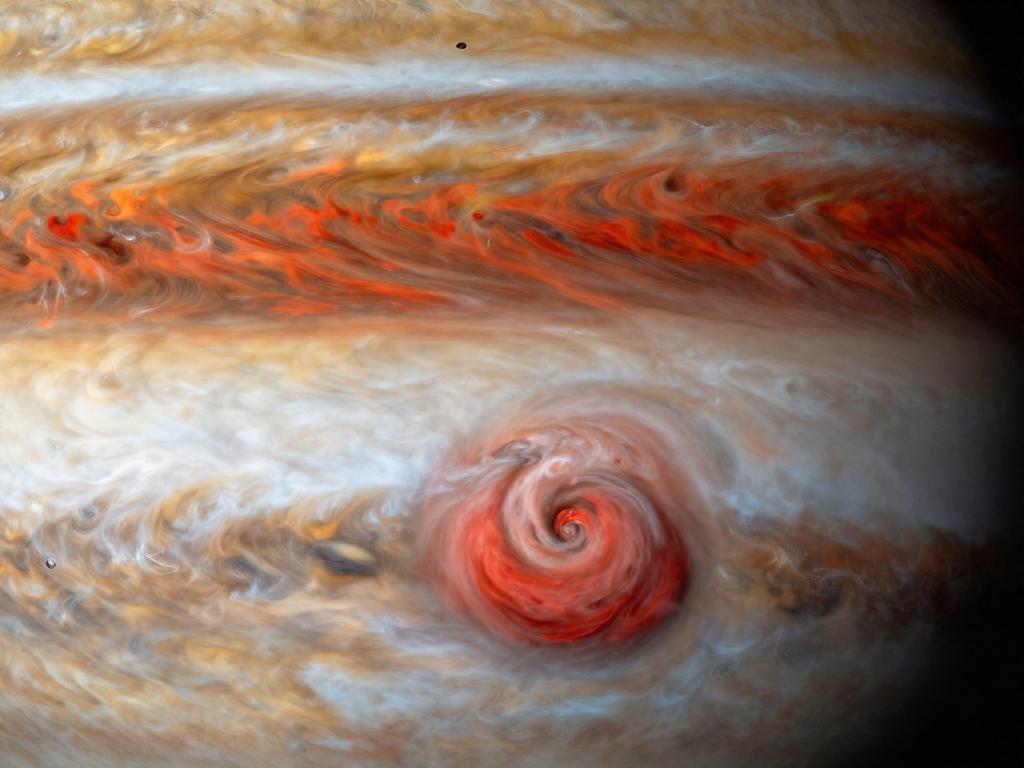
Picture a hurricane so enormous it could swallow our entire planet—and one that has been raging for centuries without ever blowing itself out. That, in a nutshell, is Jupiter's Great Red Spot: a colossal, never-ending storm swirling through the clouds of the largest planet in our solar system.
You'll find it churning away in Jupiter's southern hemisphere, a deep reddish oval that stands out against the planet's pale, striped bands of clouds. It's so big that telescopes here on Earth have been able to spot it for hundreds of years.
Here's a detail that surprises a lot of people: the Great Red Spot isn't sitting on anything. Jupiter has no solid ground to stand on—it's a giant ball of gas, mostly hydrogen and helium, with no surface like Earth's. So the storm is a feature of the atmosphere itself, floating in the clouds rather than scarring any land.
In weather terms, the Spot is an anticyclone. That word simply means a storm that spins around a center of high pressure (a region where the air is pressing down more strongly than its surroundings). On Earth, our most destructive storms—hurricanes—are the opposite: low-pressure systems. So while it looks hurricane-like in scale and fury, it's technically built a little differently.
The simplest way to frame it: the Great Red Spot is the biggest and oldest storm we know of anywhere in the solar system. Nothing else we've found comes close to its combination of size and longevity.
Quick takeaway: The Great Red Spot is a planet-sized, high-pressure storm spinning in Jupiter's southern atmosphere—the largest, longest-lasting storm known in our solar system. (Source: NASA)
Bigger Than Earth: Putting the Size in Perspective
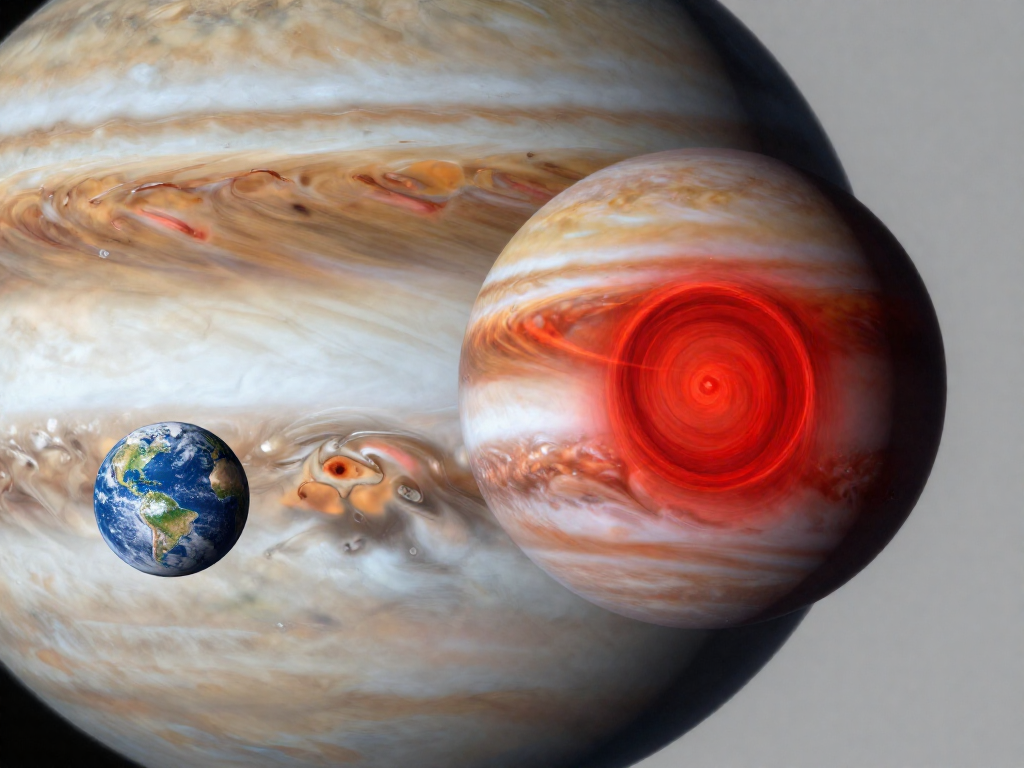
Here's the fact that stops people in their tracks: the Great Red Spot is so enormous that you could drop our entire planet inside it and still have room to spare. At its current size, roughly one Earth fits within the storm—and not too long ago, when the spot was wider, two Earths could have nestled side by side inside it.
How wide is that, exactly? Today the storm stretches about 10,000 miles (16,000 kilometers) across, according to NASA. If you could somehow drive a car around its edge at highway speed without stopping, the trip would take you weeks. It's a single weather system the width of a planet.
To make that scale feel real, try a few everyday comparisons:
- Coast to coast, twice. The continental United States is roughly 2,800 miles wide. The Great Red Spot is wide enough to lay that journey end to end more than three times over.
- A planet-sized eye. Think of a hurricane photo from space, then imagine one big enough that Earth itself would look like a small marble resting on top of it.
And here's the kicker for anyone who's ever weathered a big storm: the largest hurricanes on Earth span maybe 1,000 miles at their widest. The Great Red Spot is around ten times that—a storm so vast that every cyclone in our planet's history could line up inside it with space left over.
Quick takeaway: The Great Red Spot is about 10,000 miles wide—big enough to swallow Earth whole and large enough to dwarf any storm our planet has ever produced.
Why Has It Lasted for Centuries?
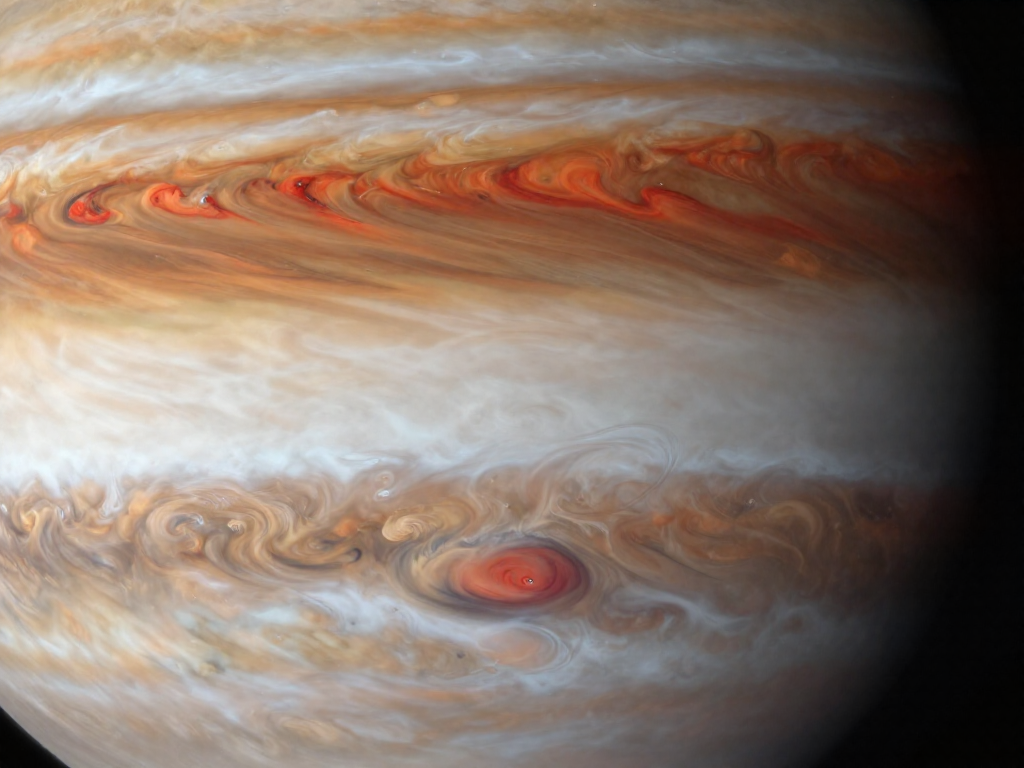
Here on Earth, even the most powerful hurricane fizzles out within a week or two. So how has the Great Red Spot kept spinning for what may be hundreds of years? Astronomers have spotted this storm in their telescopes since at least the 1800s, and some observations from the 1600s may show it too. That means the Great Red Spot is somewhere between 150 and 350 years old (NASA). Imagine a single storm that has been raging since before your great-great-grandparents were born.
A few things keep this giant alive:
-
There's no land to slow it down. On Earth, hurricanes weaken and break apart when they move over land, because the rough ground drags on the swirling winds. Jupiter has no solid surface at all — it's a giant ball of gas — so the storm can spin freely with nothing to stop it.
-
It eats smaller storms. The Great Red Spot is surrounded by smaller storms and fast-moving rivers of air called jet streams (think of them as powerful winds blowing in steady lanes). When smaller storms drift too close, the Red Spot absorbs them, soaking up their energy like a snowball rolling downhill and growing bigger.
-
Jupiter's deep atmosphere feeds it. The planet's thick, energy-rich atmosphere stretches far below the clouds, providing a constant supply of heat and movement that keeps the storm churning.
Scientists are still studying exactly how all these forces work together, so the full picture is an active area of research rather than a settled answer.
Quick takeaway: With no land to break it up, plenty of smaller storms to feed on, and a deep, energetic atmosphere beneath it, the Great Red Spot has been able to last for centuries.
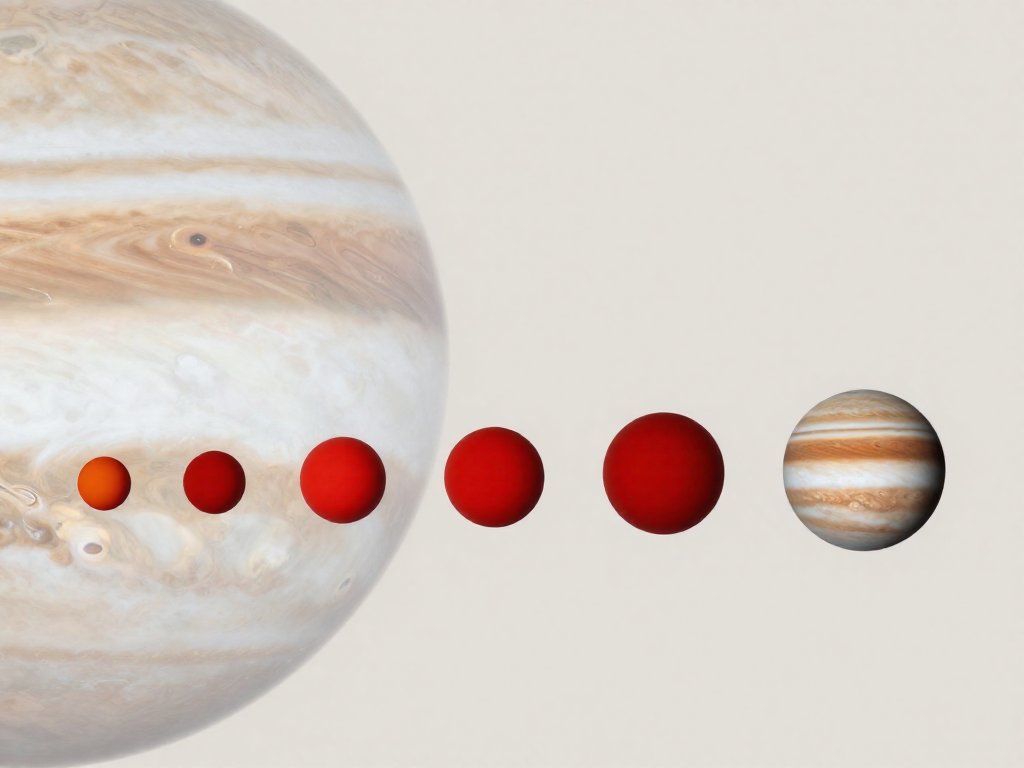
Why Is It Red?
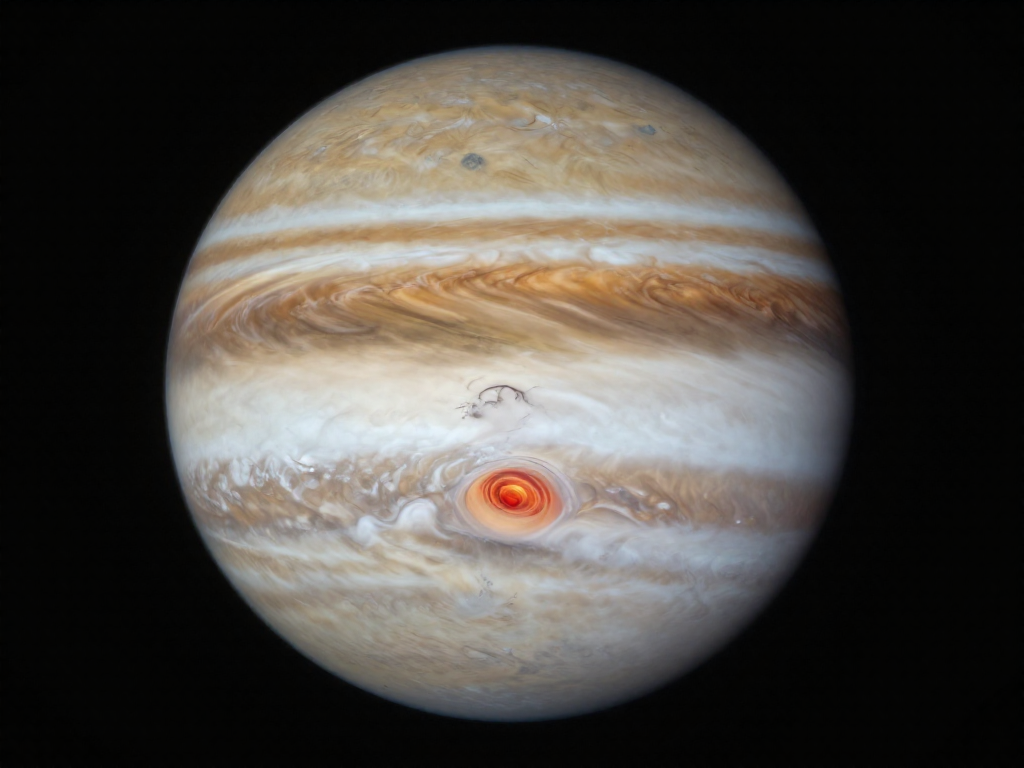
Here's the honest truth: scientists still aren't completely sure. The Great Red Spot has been studied for centuries, yet its exact color recipe remains one of Jupiter's open mysteries.
The leading idea points to chemistry happening high in the storm's clouds. Jupiter's atmosphere is rich in gases like ammonia and simpler compounds, and when sunlight—especially ultraviolet (UV) light, the same invisible rays that give you a sunburn here on Earth—strikes the cloud tops, it can trigger reactions that produce reddish and brownish substances. Think of it a little like how a sliced apple turns brown when left out: exposure to the air and light changes its color. NASA scientists describe these sun-altered chemicals as the most likely source of the famous red hue.
What makes this especially interesting is that the color isn't fixed. Over the years, observers have watched the spot shift from a deep, brick red to a much paler, almost salmon shade—and sometimes back again.
Those color changes aren't just for show. Astronomers treat them as clues. A darker, redder spot may hint that storm material is rising higher, getting more sun exposure, while a paler tone can suggest changes in the storm's strength or structure. In other words, the color is a window into what's churning inside.
Quick takeaway: The red likely comes from sunlight reacting with cloud chemicals—but the shifting shades remind us this storm is still keeping secrets.
Is the Great Red Spot Shrinking?
Here's a surprising twist: the most famous storm in the solar system is shrinking before our eyes.
A century ago, the Great Red Spot was a sprawling giant—wide enough to swallow three or more Earths side by side. Today, it can hold only about one. Astronomers tracking it over the decades have watched it steadily narrow, and as it shrinks it's also changing shape, morphing from a stretched-out oval into something rounder and more compact. NASA's Hubble Space Telescope has documented this slimming trend in detail since the 1990s.
So what happens next? This is where established science gives way to open questions. Some scientists wonder whether the storm could keep dwindling until it fades away entirely; others suspect it may stabilize at a smaller size, or even that what we're seeing is part of a natural cycle of growing and shrinking. The honest answer is that nobody knows for sure.
Why can't we simply predict its future? Because a planet-sized storm is fantastically complex. Jupiter has no solid surface to slow the swirling gases, and countless factors—winds, smaller storms feeding or draining it, and forces deep in the atmosphere we still can't fully measure—all interact in ways too tangled to forecast.
Quick takeaway: The Great Red Spot is genuinely shrinking, but whether it disappears, stabilizes, or rebounds remains an unsolved mystery.
How We Know All This: Spacecraft and Telescopes
So how do we know so much about a storm sitting over 365 million miles away? It comes down to centuries of patient watching, paired with some remarkable robotic explorers.
It started small. As far back as the 1600s, astronomers spotted the Great Red Spot using simple telescopes—not so different from a good backyard telescope you might own today. They couldn't see much detail, but they knew something big and red was there.
The real close-ups came in 1979, when NASA's twin Voyager spacecraft flew past Jupiter. A flyby is exactly what it sounds like: a probe zooming by without stopping, snapping photos as it goes. For the first time, we saw the storm's swirling clouds in stunning detail.
Then came Juno, a NASA spacecraft orbiting Jupiter since 2016. Its instruments peered beneath the cloud tops and revealed the storm reaches hundreds of miles deep—far more than anyone expected.
Meanwhile, the Hubble Space Telescope checks in year after year, tracking how the spot's color and size slowly change over time.
Quick takeaway: Backyard-style telescopes, Voyager's flybys, Juno's deep dives, and Hubble's yearly check-ups together built everything we know about this giant storm.
What the Great Red Spot Tells Us About Jupiter
The Great Red Spot is more than a pretty swirl—it's a window into what kind of world Jupiter really is. Unlike Earth, Jupiter has no solid surface to stand on. It's a giant ball of gas, mostly hydrogen and helium, with winds that never truly stop. A storm this enormous, raging for centuries, shows us just how violent and restless that gas-dominated world is.
It also reminds us how different other planets can be. Earth's storms fade in days or weeks; Jupiter's keep churning across human lifetimes. By studying it, scientists learn how atmospheres and weather work not just here, but on distant planets we may never visit—including worlds orbiting other stars.
Quick takeaway: The Great Red Spot reveals Jupiter as a turbulent, surface-less giant, and it helps us understand weather across the universe.
Perhaps the most humbling part? Even with spacecraft like NASA's Juno watching closely, we still can't fully explain why it has lasted so long—a reminder of how much the cosmos has left to teach us.
See also
- Jupiter: The Largest Planet in Our Solar System
- What Are Gas Giants? A Beginner's Guide
- The Voyager Missions Explained Simply
- NASA's Juno Mission: What It Discovered at Jupiter
- Jupiter's Moons: A Tour of the Galilean Moons
Related articles
Why Does Uranus Spin on Its Side?
Uranus is tilted a wild 98 degrees, rolling around the Sun like a ball. Discover the ancient collision that likely knocked it onto its side.
Jun 29, 2026 · 6 min read
Quick Facts About Every Planet, at a Glance
Key stats for all 8 planets in one scannable place: size, distance from the Sun, day length, moons, and what makes each world weird.
Jun 29, 2026 · 6 min read
How Big Is the Solar System Really? A Sense of Scale
The distances between planets are mind-bending. Use simple shrink-it-down analogies to finally grasp how vast our solar system truly is.
Jun 29, 2026 · 7 min read