Why Is Saturn the Only Planet With Such Famous Rings?
What are Saturn's rings made of and why are they so prominent?
On this page
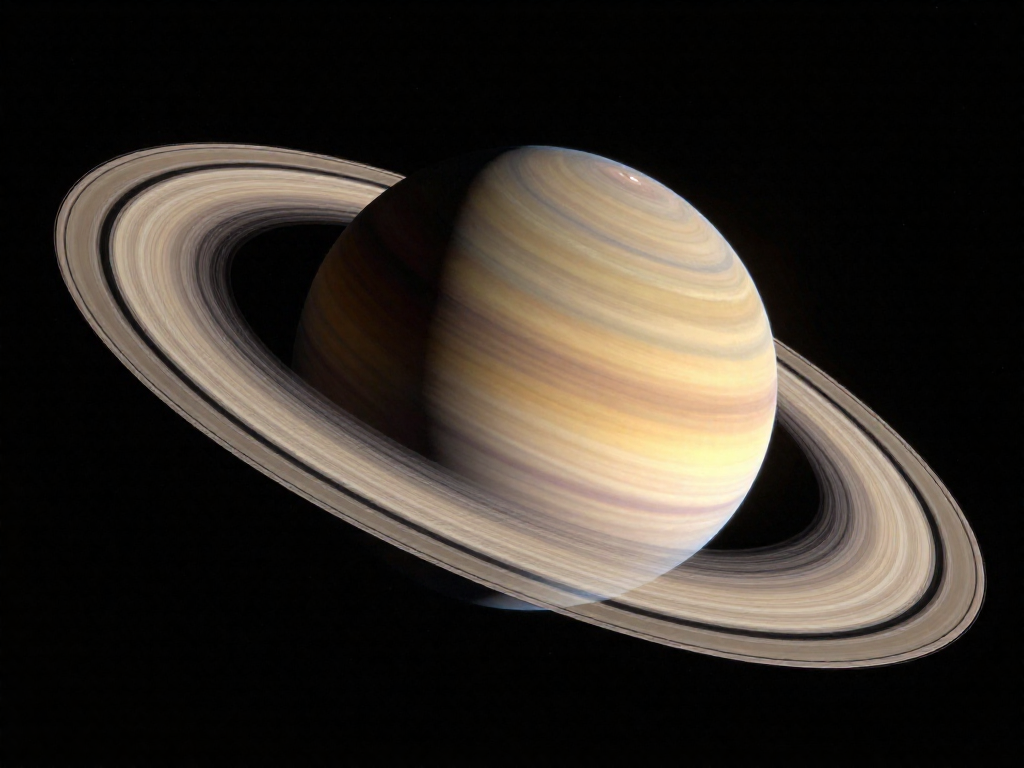
Saturn Isn't the Only Ringed Planet (But It Wins Anyway)
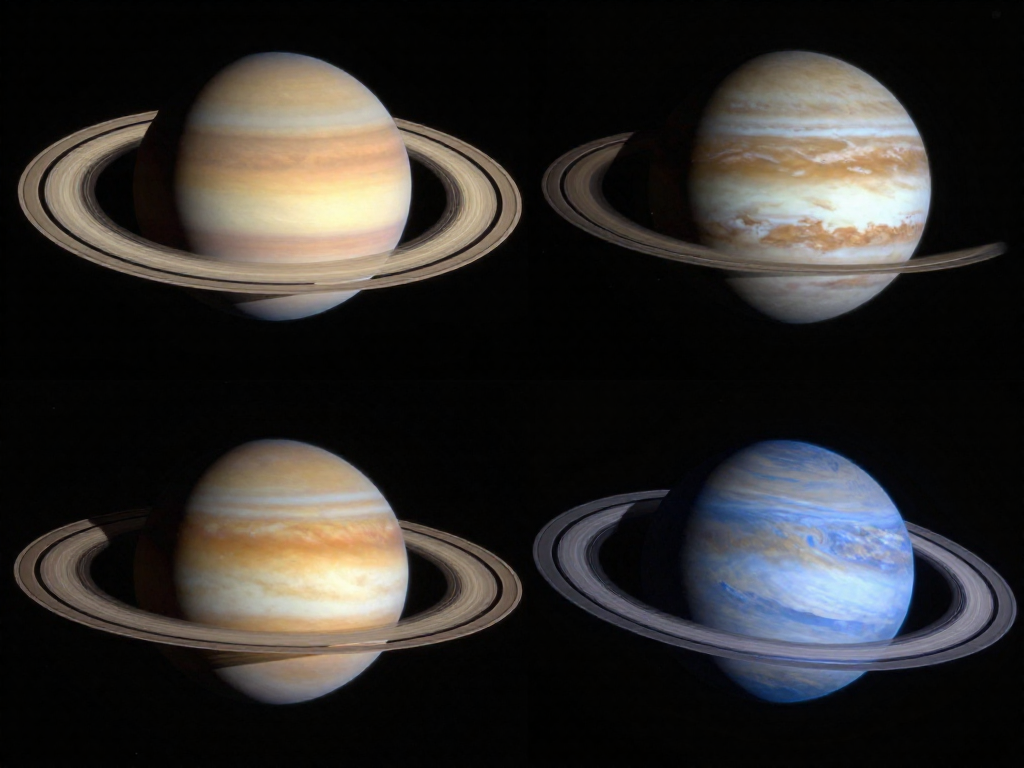
Here's a fact that surprises most people: Saturn is not the only planet with rings. Every one of the solar system's four giant planets—Jupiter, Saturn, Uranus, and Neptune—wears a set. ("Giant planets" just means the four huge worlds in the outer solar system, far bigger than rocky Earth.) So why does Saturn get all the glory?
The short answer is that the other ring systems are shy. Jupiter's rings are thin, dark, and made mostly of fine dust, like a faint smudge you'd never notice without a spacecraft flying past. NASA only confirmed they existed in 1979, when the Voyager 1 probe sent back the first clear images. Uranus and Neptune do a little better, but their rings are narrow and dim—think of a few delicate threads rather than a bright, sweeping disk.
Saturn's rings are in a different league entirely. They're broad, bright, and made largely of ice that reflects sunlight beautifully, which is why they're the only planetary rings you can actually spot through a small backyard telescope. Point even a modest scope at Saturn on a clear night and the rings pop into view as a tidy little band—a moment that has hooked countless first-time stargazers.
So the real question isn't who has rings. It's why Saturn's are so spectacular compared to everyone else's. That's what the rest of this article unpacks.
Quick takeaway: All four giant planets have rings, but Saturn's are uniquely big, bright, and icy—the only ones easily visible from your backyard.
What Saturn's Rings Are Actually Made Of
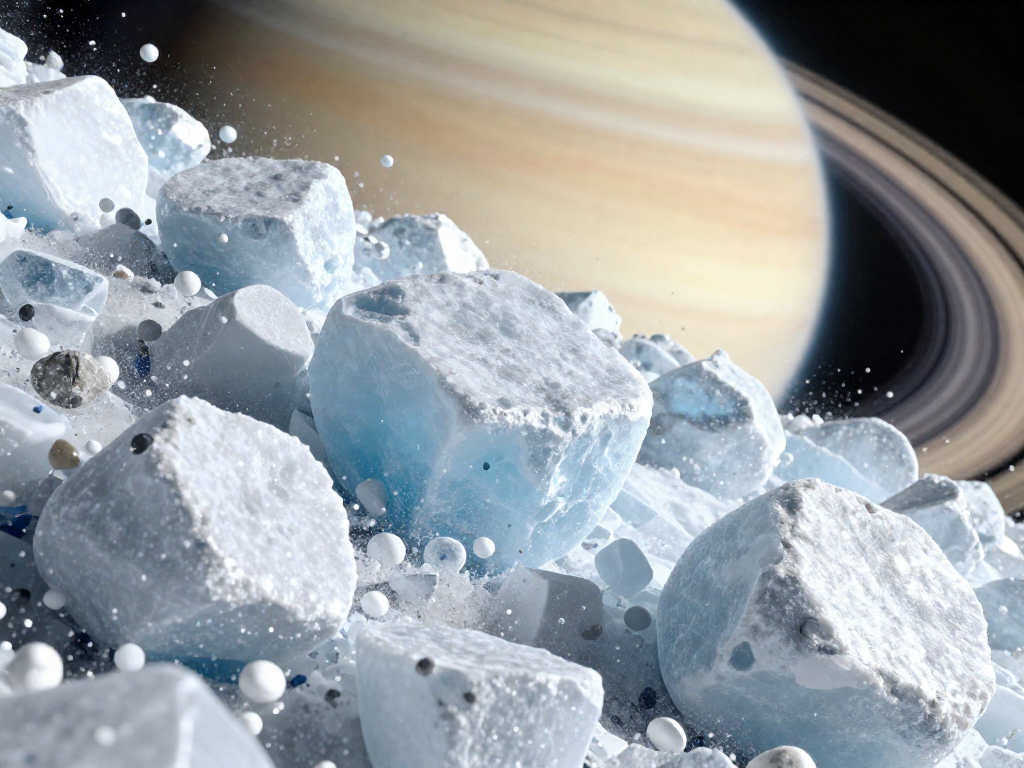
If you could fly out to Saturn and scoop up a handful of its rings, you might be surprised by what you'd find: mostly ice. Plain, frozen water—the same stuff that fills your freezer at home.
According to NASA, Saturn's rings are made up of billions of pieces of water ice, and they come in wildly different sizes. Some are as tiny as specks of dust or grains of sugar. Others are as big as boulders, cars, or even houses. So instead of one smooth, solid disk, picture an endless swarm of icy objects, all circling the planet together like a slow-motion traffic jam that never crashes.
Mixed in with all that ice is a small amount of rocky dust—think of it like a sprinkle of dirt scattered through fresh snow. But the ice is by far the main ingredient, and that's a big reason the rings look so spectacular from Earth.
Why so bright?
Ice is naturally shiny and reflective. When sunlight hits Saturn's countless ice particles, they bounce that light back toward us—a bit like how a fresh field of snow gleams almost painfully bright on a sunny day. That reflectiveness is what makes the rings stand out so vividly in telescopes and photos, far more than the darker, dustier rings around other planets.
Mostly empty space

Here's the part that surprises most people: even though the rings look solid and glassy from a distance, they're actually mostly empty space. The individual ice chunks are spread out, each one quietly orbiting Saturn on its own path. Up close, you'd see gaps between particles rather than a single sheet.
And while the rings are staggeringly wide—stretching tens of thousands of miles across—they're astonishingly thin. In many places they're only about 30 feet (10 meters) thick, sometimes even less, per NASA observations. Imagine a sheet of paper the width of a football field, and you start to get the idea.
Quick takeaway: Saturn's rings are huge swarms of water ice (with a little rocky dust), incredibly wide but paper-thin, and bright because all that ice reflects sunlight beautifully.
Why So Bright? The Ice Advantage
Here's the secret behind Saturn's showstopping rings: they're basically a giant field of freshly fallen snow floating in space. The rings are made mostly of water ice—the same frozen water you'd find in your freezer, just in chunks ranging from tiny grains to house-sized boulders. And clean ice is one of the most reflective materials in the solar system. According to NASA, Saturn's rings bounce back a huge fraction of the sunlight that hits them, which is exactly why they blaze so brilliantly through even a small backyard telescope.
Now compare that to the competition. Jupiter, Uranus, and Neptune all have rings too—but you've probably never seen a photo of them, and there's a good reason. Jupiter's rings are made of dark dust, fine sooty particles flung off its small moons. Dark dust is the opposite of snow: instead of reflecting light, it swallows most of it. Picture the difference between a fresh white snowbank and a pile of ash. Both are made of small particles, but only one catches your eye in the sunlight. That's why Jupiter's rings are so faint that we didn't even confirm they existed until a spacecraft flew past in 1979.
So if dust makes rings invisible, why do Saturn's stay so dazzlingly clean? That's one of the genuine open questions in astronomy. Space is full of drifting dust that should darken the ice over time, yet Saturn's rings still look remarkably bright—a hint that they may be surprisingly young, or that something refreshes them. Scientists are still debating the details, so treat this part as an active investigation rather than settled fact.
Quick takeaway: Saturn's rings win on looks for one main reason—reflectivity. Bright, clean ice catches sunlight; dark dust hides it. That single difference is the biggest reason Saturn's rings dominate the sky.
How Saturn Got Its Rings
So where did these dazzling rings actually come from? The honest answer is that scientists are still debating it—but they have a leading suspect.
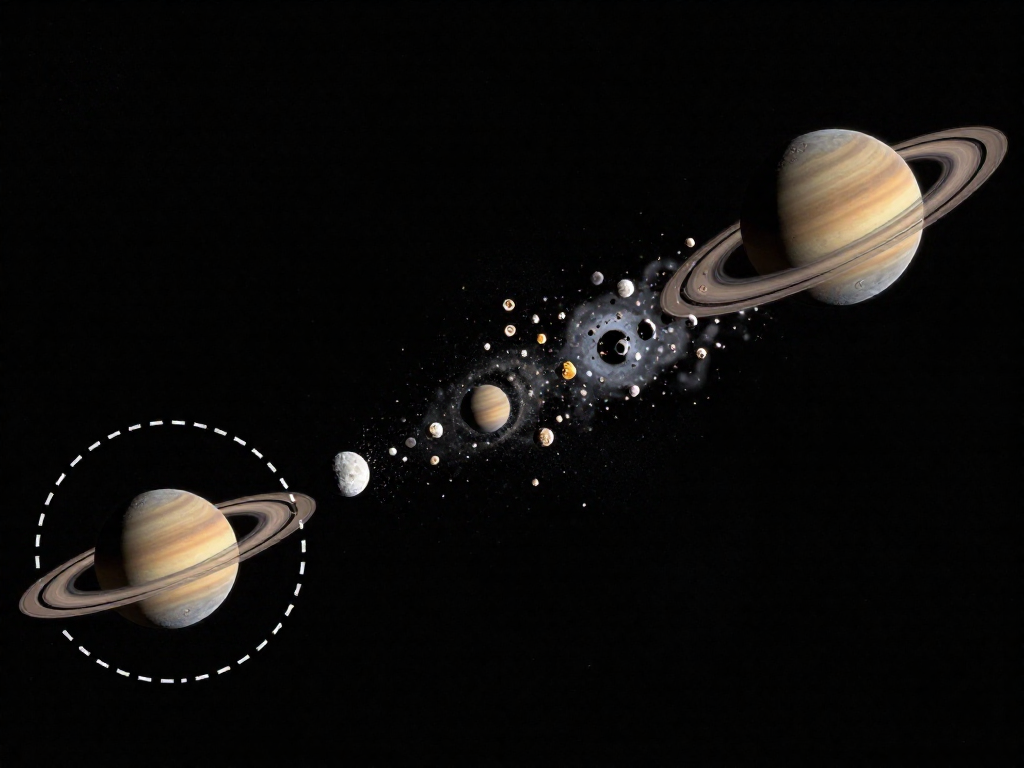
The most popular idea: a destroyed moon or comet. Many astronomers think Saturn's rings are the wreckage of an object—possibly an icy moon or a wandering comet—that drifted too close to the planet and was torn to pieces by its gravity. Instead of crashing into Saturn, the debris spread out into the flat, spinning band we see today. NASA notes the rings may be relatively young in cosmic terms, perhaps only 100 million years old, meaning the dinosaurs may have lived before Saturn had its rings.
Why the object got shredded: the Roche limit. There's an invisible boundary around any planet called the Roche limit. Get closer than this line, and the planet's gravity pulls harder on the near side of an object than the far side—stretching it until it rips apart, like pulling taffy until it snaps. Inside this zone, loose material can never clump together into a moon. It's stuck as rubble, which is exactly what a ring is.
Why the rings stay so neat. Saturn doesn't just create rings—it grooms them. Its strong gravity and dozens of small moons act like cosmic sheepdogs. Some "shepherd moons" orbit right beside the rings, nudging stray particles back into line and carving the sharp gaps you can see through a telescope.
Why this didn't happen so spectacularly elsewhere. Other planets have rings too (see the earlier section), but theirs are faint and dusty. Saturn likely got lucky: the right object, broken at the right distance, made mostly of bright ice rather than dark rock.
Quick takeaway: Saturn's rings are probably the shattered remains of a moon or comet that strayed inside the Roche limit—then got tidily maintained by Saturn's gravity and moons. The "destroyed moon" origin is still a leading hypothesis, not settled fact.
Are Saturn's Rings Permanent?
Here's the surprising part: Saturn's spectacular rings won't last forever. In fact, they're slowly disappearing right now.
NASA scientists have measured something they call "ring rain"—icy particles from the rings getting pulled down into Saturn's atmosphere, where they vanish like raindrops soaking into soil. Saturn's gravity and magnetic field are essentially draining the rings, one tiny ice crystal at a time. According to NASA, the rings are losing material fast enough that they could fade away in the cosmic blink of an eye.
Even more astonishing is the question of when the rings showed up. For a long time, many assumed they were as old as Saturn itself—about 4.5 billion years. But evidence gathered by NASA's Cassini spacecraft suggests the rings may be far younger, possibly only 100 to 400 million years old. To put that in perspective: the rings might be younger than the dinosaurs that once roamed Earth.
(A quick honesty note: the rings' exact age is still debated among scientists. The "young rings" idea is a leading hypothesis supported by Cassini data, not a settled fact.)
Put those two ideas together and something wonderful emerges. If the rings appeared recently and are slowly fading, then we're living during a rare window in cosmic history when they exist at all.
Quick takeaway: Saturn's rings are temporary—they're raining down onto the planet, and they may be surprisingly young. We just happen to be here at the perfect time to see them.
How to See Saturn's Rings Yourself
Here's the best part: you don't need a giant observatory to see Saturn's rings. A small beginner telescope—even one you can buy for the price of a nice dinner—is enough to reveal them as a faint ring around the planet. At higher magnification, that ring sharpens into the iconic shape you've seen in photos. The first time you spot it with your own eyes, it stops being a picture and becomes real.
A few tips to give yourself the best shot:
- Wait for darkness and steady skies. Find a spot away from bright city lights, and pick a night when the air is calm—twinkling, shimmering stars mean turbulent air that blurs the view.
- Catch Saturn when it's high. Saturn is visible to the naked eye as a steady, yellowish "star" for several months each year. Stargazing apps or NASA's Spot the Station–style sky guides can tell you exactly when and where to look.
- Be patient with the tilt. Saturn's rings are tilted toward us, and that angle slowly shifts over its roughly 29-year orbit. Sometimes they tip wide open; other times they turn edge-on and nearly vanish from view (the next near edge-on appearance is around 2025).
Quick takeaway: Grab any small telescope, find a dark night, and look up. Seeing those rings yourself is a moment of awe no photo can match.
See also
- What Are the Gas Giants and How Are They Different?
- How Many Moons Does Saturn Have?
- Beginner's Guide to Choosing Your First Telescope
- What Is the Roche Limit? Explained Simply
- Why Is Jupiter So Big?
Related articles
Why Does Uranus Spin on Its Side?
Uranus is tilted a wild 98 degrees, rolling around the Sun like a ball. Discover the ancient collision that likely knocked it onto its side.
Jun 29, 2026 · 6 min read
Quick Facts About Every Planet, at a Glance
Key stats for all 8 planets in one scannable place: size, distance from the Sun, day length, moons, and what makes each world weird.
Jun 29, 2026 · 6 min read
How Big Is the Solar System Really? A Sense of Scale
The distances between planets are mind-bending. Use simple shrink-it-down analogies to finally grasp how vast our solar system truly is.
Jun 29, 2026 · 7 min read