Why Doesn't the Moon Fall Down? Gravity and Orbits Made Simple
Why does the Moon orbit Earth instead of falling?
On this page
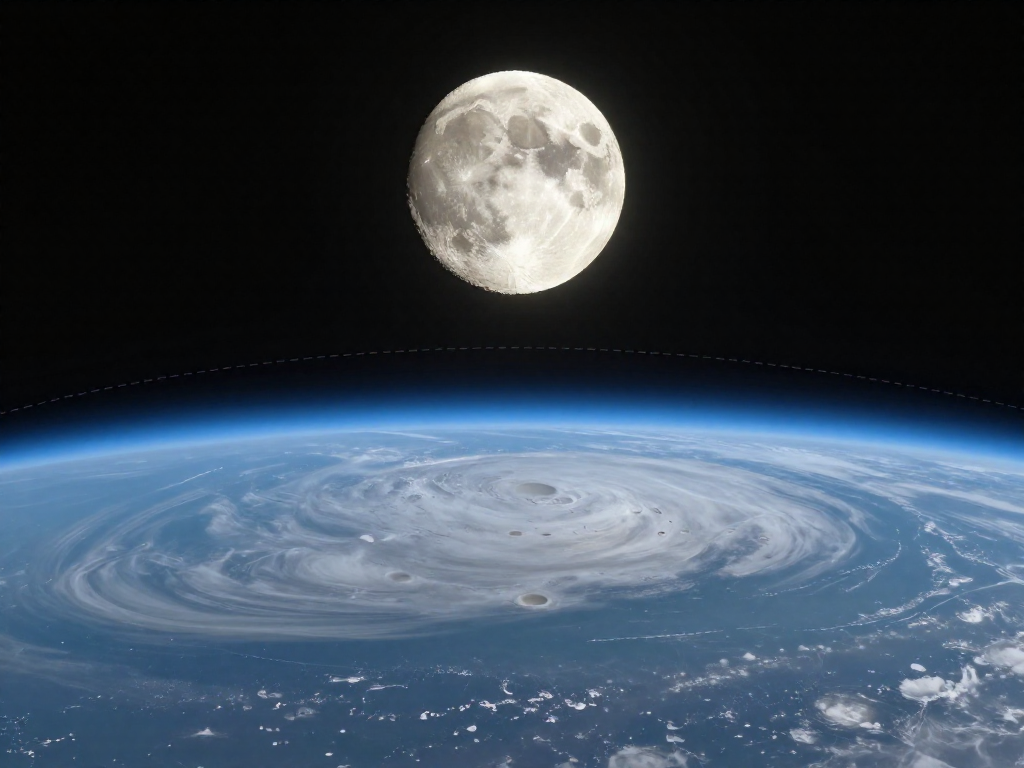
The Short Answer: The Moon Is Falling (It Just Keeps Missing)
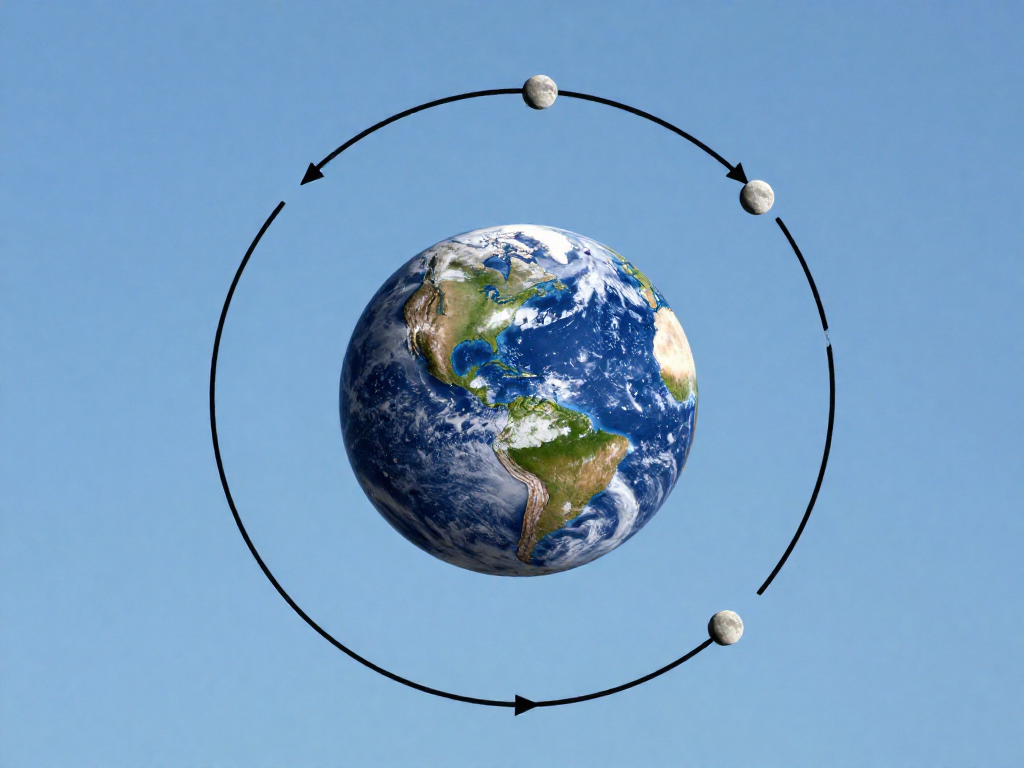
Here's the surprising truth: the Moon is falling toward Earth right now. It always has been, and it always will be.
So why doesn't it crash into us? Because the Moon isn't just falling down — it's also racing sideways at tremendous speed (about 3,680 km/h, according to NASA). Earth's gravity keeps tugging it inward, but the Moon is moving sideways so fast that the ground keeps curving away beneath it before it can ever land.
The result is a cosmic game of "almost": the Moon falls, misses Earth, falls again, misses again — forever. That endless falling-but-missing loop has a name. We call it an orbit.
Quick takeaway: An orbit is just falling so fast sideways that you keep missing the thing you're falling toward.
And here's the best part: this one simple idea explains every orbit in the universe — from satellites to planets to entire galaxies. Read on to see how.
What Gravity Actually Does (Without the Equations)
Gravity is simply a pull. Every object that has mass—meaning anything made of "stuff," from a grain of sand to a giant planet—tugs on every other object around it. You don't notice most of these pulls because they're incredibly tiny. But pile up enough mass, like an entire planet's worth, and that pull becomes the invisible force gluing your feet to the ground.
Two things decide how strong that pull is:
- How much mass an object has. Bigger means stronger. Earth has far more mass than you, which is why you fall toward Earth and not the other way around.
- How close you are. Closer means stronger. Move farther away, and the pull fades—though it never disappears completely.
Here's a surprise: gravity goes both ways. Earth pulls the Moon, and the Moon pulls Earth right back. The Moon's pull is weaker because it has less mass, but it's real—it's what drags our oceans into the daily tides.
Myth-bust: Space is not a place with "no gravity." Gravity never switches off. Astronauts floating on the International Space Station are still firmly in Earth's grip—they're falling, not gravity-free (more on that next). According to NASA, Earth's gravity at that altitude is still about 90% as strong as it is on the ground.
Quick takeaway: Gravity is an always-on pull between any two objects, stronger when they're bigger or closer—and it reaches everywhere, including space.
The Cannonball Thought Experiment That Explains Everything
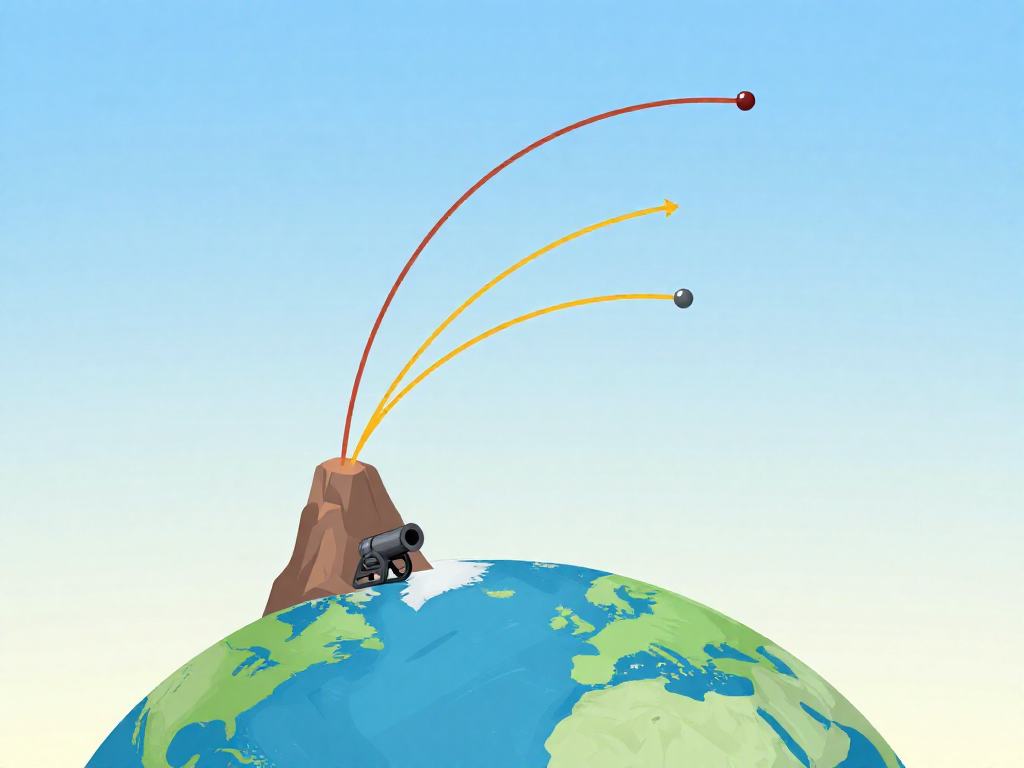
Back in the 1600s, Isaac Newton imagined something delightfully simple to explain why the Moon stays in the sky. Picture standing on top of an impossibly tall mountain with a cannon, firing cannonballs straight outward (horizontally). What happens next is the key to understanding every orbit in the universe.
Fire it slowly. The cannonball travels a short distance, curves downward, and thuds into the ground nearby. Gravity—the invisible pull that draws everything toward Earth's center—wins quickly.
Fire it faster. Now the cannonball flies much farther before landing. Here's the twist: Earth is a sphere, so its surface gently curves away beneath the ball's path. The faster you fire, the more that curve matters, and the longer the ball stays airborne.
Fire it fast enough. Something remarkable happens. The cannonball is still falling—gravity never switches off—but the ground curves away just as fast as the ball drops toward it. The ball keeps missing the Earth. It falls around the planet instead of into it, looping back to where it started. That endless falling-without-landing is what we call an orbit.
Quick takeaway: An orbit isn't an escape from gravity. It's falling so fast sideways that you keep missing the ground.
And that, in plain terms, is exactly what the Moon is doing. It was set moving sideways at enormous speed long ago, and it has been "falling" around Earth ever since—forever missing, forever circling. No engine, no rope, no magic. Just the right sideways speed paired with steady gravity.
Newton's "cannonball" was only a thought experiment, but the physics is rock-solid. NASA uses the very same principle to keep satellites and the International Space Station in orbit today.
Everyday Analogies: Swinging a Bucket and Rounding a Corner
You don't need a telescope to feel how orbits work—you've felt it in your own body.
The bucket on a string. Picture spinning a bucket of water in a big circle over your head. The water never spills, even when it's upside down. Why? The water "wants" to fly off in a straight line, but the string keeps yanking it back toward your hand, bending its path into a circle. Let go of the string, and the bucket sails off straight.
Now swap the pieces: the bucket is the Moon, your hand is Earth, and the string is gravity—the invisible pull every object with mass has on every other object. Gravity is the "string" that keeps redirecting the Moon, curving its straight-line motion into a loop around us.
The car taking a fast corner. Ever felt shoved toward the door when a car turns quickly? Your body wanted to keep going straight, but the car turned underneath you. An orbit is that same feeling, made permanent: a turn that never stops. The Moon is forever "trying" to go straight, and gravity is forever turning it.
Quick takeaway: An orbit isn't a thing hanging in space—it's an endless turn. Straight-ahead motion plus a constant inward pull equals a circle that never breaks.
Why Astronauts Float: Free-Fall, Not Zero Gravity
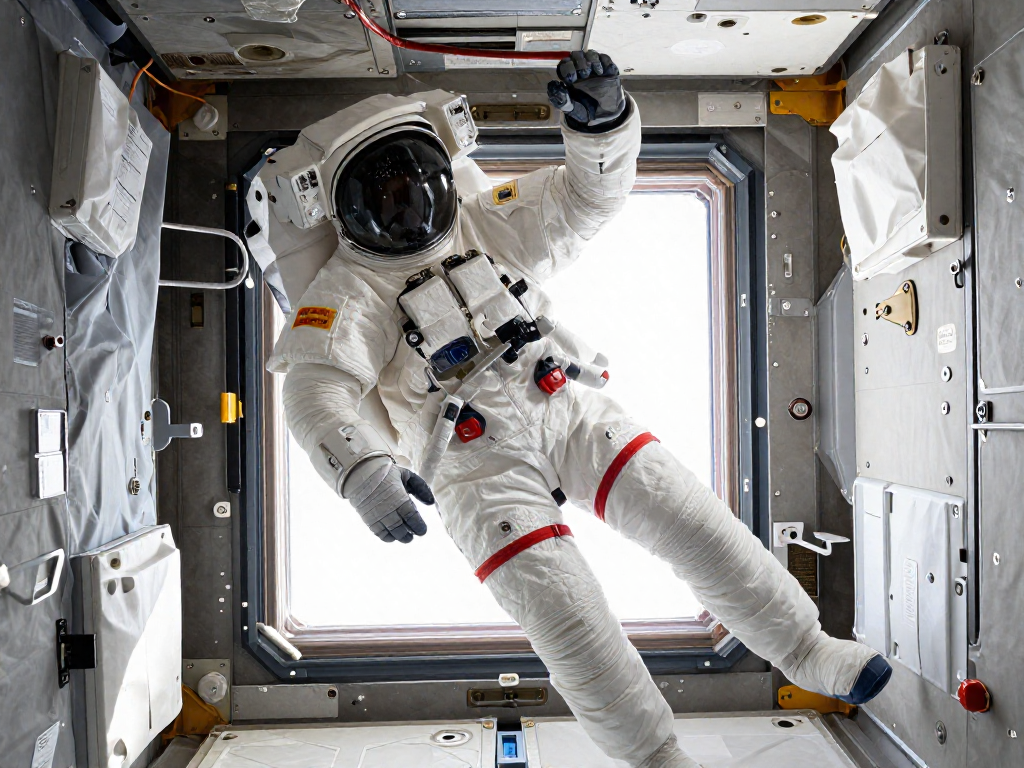
Here's a surprise: the astronauts you see drifting weightlessly aboard the International Space Station (ISS) are not beyond Earth's gravity. At their altitude—about 250 miles up—gravity is still nearly 90% as strong as it is on the ground (NASA). So why do they float?
For the same reason the Moon does: they're falling. The station is constantly falling toward Earth, but it's also racing sideways so fast that it keeps missing the planet and loops around instead. The astronauts inside are falling at exactly the same rate as the station around them. When everything falls together, nothing presses against anything else—so nothing feels heavy.
You've actually felt a tiny version of this. At the top of a rollercoaster drop, your stomach lifts and you feel light for a heartbeat. In that instant, you and the coaster are falling together, just like the astronauts. The ISS simply makes that feeling last indefinitely.
This is why "free-fall" is a more accurate term than "zero gravity." There's plenty of gravity up there—it's the endless falling that does the floating.
Quick takeaway: Astronauts float because they're falling around Earth alongside their spacecraft, not because gravity has switched off.
Will the Moon Ever Fall Down or Drift Away?
Here's a surprise: the Moon isn't holding still at all. It's slowly drifting away from us—about 1.5 inches (3.8 centimeters) every year, roughly the rate your fingernails grow. NASA confirmed this using mirrors that Apollo astronauts left on the lunar surface, bouncing lasers off them to measure the distance precisely.
Why the drift? It comes down to tides—the gentle bulging of Earth's oceans caused by the Moon's gravity. As Earth spins, those bulges tug on the Moon and nudge it into a slightly higher, wider orbit. Think of it as the Moon getting a tiny push outward with every spin.
So will it crash into us or fly off into space? Neither—not for billions of years. The Sun will likely transform long before the Moon ever wanders far enough to leave.
Quick takeaway: The Moon is creeping away at fingernail speed, but it's going nowhere on any timescale that matters to us.
See also
- What Causes the Phases of the Moon?
- How Do Tides Work? The Moon's Pull Explained
- Why Does Earth Orbit the Sun?
- What Is Gravity, Really? A Beginner's Guide
- How Do Satellites Stay in Orbit?
Related articles
Why Does Uranus Spin on Its Side?
Uranus is tilted a wild 98 degrees, rolling around the Sun like a ball. Discover the ancient collision that likely knocked it onto its side.
Jun 29, 2026 · 6 min read
Quick Facts About Every Planet, at a Glance
Key stats for all 8 planets in one scannable place: size, distance from the Sun, day length, moons, and what makes each world weird.
Jun 29, 2026 · 6 min read
How Big Is the Solar System Really? A Sense of Scale
The distances between planets are mind-bending. Use simple shrink-it-down analogies to finally grasp how vast our solar system truly is.
Jun 29, 2026 · 7 min read