Comets vs. Asteroids vs. Meteors: What's the Difference?
How are comets, asteroids, and meteors different?
On this page
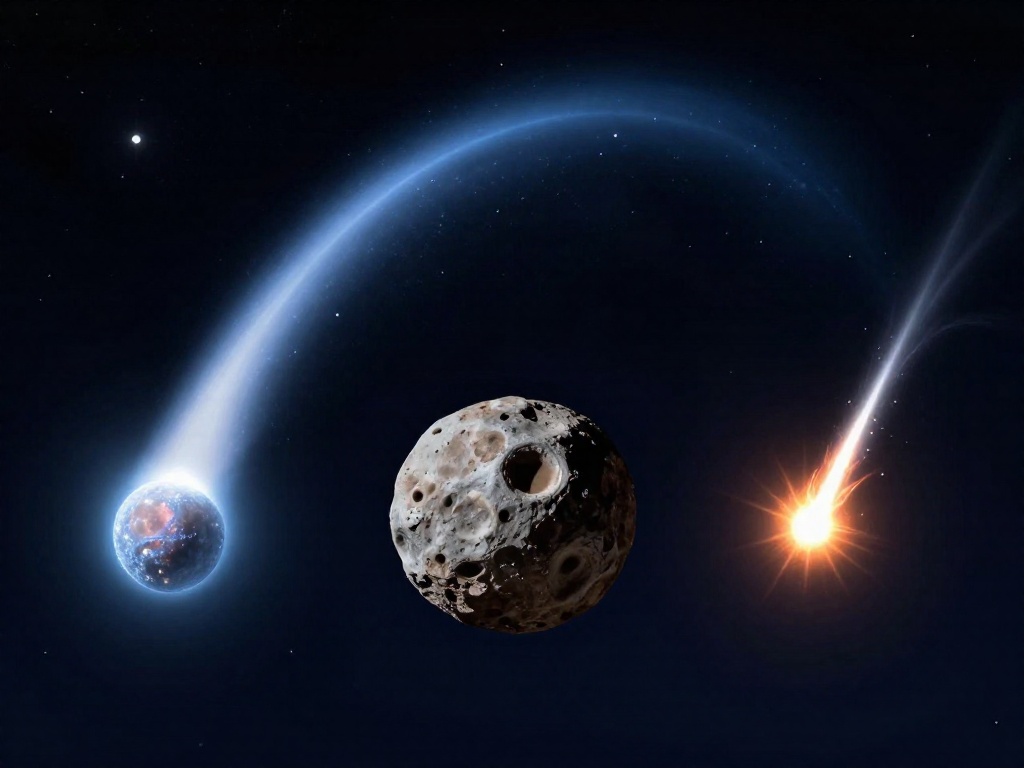
The Quick Answer (If You Only Read One Thing)
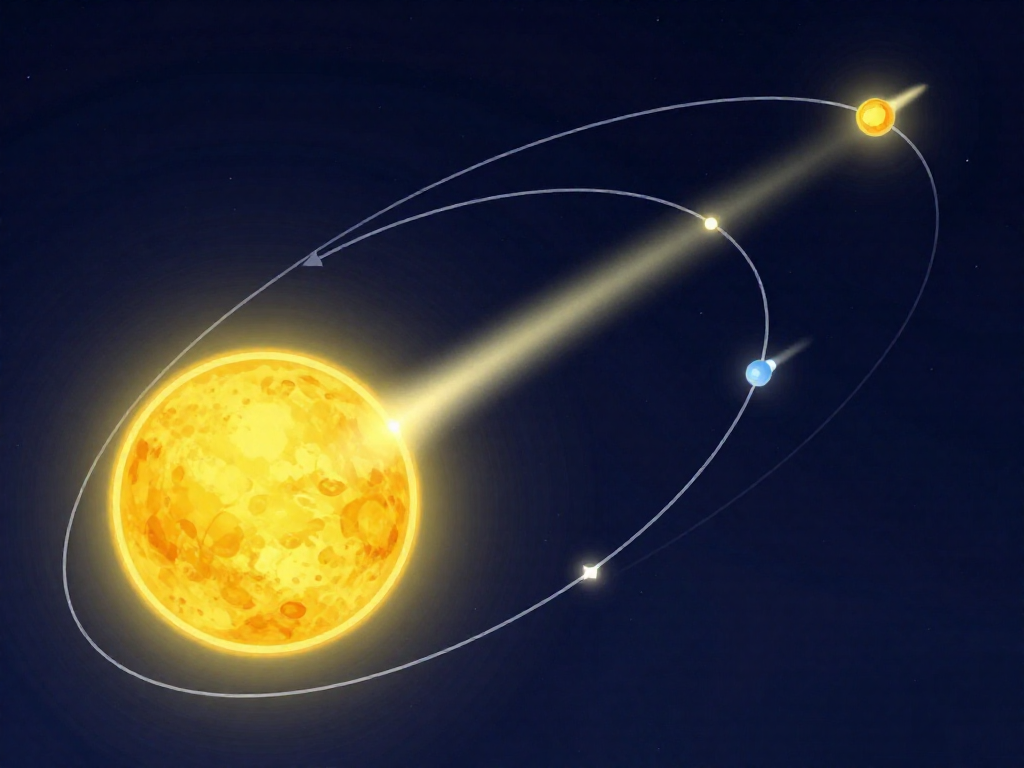
Short on time? Here's the whole story in four words: rock, ice, light, leftover.
- Asteroid — a chunk of rock or metal orbiting (circling) the Sun. Most hang out in the asteroid belt, a doughnut-shaped zone between Mars and Jupiter. Think of it as a leftover building block from when the planets formed.
- Comet — an icy "dirty snowball" made of frozen gases, dust, and rock. When a comet swings close to the Sun, its ices heat up and stream off, creating that glowing tail you've seen in photos.
- Meteor — not an object at all, but an event: the bright streak of light you see when a small space rock plunges into our atmosphere and burns up. That's the "shooting star" you wish on.
- Meteorite — the piece that survives the fiery fall and actually lands on the ground, where you could pick it up.
Memory hook: rock in space (asteroid) vs. ice in space (comet) vs. the light show (meteor) vs. the leftover on the ground (meteorite).
Want the deeper "why" behind each? Keep reading — but if you came for the difference, you've now got it. (Definitions follow NASA's usage.)
What Is an Asteroid?
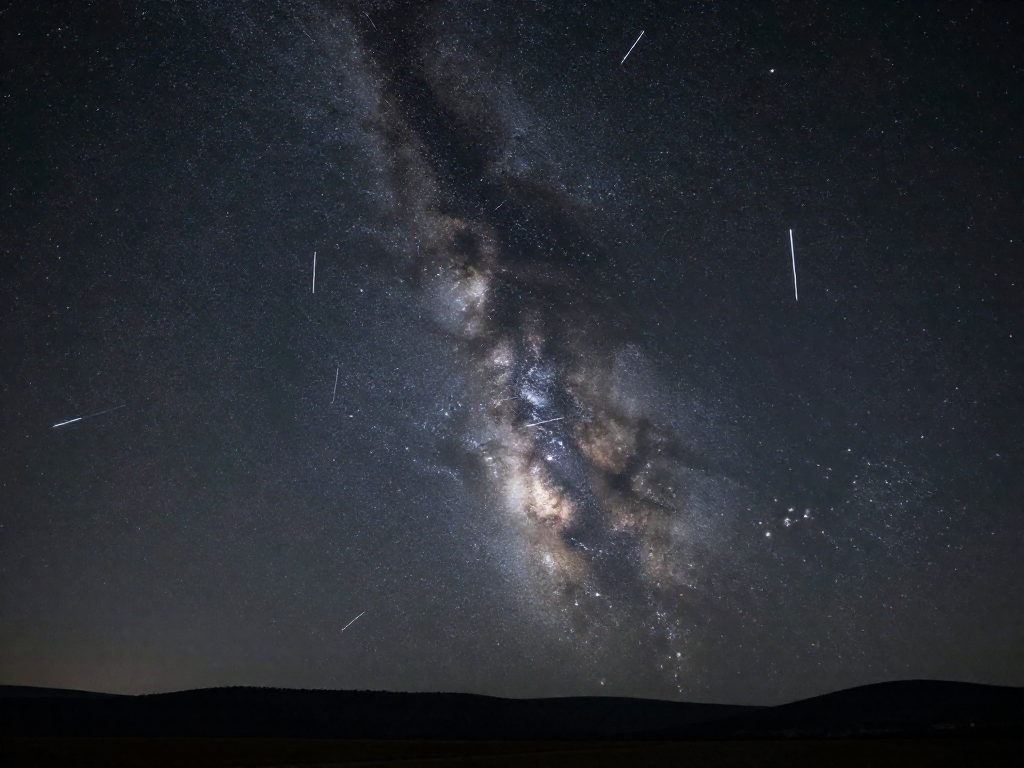
Think of an asteroid as a chunk of leftover construction material from when our solar system was being built about 4.6 billion years ago. They're made of rock and metal—the heavier stuff that never got swept up into a planet. In that sense, they're the cosmic equivalent of bricks left over after a house is finished.
Most asteroids hang out in the asteroid belt, a doughnut-shaped zone orbiting the Sun between Mars and Jupiter. It sounds crowded, but it isn't: the asteroids there are so spread out that spacecraft fly through without a scratch.
They come in wildly different sizes. Some are no bigger than a pebble, while the largest, Ceres, is about 590 miles (940 km) across—big enough that NASA classifies it as a dwarf planet. Vesta, another giant, is roughly 330 miles wide.
So why didn't all this material clump into a real planet? The short answer: Jupiter. The giant planet's powerful gravity kept stirring the pot, preventing the asteroids from gently gathering into one world.
Finally, some asteroids drift closer to us. These near-Earth asteroids travel paths that bring them into our neighborhood, which is why NASA and ESA carefully track them—not to alarm anyone, but to know our cosmic surroundings well in advance.
Quick takeaway: Asteroids are rocky-metal leftovers, mostly living between Mars and Jupiter, ranging from pebbles to dwarf planets.
Sources: NASA Solar System Exploration; ESA.
What Is a Comet?
A comet is often described as a "dirty snowball" — a chunk of ice, dust, and rock left over from the birth of our solar system. Picture a cosmic snowball a few miles across, with bits of grit and pebbles frozen inside. That mix of ice and dirt is the single feature that sets comets apart from their rocky cousins, the asteroids.
Most comets live in the deep-freeze at the far edges of the solar system, in two regions called the Kuiper Belt (a ring of icy bodies beyond Neptune) and the even more distant Oort Cloud (a vast shell of icy objects surrounding the entire solar system). Out there, far from the Sun's warmth, they stay frozen and invisible for thousands of years.
Everything changes when a comet's long, looping orbit carries it close to the Sun. The heat vaporizes its ice into gas and dust, creating the glowing tail we recognize. Here's a surprising detail from NASA: the tail always points away from the Sun — pushed by sunlight and solar wind — not trailing behind like smoke from a moving car. So on the way out, a comet actually travels tail-first.
Because comets are big and their tails stretch for millions of miles, they hang in our sky for days or even weeks. Some return on a reliable schedule — Halley's Comet swings by Earth roughly every 76 years.
Quick takeaway: Comets are icy, far-traveling visitors that grow a glowing tail near the Sun — and that tail always points away from it.
What Are Meteoroids, Meteors, and Meteorites?
Here's the confusing part that trips up almost everyone: meteoroid, meteor, and meteorite often refer to the same object — just at three different points in its journey. Think of it like water being called "vapor," "rain," and "puddle" depending on where it is. The thing doesn't change; its location does.
Let's walk through the three stages:
-
Meteoroid — This is the object while it's still out in space: a small chunk of rock or even a speck of dust drifting through the solar system. Most are tiny, ranging from grains of sand to small boulders.
-
Meteor — The moment that meteoroid slams into Earth's atmosphere, it heats up and glows, leaving a brilliant streak of light across the sky. That streak is the meteor — what most people call a "shooting star." (It's not a star at all, just a glowing bit of space debris.)
-
Meteorite — If any piece survives the fiery plunge and lands on the ground, that surviving chunk earns a new name: a meteorite. You can actually hold one in your hand.
So what about meteor showers? Those dazzling nights when dozens of "shooting stars" appear happen when Earth, on its yearly orbit, plows through a trail of crumbs left behind by a comet. As the comet's icy body sheds dust and pebbles, it leaves a debris stream in space. When our planet passes through it, all those particles burn up at once, creating the show (NASA).
Quick takeaway: One object, three names — meteoroid in space, meteor in the sky, meteorite on the ground.
Side-by-Side Comparison Table
Here's the whole picture at a glance. Save this one for the next time a glowing streak crosses the sky and you want to know what you just saw.
| Feature | Asteroid | Comet | Meteor |
|---|---|---|---|
| What it's made of | Rock and metal | Ice and dust (a "dirty snowball") | A bit of debris, often shed by a comet |
| Where it comes from | Mostly the asteroid belt, a ring of rubble between Mars and Jupiter | The cold outer edges of the solar system | Anywhere—it's tiny space dust meeting Earth |
| Typical size | Pebble-sized up to hundreds of miles wide | Often a few miles across | Usually smaller than a grain of sand |
| Does it have a tail? | No | Yes—a glowing tail that forms as the Sun warms its ice | No (it is the streak of light) |
| What you see from Earth | Usually nothing—you need a telescope | A fuzzy glow with a tail, visible for days or weeks | A brief streak of light lasting seconds (a "shooting star") |
Quick takeaway: Asteroids are space rocks, comets are icy and grow tails near the Sun, and a meteor is the flash you see when debris burns up in our atmosphere.
Source: NASA Solar System Exploration.
Easy Ways to Remember the Difference
Once you know the science, a few simple memory hooks make it stick for good:
- Asteroid = "A" for a big rock. Picture a tumbling chunk of stone and metal. A rock, asteroid.
- Comet has a cold, icy tail. Comets are frozen balls of ice and dust, so as they near the Sun they grow a glowing comet-tail. Think Cold Comet.
- Meteor = a moment of light. That's the streak you call a "shooting star"—really a small bit of space debris burning up in the air. It's gone in seconds, just a moment.
- Meteorite ends in "-ite," like a site you can visit. If a meteor survives the fall and lands on the ground, it becomes a meteorite—a real rock you could hold.
Spotting them in the night sky: A quick streak that vanishes is a meteor. A faint, fuzzy smudge with a tail that stays put night after night is a comet. Asteroids are usually too small and dim to see without a telescope.
Quick takeaway: Rock = asteroid, icy tail = comet, flash of light = meteor, landed rock = meteorite.
Why It Matters (And Why It's Awesome)
Here's the part that gives you goosebumps: comets and asteroids are leftovers from the birth of our solar system, roughly 4.6 billion years ago. They're cosmic time capsules—frozen snapshots of the ingredients that built the planets, barely changed since.
And they may be personal. Many scientists think comets and asteroids delivered water, and even some of the chemical building blocks for life, to a young Earth (NASA). The story is still being pieced together, but the idea that part of you traces back to an icy visitor is a real, actively studied hypothesis—not just a daydream.
Best of all, you don't need a telescope. Meteor showers are free, naked-eye astronomy anyone can enjoy from a dark backyard. Meanwhile, NASA and ESA track near-Earth objects in earnest—genuine planetary defense, keeping watch on the sky for us.
Quick takeaway: These rocks and ice balls are our origin story, our nightly show, and our cosmic neighborhood watch—all at once.
See also
- What Is the Asteroid Belt?
- How to Watch a Meteor Shower (Beginner's Guide)
- The Oort Cloud and Kuiper Belt Explained
- What Would Happen If an Asteroid Hit Earth?
- Halley's Comet: When Will We See It Again?
Related articles
Why Does Uranus Spin on Its Side?
Uranus is tilted a wild 98 degrees, rolling around the Sun like a ball. Discover the ancient collision that likely knocked it onto its side.
Jun 29, 2026 · 6 min read
Quick Facts About Every Planet, at a Glance
Key stats for all 8 planets in one scannable place: size, distance from the Sun, day length, moons, and what makes each world weird.
Jun 29, 2026 · 6 min read
How Big Is the Solar System Really? A Sense of Scale
The distances between planets are mind-bending. Use simple shrink-it-down analogies to finally grasp how vast our solar system truly is.
Jun 29, 2026 · 7 min read