What's Actually in the Asteroid Belt? (It's Emptier Than You Think)
What is the asteroid belt and what's inside it?
On this page
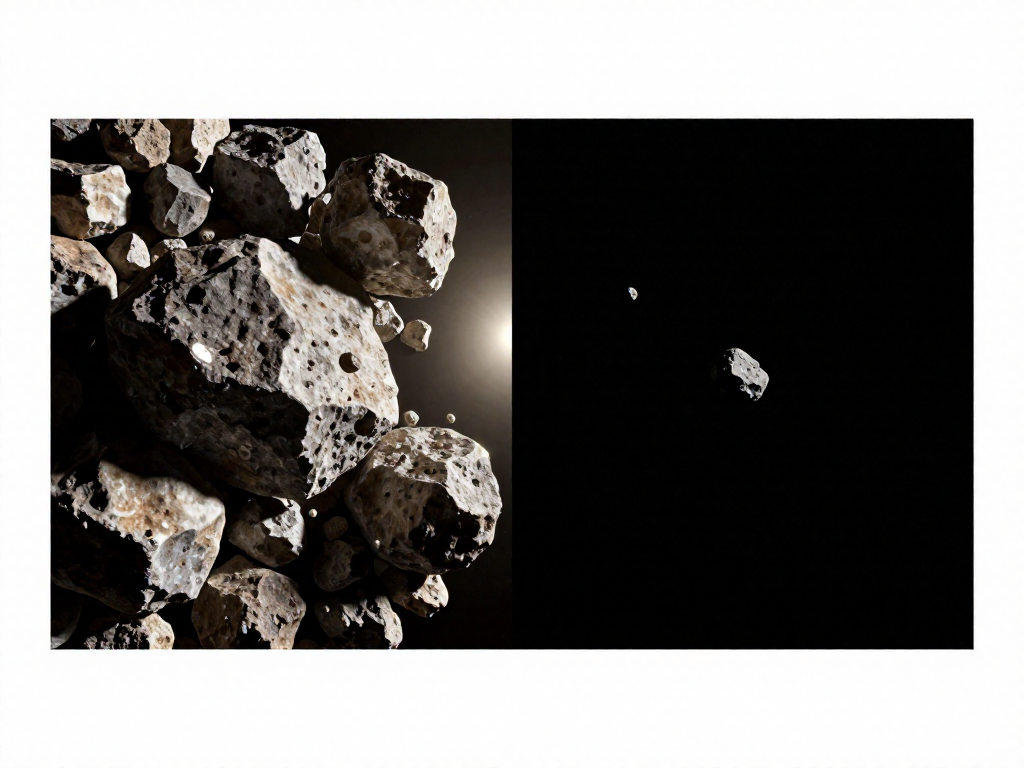
Open by naming the sci-fi image everyone has — a spaceship dodging tumbling boulders — then immediately puncture it: if you stood on an asteroid, you probably couldn't see another one. Promise to explain what the belt actually contains and why it's so surprisingly empty.
The Asteroid Belt Isn't What the Movies Showed You
Picture the classic sci-fi scene: a spaceship dodging and weaving through a storm of tumbling boulders, narrowly missing one rock after another. It's thrilling. It's also completely wrong.
The real asteroid belt—the ring of rocky leftovers orbiting the Sun between Mars and Jupiter—is one of the emptiest places you can imagine. Yes, it holds millions of asteroids (chunks of rock and metal that never formed into a planet). But they're spread across a colossal stretch of space.
How far apart are they? On average, your typical asteroid sits hundreds of thousands of miles from its nearest neighbor—often farther than the distance from Earth to the Moon. If you stood on one asteroid, you'd likely struggle to see another one at all.
That's why it's not a death trap. NASA has flown more than a dozen spacecraft straight through the belt—including the Pioneer, Voyager, and Galileo missions—and not one has ever been damaged by a stray rock. The odds of a random collision are astonishingly small.
So if it's mostly empty, what's actually out there? Let's take a closer look.
Where Is the Asteroid Belt?
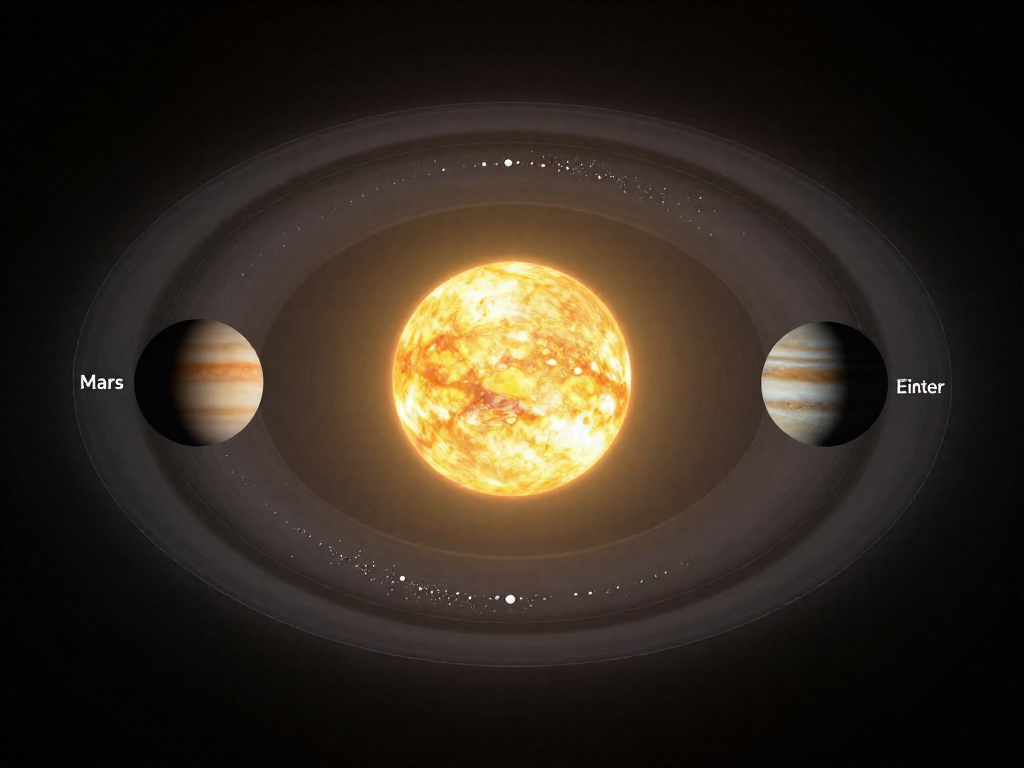
The asteroid belt sits in the wide gap between Mars and Jupiter, the fourth and fifth planets out from the Sun. If you picture the solar system as a series of running tracks circling the Sun, the belt is the lane between those two worlds.
How far out is that? Astronomers measure these distances in AU, short for astronomical unit — which is just the distance from the Earth to the Sun (about 93 million miles, or 150 million km). The belt stretches from roughly 2 to 3.5 AU, meaning it's two to three and a half times farther from the Sun than we are.
It also isn't a flat, tidy ring like the bands you see around Saturn. It's more like a fat, lumpy doughnut: the asteroids are spread out in a thick, slightly tilted zone, not lined up neatly on a single plane.
And here's the part that surprises most people — the gap is enormous. If you shrank the Sun down to the size of a beach ball, the asteroid belt would be a scattering of dust grains spread across an area the size of a football field. There's a lot of empty space out there.
Quick takeaway: The asteroid belt is a wide, doughnut-shaped region between Mars and Jupiter, about 2 to 3.5 times Earth's distance from the Sun — and it's mostly empty.
Source: NASA Solar System Exploration.
What's Actually Inside It
So what's really floating out there? In short: a lot of rocks, but spread incredibly thin. The asteroid belt holds millions of objects, yet they're so far apart that if you stood on one, you probably couldn't see another with the naked eye.
These objects come in wildly different sizes. The vast majority are tiny — think dust grains, pebbles, and boulders no bigger than a house. For every giant asteroid, there are countless small ones. Imagine emptying a bag of sand, gravel, and a few basketballs across an entire ocean: that's roughly the size mix you're dealing with.
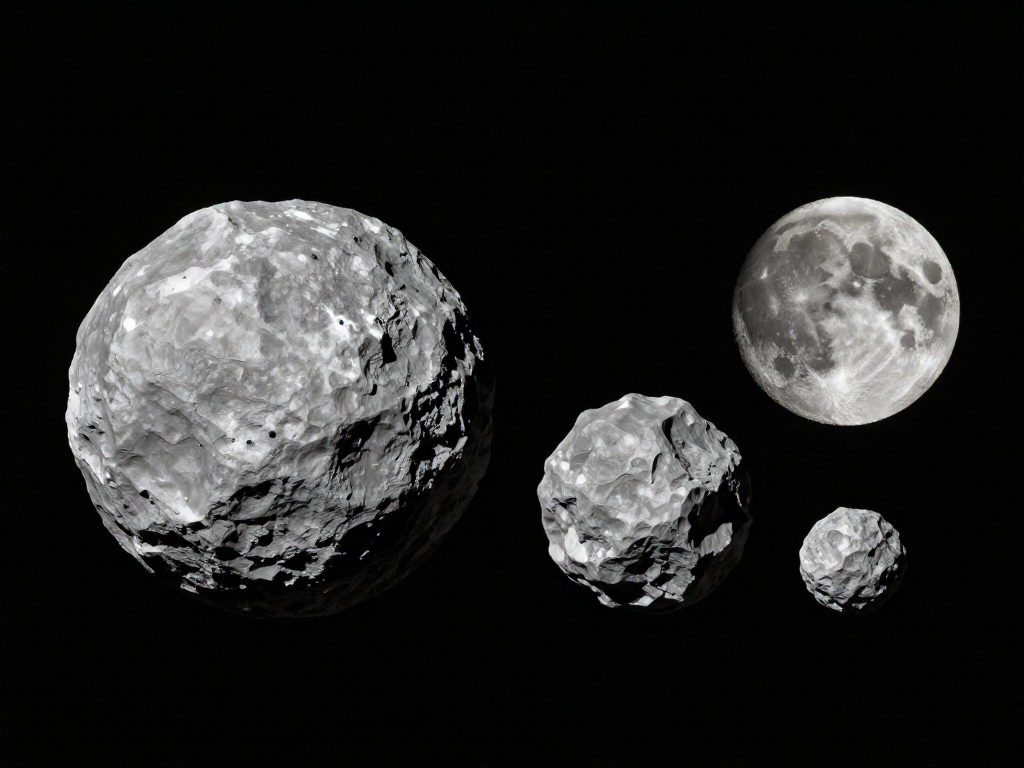
Only a small handful are genuinely large. The biggest heavy-hitters are Vesta, Pallas, and Hygiea — each hundreds of kilometers across, big enough that you'd need hours to drive across one if it had roads.
But one object towers above the rest: Ceres. It's a dwarf planet — a body round enough to look like a small world, but not big enough (or dominant enough in its orbit) to count as a full planet. Ceres is so massive that it alone holds about a third of the entire belt's mass (NASA). In other words, one object accounts for a huge slice of everything out there, and the millions of leftover rocks share what remains.
What are all these objects actually made of? Mostly three things:
- Rock — stony material, similar to what's under your feet on Earth.
- Metal — iron and nickel, the same metals found deep in Earth's core.
- Carbon-rich material — dark, sooty stuff that includes some of the oldest, most primitive matter in the solar system.
Different asteroids lean toward different mixes, which is part of why scientists find them so fascinating: they're leftover building blocks from the solar system's birth, frozen in time for over 4.5 billion years (ESA).
Quick takeaway: The belt is millions of objects, but mostly small ones. A few big bodies — Vesta, Pallas, Hygiea, and especially the dwarf planet Ceres — hold most of the material, all made of rock, metal, and carbon-rich dust.
Just How Empty Is It, Really?
Here's the part that surprises almost everyone: the asteroid belt is mostly empty space. Spectacularly, almost unbelievably empty.
Start with the total amount of "stuff." If you gathered every asteroid in the belt and squished them together into a single ball, that ball would weigh less than our Moon — only about 3% of the Moon's mass, according to NASA. And nearly half of that small amount is locked up in just four big objects: Ceres, Vesta, Pallas, and Hygiea. Everything else is leftovers, scattered thin.
Now spread those leftovers across the enormous region between Mars and Jupiter. The gaps are staggering. On average, asteroids are hundreds of thousands to millions of kilometers apart — often farther than the distance between Earth and the Moon. If you were standing on one asteroid, you almost certainly couldn't see another one with your naked eye. The nearest neighbor would be a faint speck, if visible at all.
So why do we picture a chaotic, ship-dodging rubble field? Blame the diagrams. To show the belt on a single page, illustrators compress millions of kilometers into a few inches, packing the dots tightly so you can actually see there's a belt there. The crowding is an artist's shortcut, not reality.
A more honest picture: imagine a few grains of sand floating in an empty cathedral. The cathedral is the belt; the sand grains are the asteroids. That's roughly how thinly spread things are. In fact, spacecraft like NASA's Pioneer, Voyager, and Dawn have all flown through the belt without any special dodging — the odds of hitting something are vanishingly small.
Quick takeaway: The asteroid belt holds less material than the Moon, spread so thinly that asteroids are usually too far apart to see one another. It's a desert, not a junkyard.
Why Didn't It Become a Planet?
Here's a myth worth busting right away: the asteroid belt is not the wreckage of a planet that blew up. That's a fun sci-fi idea, but the science points somewhere more interesting. The belt is actually leftover building material—cosmic bricks that never got assembled into a planet in the first place.
So what stopped them? Blame Jupiter. As the biggest planet in our solar system, Jupiter has enormous gravity (the invisible pull that keeps your feet on the ground and the Moon circling Earth). During the solar system's early days, that pull kept the rocks in this region constantly stirred up, like a spoon swirling a bowl too fast for anything to settle.
To build a planet, smaller rocks need to gently bump together and stick, growing bigger over millions of years. But Jupiter sped those rocks up so much that their collisions became violent. Instead of merging, they shattered.
The result is the belt we see today: scattered debris from a planet that never formed, not pieces of one that was destroyed.
Quick takeaway: Jupiter's gravity kept the rocks too riled up to combine, so the belt is unused construction material—never a planet, never exploded.
Sources: NASA Solar System Exploration; ESA.
Have We Actually Visited the Asteroid Belt?
Yes—and what we've found is genuinely thrilling. NASA's Dawn spacecraft spent years orbiting the belt's two biggest residents: Vesta, a battered, rocky world, and Ceres (a "dwarf planet," meaning it's round like a planet but too small to dominate its orbit). Up close, Dawn revealed Vesta's giant impact crater and surprising bright spots on Ceres—salty deposits hinting at briny water beneath the surface.
Other missions, like Japan's Hayabusa2 and NASA's OSIRIS-REx, flew to smaller nearby asteroids and actually scooped up samples to bring home.
Why bother? Asteroids are leftover building blocks from when the solar system formed, roughly 4.6 billion years ago. Studying them is like reading the universe's oldest construction notes.
Quick takeaway: We've orbited Vesta and Ceres and even returned asteroid samples—each one a time capsule from the early solar system.
Sources: NASA, ESA, JAXA.
See also
- Dwarf planets explained: what makes Ceres and Pluto different
- Jupiter: the giant that shaped our solar system
- What's the difference between an asteroid, comet, and meteor?
- A simple tour of the solar system for beginners
Related articles
Why Does Uranus Spin on Its Side?
Uranus is tilted a wild 98 degrees, rolling around the Sun like a ball. Discover the ancient collision that likely knocked it onto its side.
Jun 29, 2026 · 6 min read
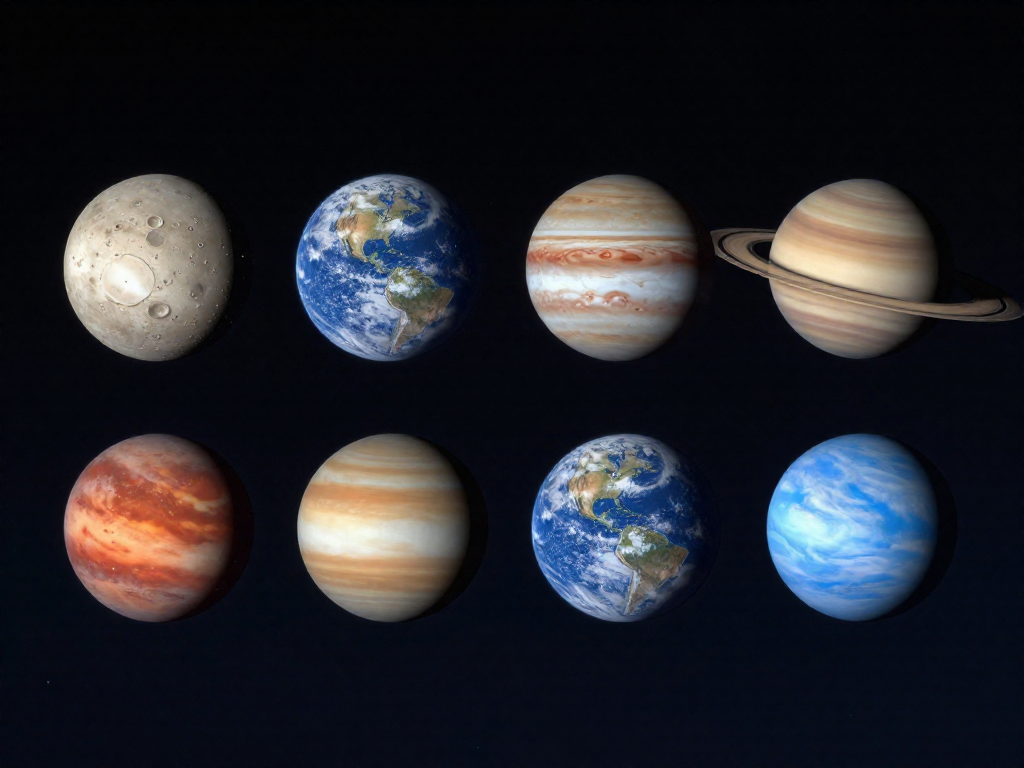
Quick Facts About Every Planet, at a Glance
Key stats for all 8 planets in one scannable place: size, distance from the Sun, day length, moons, and what makes each world weird.
Jun 29, 2026 · 6 min read
How Big Is the Solar System Really? A Sense of Scale
The distances between planets are mind-bending. Use simple shrink-it-down analogies to finally grasp how vast our solar system truly is.
Jun 29, 2026 · 7 min read