What Is Dark Matter? The Invisible Stuff Holding Galaxies Together
What is dark matter and why do scientists think it exists?
On this page
The Short Answer: What Dark Matter Actually Is
If you want the quick version: dark matter is invisible mass that we can't see, but can feel through its gravity.
It doesn't glow, doesn't block light, and doesn't bounce light back the way the Moon or a planet does. Shine a flashlight at it and nothing happens — it's completely transparent to every kind of light, from radio waves to visible colors to X-rays. That's why "dark" is a little misleading. It isn't black or shadowy. It's just plain invisible.
So how do we know it's there at all? The same way you'd know an invisible person was sitting on a trampoline — you'd see the dip their weight makes. Dark matter has mass, and mass bends space and tugs on things with gravity. By watching how stars and galaxies move, scientists can map where this unseen weight is pulling, even though they can't photograph it.
And there's a lot of it. Dark matter outweighs all the "normal" stuff in the universe — every star, planet, and cloud of gas — by roughly 5 to 1 (NASA).
Just as important is what dark matter is not:
- It is not black holes (those are collapsed normal matter).
- It is not dark energy (a separate mystery that pushes the universe apart).
- It is not antimatter (which we can detect easily when it meets normal matter).
Quick takeaway: Dark matter is unseen mass we detect only by its gravity — and it makes up most of the matter in the universe.
The First Clue: Galaxies Spinning Too Fast
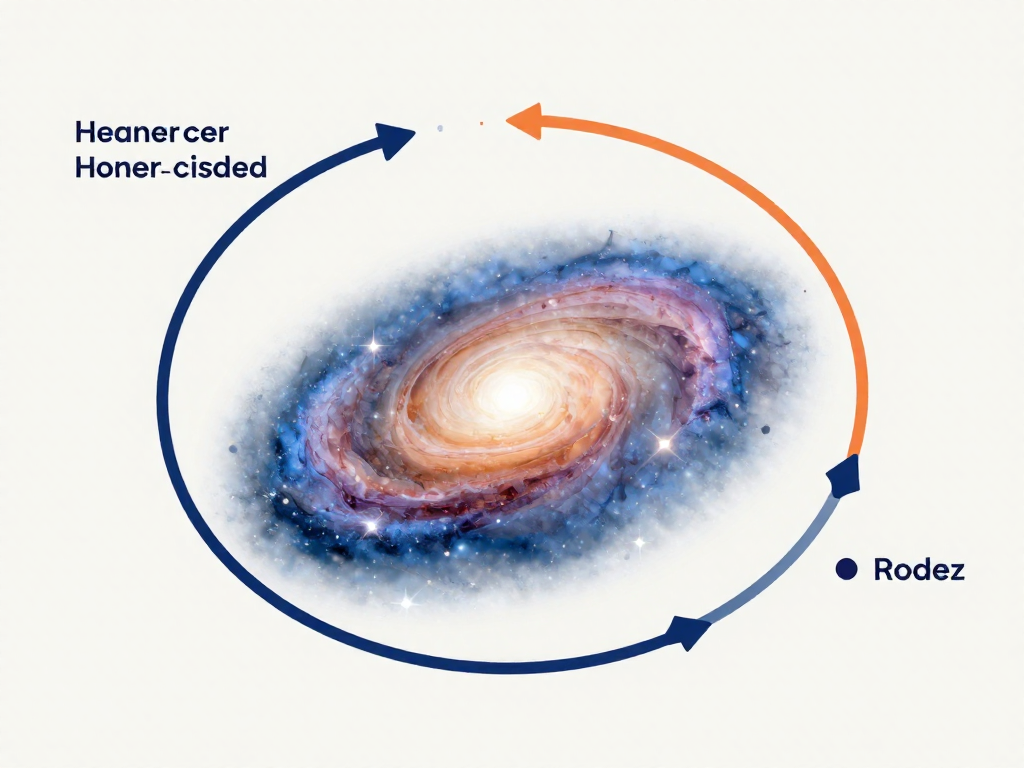
Imagine a merry-go-round. The kids clinging to the outer edge whip around fast, while those near the center barely move. Our solar system works the same way: Mercury, hugging the Sun, races around in just 88 days, while distant Neptune plods along, taking 165 years for a single lap. The farther out you go, the slower things move — because gravity weakens with distance.
So when astronomers looked at galaxies — giant pinwheels of hundreds of billions of stars — they expected the same pattern. Stars near the bright, crowded center should zip around quickly, and stars way out on the lonely edges should crawl.
They found the opposite.
In the 1960s and '70s, astronomer Vera Rubin carefully measured how fast stars orbit at different distances from the centers of galaxies. To her surprise, stars at the far edges were moving just as fast as stars closer in. The galaxies were spinning too fast at the outskirts to make sense.
Here's why that's a problem. A spinning galaxy is held together by gravity, which comes from mass — the "stuff" inside it. If the outer stars are racing around that quickly, the visible mass we can see (all those glowing stars and gas clouds) simply isn't enough to hold them in place. By all rights, those outer stars should be flung off into deep space, like a rider losing their grip on a merry-go-round spun too hard.
But they weren't flying away. Something was holding them. The only way the numbers add up is if there's a huge amount of extra, invisible mass we can't see — far more than all the visible stars combined.
Quick takeaway: Galaxies spin too fast for their visible mass to hold together. That hidden "something" providing the extra gravity is our first major clue for dark matter.
Source: NASA, "Dark Matter"; Rubin & Ford (1970), Astrophysical Journal.
More Evidence: Bending Light and Cosmic Glue
The spinning-galaxy clue was just the start. Several other independent observations all point to the same conclusion: there's far more mass out there than we can see.
1. Light gets bent. Gravity doesn't just pull on objects—it can bend the path of light itself, like a glass lens warping what's behind it. Astronomers call this gravitational lensing. When we see light from distant galaxies smeared into arcs or rings, we can measure how much mass did the bending. Again and again, there's far more mass than the visible stars and gas can account for (NASA).
2. Clusters move too fast. Galaxies often gather in huge groups called galaxy clusters. The galaxies inside them zip around so quickly that their combined visible gravity should fling them apart—yet they stay together. Something invisible is acting like cosmic glue, holding them in place.
3. The "smoking gun." In the Bullet Cluster, two galaxy clusters collided. The normal matter (hot gas) slowed down and bunched in the middle, but the gravity stayed out on the edges—exactly where invisible dark matter would have sailed straight through. Seeing the two separate is the closest thing scientists have to a direct fingerprint of dark matter (ESA).
4. The early universe needed it. The faint afterglow of the Big Bang, called the cosmic microwave background, shows a pattern that only makes sense if dark matter was present early on, giving ordinary matter something to clump around to form galaxies.
Quick takeaway: Four separate lines of evidence—bending light, fast-moving clusters, the Bullet Cluster, and the Big Bang's afterglow—all agree. Dark matter is well-supported science, not a wild guess.
So What Could Dark Matter Be Made Of?
Here's the honest truth: nobody knows yet. We can see dark matter's gravity tugging on galaxies, but we've never caught a single piece of it directly. That's not a failure—it's one of the most exciting open mysteries in science right now.
The leading idea is that dark matter is made of a brand-new kind of particle we haven't discovered. Two popular candidates have nicknames worth knowing:
- WIMPs (Weakly Interacting Massive Particles) — heavy particles that barely interact with normal stuff, slipping through ordinary matter like ghosts through walls.
- Axions — hypothetical particles so light and shy they'd be almost impossible to notice.
You might wonder: could dark matter just be ordinary stuff—dim planets, faint gas, burned-out stars—that we simply haven't spotted? Scientists have looked hard, and there isn't nearly enough of that ordinary "hidden" matter to explain the gravity we measure. The math points to something genuinely different (NASA).
So how do you hunt for something invisible? Researchers try three main approaches:
- Underground detectors — ultra-sensitive instruments buried deep in mines, waiting for a rare bump from a passing dark matter particle.
- Particle colliders — like CERN's Large Hadron Collider, smashing particles together hoping to create dark matter in the lab.
- Space telescopes — scanning the cosmos for subtle signs of dark matter interacting far away.
Quick takeaway: Dark matter is probably an undiscovered particle, not hidden ordinary matter—and the fact that we're still searching is what makes it so fascinating.
Dark Matter vs. Dark Energy: Not the Same Thing
It's easy to lump dark matter and dark energy together—they both have "dark" in the name, after all. But they do almost opposite jobs.
Think of the universe as a giant tug-of-war:
- Dark matter pulls. Its gravity acts like invisible glue, holding galaxies together and clumping cosmic structures into place.
- Dark energy pushes. It works in the other direction, stretching space itself and making the universe expand faster over time.
So why do they share a name? "Dark" here just means invisible and not yet understood—we can't see either one directly; we only notice their effects. The label stuck for both, even though they're unrelated.
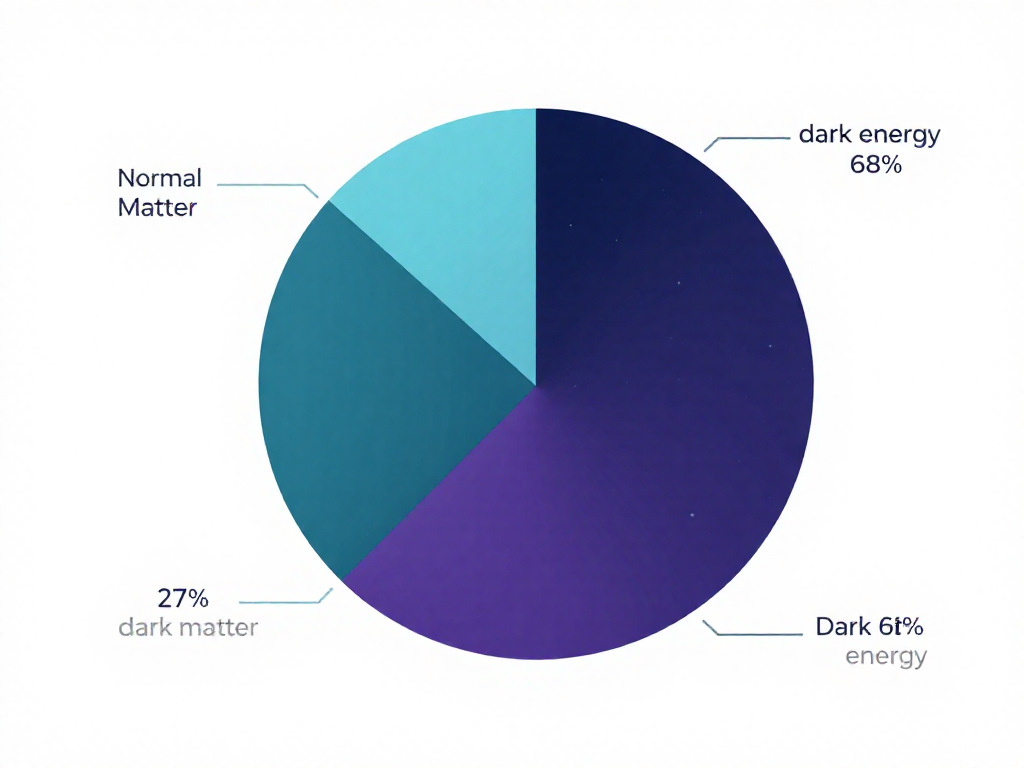
Here's how the whole universe breaks down, according to NASA:
- ~5% ordinary matter (everything you can see—stars, planets, you)
- ~27% dark matter (the invisible glue)
- ~68% dark energy (the mysterious push)
Quick takeaway: Dark matter pulls things together; dark energy drives them apart. Same nickname, completely different roles.
Source: NASA, "Dark Energy, Dark Matter."
Why Dark Matter Matters to You
Here's the part that gives most people goosebumps: without dark matter—the invisible material that adds extra gravity to the cosmos—galaxies might never have pulled themselves together in the first place. And no galaxies likely means no stars, no Sun, and no Earth for us to stand on while we wonder about all of this.
Sit with that for a moment. According to NASA, the ordinary stuff you can see and touch—stars, planets, you—makes up only about 5% of the universe. Most of everything is something we cannot yet see or fully explain.
That's not a failure of science. It's an open invitation.
Quick takeaway: Dark matter is a reminder that the universe still holds enormous mysteries, even close to home. If that sparks your curiosity rather than frustrates you, you're thinking exactly like an astronomer—so keep looking up and keep asking questions.
See also
- What Is Dark Energy? The Force Pulling the Universe Apart
- What Is a Black Hole? A Beginner's Guide
- How Galaxies Form and Why There Are So Many Kinds
- What Is Gravity, Really? Explained Simply
- The Big Bang Explained for Beginners
Related articles
Neutron Stars: The Densest Things in the Universe
What is a neutron star? Discover how a teaspoon can weigh a billion tons, how these cosmic objects form, and why they're the densest things we know of.
Jun 29, 2026 · 8 min read
Will the Universe Ever End? Possible Cosmic Futures
Will the universe ever end? Explore the Big Freeze, Big Rip, Big Crunch, and other possible cosmic fates explained simply for beginners—no equations needed.
Jun 29, 2026 · 9 min read

The Colors of Stars: What Red, Blue, and White Tell Us
Why are stars different colors? Discover how red, blue, and white reveal a star's temperature—explained in plain, jargon-free language for beginners.
Jun 29, 2026 · 6 min read