The Big Bang in Plain English: How the Universe Began
What was the Big Bang?
On this page

Open by dismantling the biggest misconception—that the Big Bang was an explosion in empty space—then promise a no-math, no-jargon walkthrough of how everything we see came to be. Hook the reader with the sheer strangeness that everything, including space itself, started unimaginably small and hot.
What the Big Bang Actually Was (and Wasn't)
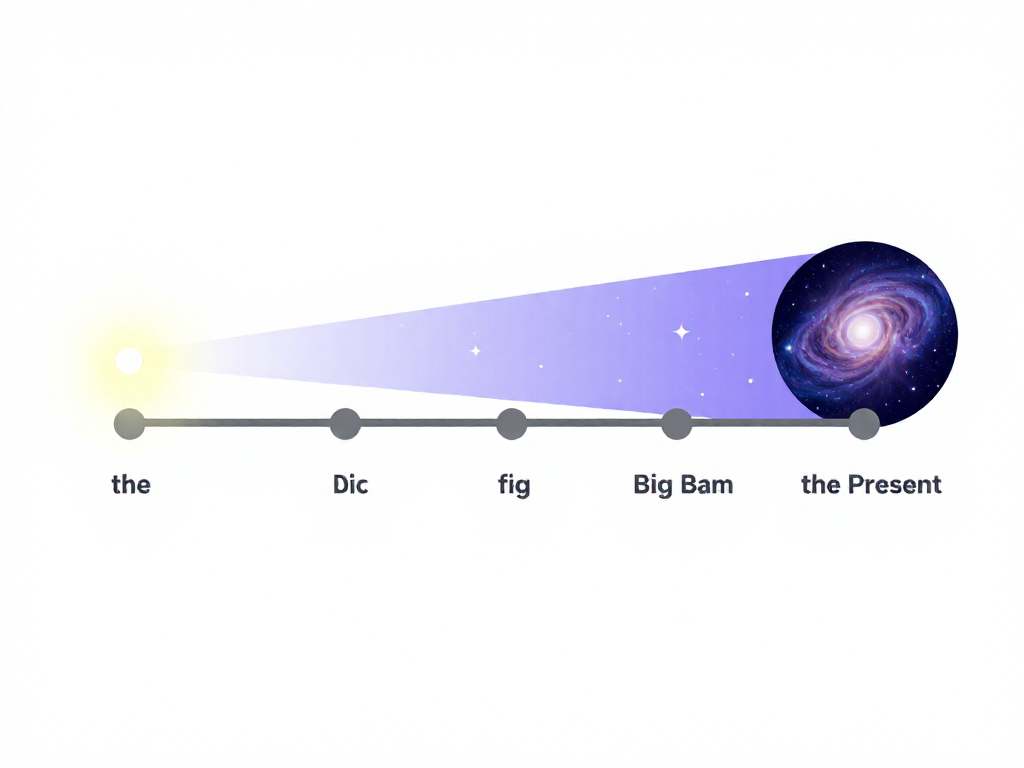
Here's the first thing to unlearn: the Big Bang was not an explosion that went off somewhere in empty space, hurling debris outward. That mental picture is the single most common misunderstanding — and it quietly breaks everything that comes after it.
So what was it? The Big Bang was the rapid expansion of space itself. Not stuff flying through space, but space stretching and growing everywhere, all at once. Around 13.8 billion years ago (a figure refined by NASA's WMAP and ESA's Planck missions), everything we can now see — every galaxy, star, and atom — was packed into a state so unimaginably hot and dense that the ordinary rules of "here" and "there" didn't yet apply. As that space expanded, it cooled, and matter gradually formed.
This leads to a strange but important point: there was no center to the Big Bang, and no outside for it to expand into. An ordinary explosion has a spot where it began and empty room around it to spread into. The Big Bang had neither. Space wasn't sitting inside a bigger emptiness — space was the thing doing the expanding.
The balloon analogy
Picture a balloon with dots drawn all over its surface. As you blow it up, every dot moves away from every other dot. No single dot is the "center" of that spreading — they're all getting farther apart at once. Now imagine the balloon's surface is the entire universe. That's the idea: galaxies aren't racing away from a central point; the space between them is simply growing.
Quick takeaway: The Big Bang wasn't an explosion in space — it was the beginning of space (and time) expanding from a hot, dense state. No bang, no center, no edge.
Hold on to that picture. With this foundation, the details that follow will click into place instead of fighting your intuition.
A Timeline of the First Few Minutes
If the entire history of the universe were a movie, the opening scene would be over almost before it began. Yet those first few minutes set the stage for every star, planet, and person that would ever exist. Let's walk through it, step by step.
1. The first sliver of a second: inflation. In a span of time far too short to imagine—a tiny fraction of the first second—the universe ballooned in size faster than anything we see today. Scientists call this inflation, which simply means a sudden, runaway stretching of space itself. Picture a raisin in a loaf of bread expanding as it bakes, except the "loaf" grew from smaller than an atom to enormous in an instant. This rapid stretch smoothed everything out and explains why the universe looks so even in every direction.
2. Cooling lets the first particles form. At the very start, the universe was unimaginably hot and dense—too hot for anything solid or stable to hold together. As space expanded, it cooled, the way steam cools and settles into water droplets. As temperatures dropped, energy began turning into the first true building blocks of matter: tiny particles like protons and neutrons (the bits that later sit at the center of every atom).
3. The first few minutes: the earliest nuclei appear. Once things cooled enough, those protons and neutrons could stick together to form the cores—called nuclei—of the two lightest elements: hydrogen and helium. This stage is known as Big Bang nucleosynthesis, a fancy term for "making the first atomic centers." Remarkably, the recipe predicted by physicists—roughly three-quarters hydrogen and one-quarter helium—matches what telescopes actually measure across the cosmos (NASA, ESA).
4. Why these moments matter. Everything came later was built from this starting kit. Hydrogen and helium would go on to form the first stars, and stars would forge heavier elements like carbon and oxygen inside them.
Quick takeaway: In under five minutes, the universe expanded, cooled, and produced the hydrogen and helium that everything else is made from.
From Hot Fog to the First Stars and Galaxies
Right after the Big Bang, the universe wasn't a sky full of stars — it was a blazing, glowing fog. Picture being inside a cloud lit up from within: light couldn't travel in a straight line because it kept bouncing off the dense soup of particles packed everywhere. This thick haze lasted a surprisingly long time — about 380,000 years.
Then came one of the most important moments in cosmic history. As the universe expanded, it cooled enough for those loose particles to settle down and form the first complete atoms (the basic building blocks of everything). Suddenly the fog cleared, and light could finally stream freely across space for the first time.
That ancient, released light is still around today. We call it the cosmic microwave background — basically the faint afterglow of the early universe, stretched and cooled over billions of years into a whisper of radiation we can detect from every direction. NASA describes it as the "oldest light in the universe," and it's some of our strongest evidence that the Big Bang really happened.
After this, the universe entered a quiet stretch sometimes called the "cosmic dark ages." There was gas, but no stars yet. Slowly, gravity — the same pull that keeps your feet on the ground — began tugging clouds of hydrogen gas together. Where the gas grew dense and hot enough, it ignited into the very first stars.
Over hundreds of millions of years, these stars were drawn together into vast collections called galaxies — enormous islands of stars, gas, and dust like our own Milky Way.
Quick takeaway: A glowing fog cleared after 380,000 years, releasing the light we still see today. Then gravity slowly built the first stars, which gathered into the first galaxies.
How Do We Actually Know This Happened?
It's a fair question. Nobody was around 13.8 billion years ago with a camera, so how can scientists speak so confidently about the universe's first moments? The honest answer is that we don't take it on faith — we look for clues the Big Bang would have left behind, like a detective reading a crime scene. Three big pieces of evidence keep pointing to the same story.
1. The afterglow that fills the whole sky. When you switch off a hot oven, it stays warm for a while. The Big Bang was unimaginably hot, and its leftover warmth is still drifting through space today. We call it the cosmic microwave background — basically a faint glow of heat coming from every direction at once. It was discovered by accident in 1965, and missions like NASA's WMAP and ESA's Planck have since mapped it in stunning detail. It's exactly the kind of "ashes" a hot, early universe should leave.
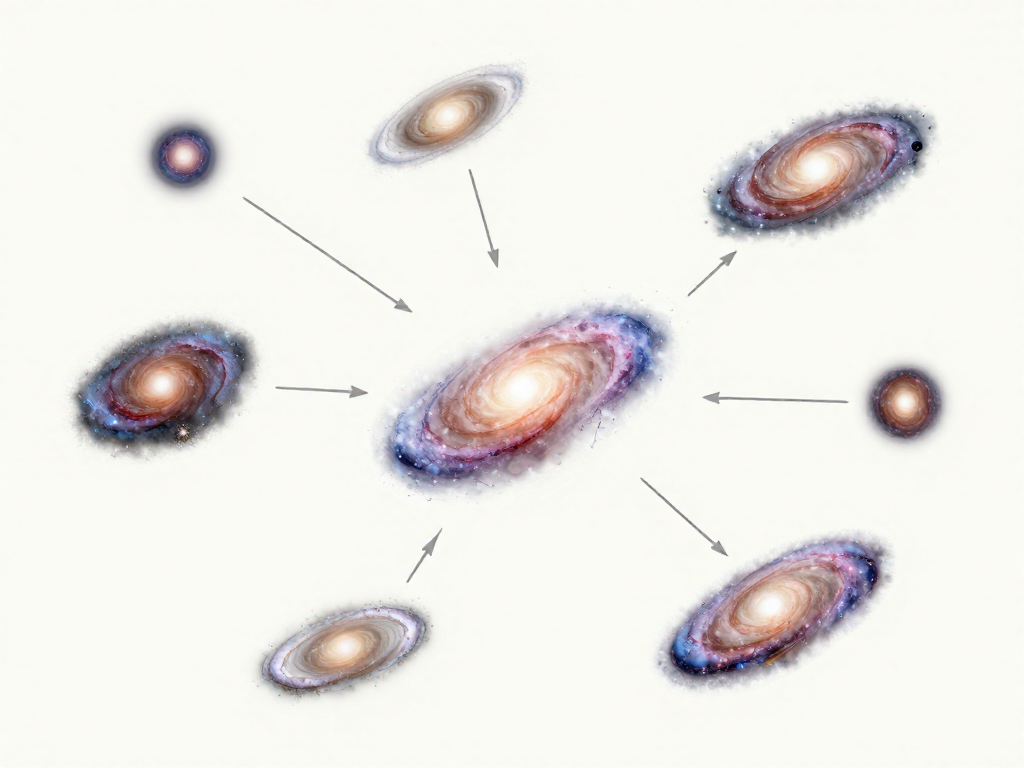
2. Galaxies are racing apart. Astronomers noticed that almost every distant galaxy is moving away from us, and the farther one is, the faster it flees. Now imagine filming that and playing the tape backward: everything rushes together toward a single point. That rewind is the heart of the Big Bang idea — the universe used to be packed tightly and has been expanding ever since.
3. The recipe matches. Scientists predicted how much hydrogen and helium — the two simplest, lightest ingredients in the cosmos — a fiery young universe should have cooked up. When we actually measure what's out there, the amounts line up remarkably well.
Quick takeaway: No single clue proves the Big Bang, but the afterglow, the fleeing galaxies, and the matching chemical recipe all tell the same story. That's why scientists treat it as the best-supported explanation we have — not a guess, but the theory the evidence keeps confirming.
The Questions Even Scientists Can't Answer Yet
Here's something refreshing: even the brightest minds studying the universe will happily tell you how much they don't know. The Big Bang explains an enormous amount, but it leaves some of the biggest questions wide open.
What came "before"? This one is trickier than it sounds. Our usual idea of time itself appears to begin with the Big Bang, so asking what came before may be a bit like asking what's north of the North Pole — the question might not even make sense. Scientists are honest that this is still a genuine mystery.
What caused it? We can describe the universe expanding from an incredibly hot, dense start, but why it happened at all is not settled science. There are interesting ideas (hypotheses, not proven facts), and researchers are careful to label them as educated guesses rather than answers.
Dark matter and dark energy. Roughly 95% of the universe is made of stuff we can't directly see (NASA). "Dark matter" is invisible material we detect only by its gravitational pull, and "dark energy" is the mysterious push speeding up the universe's expansion. We named them, but we still don't fully understand them.
Why this is exciting, not embarrassing. "We don't know yet" isn't a failure — it's an invitation. Every unanswered question is a frontier, and the people exploring it might one day be you.
Quick takeaway: Science isn't about having every answer. The mysteries are part of the wonder.
The Big Picture: Why the Big Bang Matters to You
Here's the part that gives most people chills: you are made of the universe. The hydrogen in every drop of water you drink formed in the first few minutes after the Big Bang. The calcium in your bones and the iron in your blood were forged later, inside stars that lived and died long before the Sun existed. When those stars exploded, they scattered those ingredients across space—and some of them became you. As the astronomer Carl Sagan put it, we are "star stuff."
And the story isn't over. Right now, in this very moment, the universe is still expanding, with galaxies drifting ever farther apart (NASA). You're not watching cosmic history from the outside—you're living inside it.
That reframes things. You're not a tiny bystander in a vast, indifferent cosmos. You're a way for the universe to look back at itself and wonder.
Quick takeaway: The Big Bang isn't just ancient history—it's your origin story.
Where to go next
- Explore NASA and ESA's free image galleries of distant galaxies.
- Read our companion articles on stars and galaxies.
- Step outside tonight and look up. That's the real beginning.
See also
- What Is the Cosmic Microwave Background?
- How Are Stars Born? A Beginner's Guide
- What Is a Galaxy? Types and Examples Explained Simply
- Dark Matter and Dark Energy Explained in Plain English
- How Big Is the Universe? Putting Scale Into Perspective
Related articles
Neutron Stars: The Densest Things in the Universe
What is a neutron star? Discover how a teaspoon can weigh a billion tons, how these cosmic objects form, and why they're the densest things we know of.
Jun 29, 2026 · 8 min read
Will the Universe Ever End? Possible Cosmic Futures
Will the universe ever end? Explore the Big Freeze, Big Rip, Big Crunch, and other possible cosmic fates explained simply for beginners—no equations needed.
Jun 29, 2026 · 9 min read
The Colors of Stars: What Red, Blue, and White Tell Us
Why are stars different colors? Discover how red, blue, and white reveal a star's temperature—explained in plain, jargon-free language for beginners.
Jun 29, 2026 · 6 min read