What Happens If You Fall Into a Black Hole?
What would happen to you near a black hole?
On this page
First, What Even Is a Black Hole?
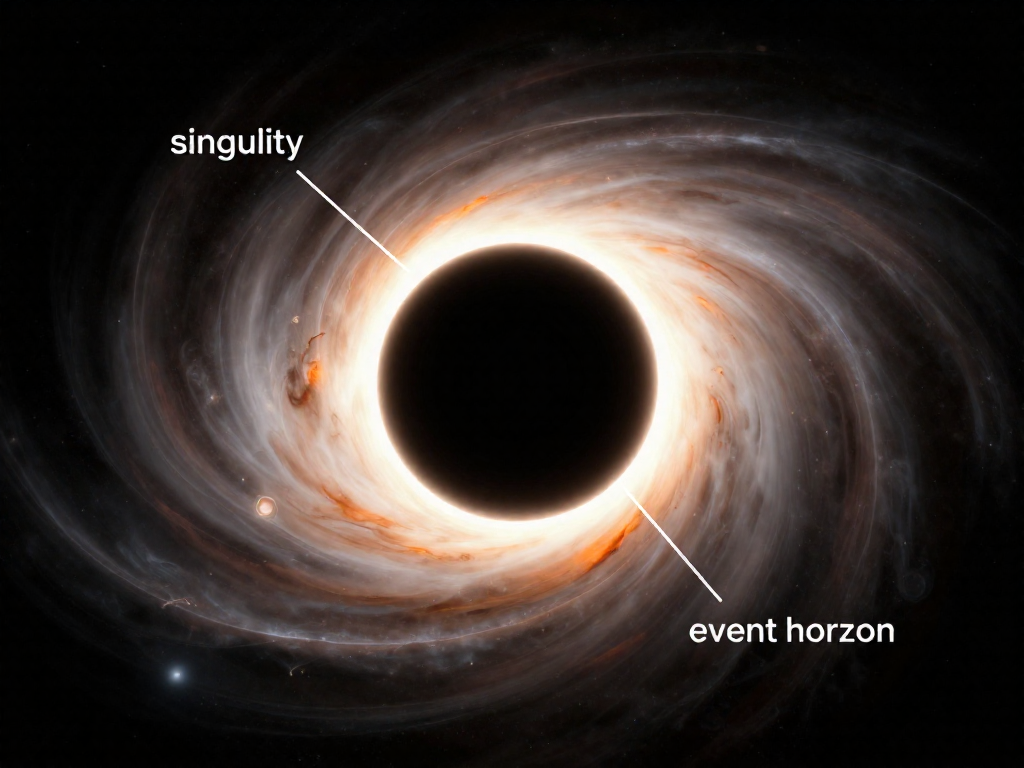
Before we toss you into one, let's get the basics straight. A black hole is a region of space where gravity is so overwhelmingly strong that nothing can escape it—not a rocket, not a beam of light, not anything. Once something crosses the line, it's gone for good.
So where do these cosmic traps come from? Most form when a massive star runs out of fuel at the end of its life. Without the outward push of nuclear burning to hold it up, the star's core collapses under its own weight, crushing an enormous amount of matter into an astonishingly tiny space (NASA).
Two terms are worth knowing, and they're simpler than they sound:
- The singularity — the very center, where all that crushed matter is thought to be packed together. Think of it as the heart of the black hole.
- The event horizon — the edge, often called the "point of no return." Imagine a waterfall: drift past a certain point in the river and the current is too strong to paddle back. Cross the event horizon, and the same is true—there's no coming back.
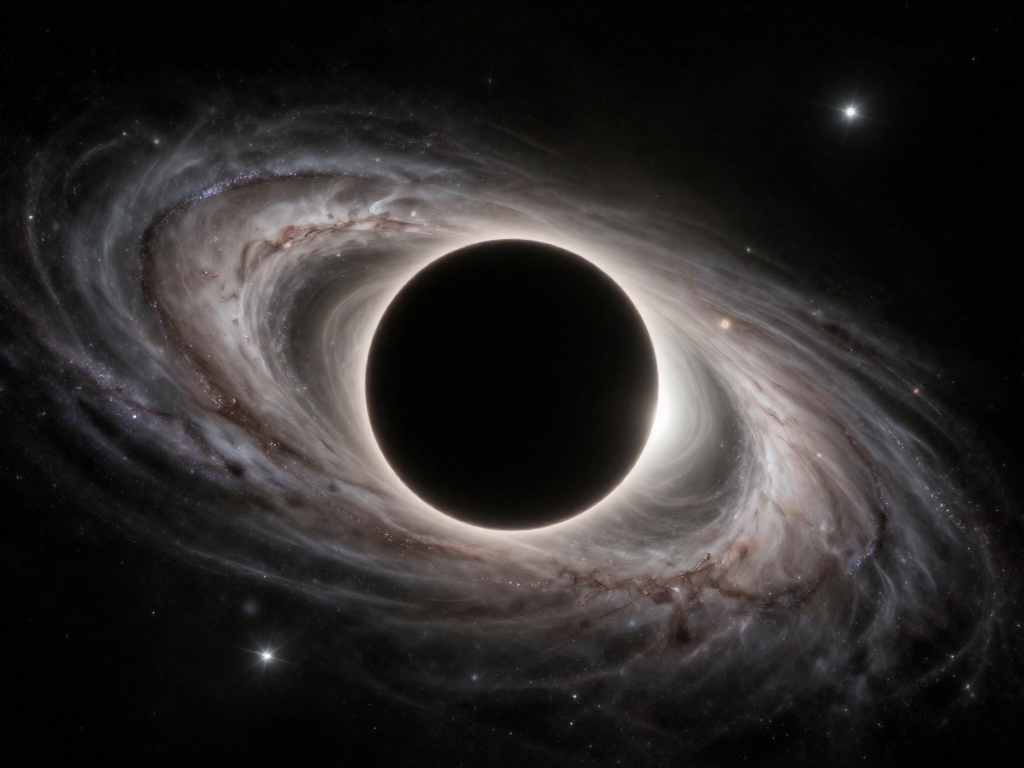
And why "black"? Because no light escapes from beyond that edge, there's nothing for our eyes or telescopes to catch. Instead of seeing the object itself, we see a void—a patch of darkness against the glowing universe behind it.
Quick takeaway: A black hole is a collapsed star whose gravity is a one-way door. The singularity is the center; the event horizon is the edge you can't return from.
Setting the Scene: Your Fall Begins
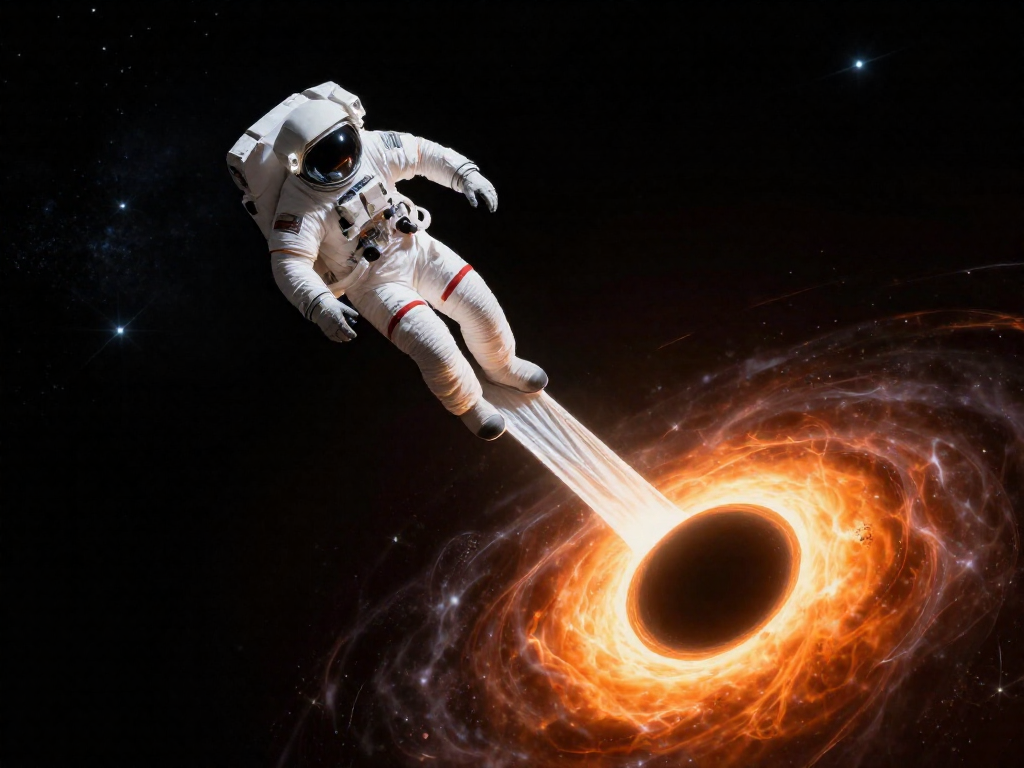
Before we take the plunge, let's set up the experiment. Picture yourself as an astronaut, floating in deep space and drifting feet-first toward a black hole. Don't worry — this is a thought experiment, the kind scientists do in their heads to explore "what if?" questions. You're perfectly safe in your armchair.
A few things to keep in mind before you fall:
-
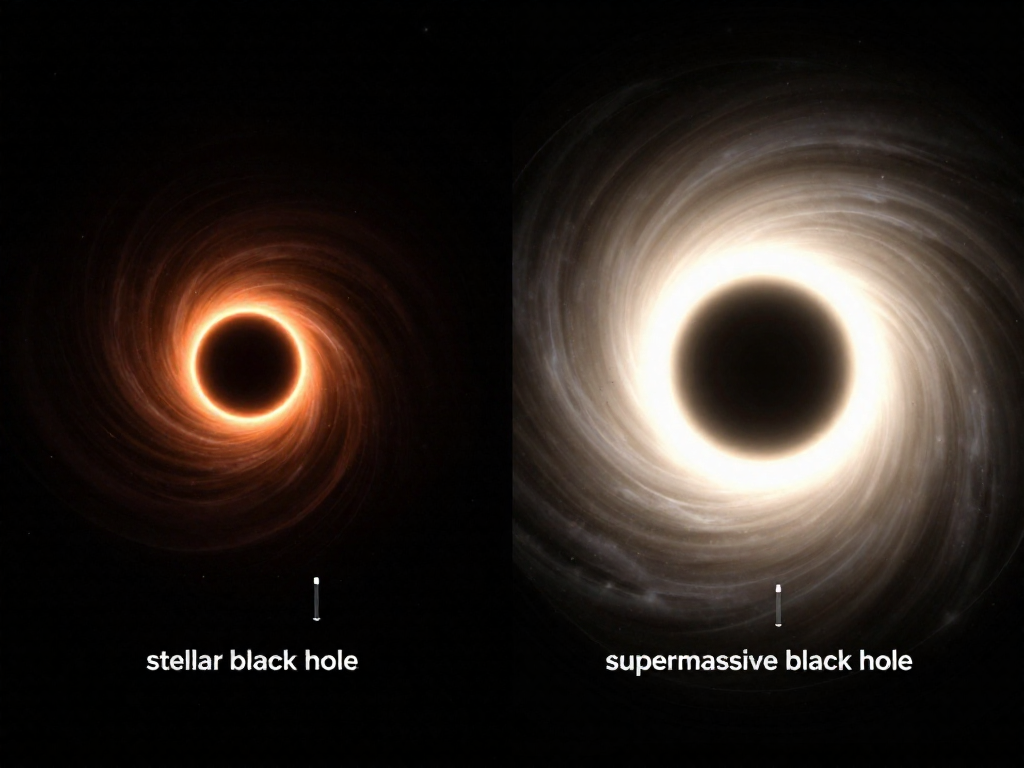
Size changes everything. Not all black holes are the same. A stellar black hole (one formed when a single big star collapses) is only a few miles across but packs the mass of several Suns. A supermassive black hole (the giant kind that sits at the center of galaxies, including our own Milky Way) can be millions or billions of times heavier. As you'll see, falling into a small one feels very different from falling into a giant.
-
Two points of view. Throughout this fall, we'll follow two perspectives: you, the one actually dropping in, and a friend watching safely from a spaceship far away. Strangely, the two of you will not agree on what happens — and that disagreement is where black holes get truly mind-bending.
Quick takeaway: You're an astronaut falling feet-first. The black hole's size matters, and we'll track both your experience and your distant friend's.
Spaghettification: The Stretchiest Way to Go
So you've crossed into the danger zone. Here's where things get personal — and stretchy.
The culprit is something called a tidal force. That just means gravity pulls harder on whatever is closer to the black hole. Imagine falling in feet-first: your feet are nearer the center than your head, so they feel a stronger tug. On Earth this difference is so tiny you'll never notice it. Near a black hole, it becomes the most important fact about your day.
Why you stretch
- Your feet get yanked harder than your head. The closer part of you is pulled down faster than the farther part.
- The gap grows. As you fall, the difference between "feet gravity" and "head gravity" keeps increasing.
- You stretch lengthwise — and squeeze sideways. While you're pulled long and thin, gravity also pinches you inward from the sides, like toothpaste forced through a tube.
The result is that you're drawn out into a long, thin strand. Scientists gave this a wonderfully silly name: spaghettification. Yes, that's the real term astronomers use, and yes, it means exactly what it sounds like — you become human spaghetti.
Size matters (a lot)
Here's the surprising twist: not all black holes do this at the same moment.
- Small black holes have such steep, concentrated gravity that the tidal forces tear you apart before you ever reach the edge. You'd be spaghetti long before the point of no return.
- Supermassive black holes — the giants at the centers of galaxies, millions or billions of times the Sun's mass — are gentler at the edge. Their gravity changes so gradually that you could cross the boundary intact, still in one piece, at least for a little while.
So what does the moment actually feel like? There'd be no warning blast — just a growing, relentless pull, head one way and feet the other, until the stretch wins. A quiet, cosmic snap, and then a thread of you spiraling inward.
Quick takeaway: Black holes don't crush you — they stretch you. Small ones do it early; giant ones let you slip inside first.
(Sources: NASA, ESA)
Crossing the Event Horizon: The Point of No Return
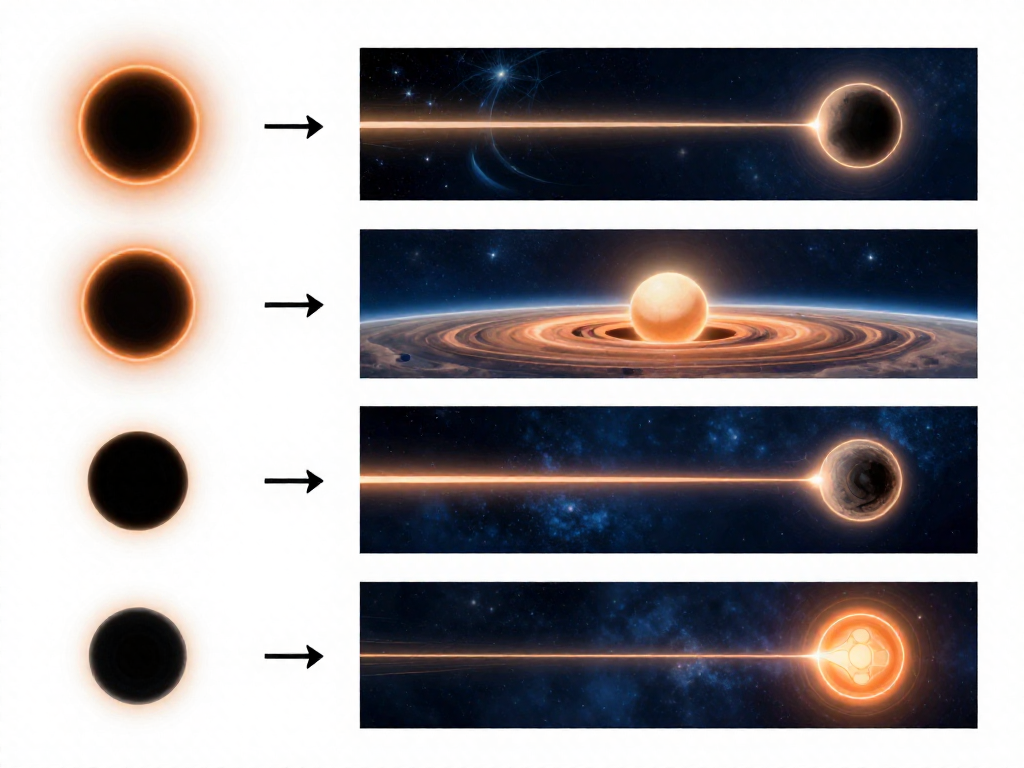
So far you've survived the approach. Now you reach the strangest milestone of all: the event horizon. Think of it as a cosmic one-way door — the invisible boundary around a black hole where gravity becomes so strong that nothing, not even light, can escape. Cross it, and there is no coming back.
Here's the part that surprises almost everyone: you might not feel anything at all when you cross it. The event horizon isn't a wall or a surface you'd bump into. There's no flash, no fence, no sign reading "Point of No Return." For a supermassive black hole — the giant kind, millions of times the mass of our Sun, that sits at the center of galaxies — the boundary is so vast and gentle that you could drift across it without noticing the exact moment it happened. To you, space would look eerily normal.
But normal is deceiving. Once you're inside, the rules change completely. Every possible direction you could move — left, right, forward, back — now leads deeper toward the center. Escaping the black hole becomes as impossible as traveling into your own past. It's not that the exit is hard to find; it's that the exit no longer exists. The black hole's gravity has bent space itself so that "outward" simply isn't an option anymore.
This is the true meaning of point of no return: a one-way journey baked into the fabric of space.
Quick takeaway: The event horizon is the invisible boundary where escape becomes impossible. For a big black hole, you could cross it without feeling a thing — but once inside, every path leads inward.
This one-way nature is well-established physics, confirmed by NASA and ESA observations of how matter and light behave around black holes.
Time, Light, and What You'd Actually See
Here's where black holes stop being scary and start being downright strange. Near one of these cosmic giants, time itself behaves in ways that feel impossible — yet they're well-established science, confirmed by experiments and Einstein's theory of general relativity (his big idea about how gravity bends space and time).
To your friend, you'd freeze in place. Imagine a friend watching safely from a distance as you fall. The closer you get to the event horizon — the "point of no return" — the more your time appears to slow down from their view. This is called time dilation: strong gravity literally stretches time. To them, your fall would seem to slow, and slow, until you appear to hang frozen forever right at the edge, like a paused video.
You'd redden and fade, not vanish. As your time slows, the light bouncing off you takes longer and longer to escape the black hole's pull. That stretched-out light shifts from visible colors toward red and then infrared — a process called redshift — until it's too faint and stretched for any eye to catch. So instead of dramatically disappearing, you'd gradually dim to a reddish smudge and quietly fade from sight.
The universe behind you would warp. A black hole's gravity bends light like a giant funhouse lens. Stars and galaxies behind it would appear smeared, duplicated, and curved into bright rings — an effect astronomers call gravitational lensing, which NASA telescopes observe around real black holes.
But to you? Everything feels normal. Here's the twist: your own watch keeps ticking at its usual pace. You wouldn't feel frozen or slowed at all. Time only looks strange to outside observers — your experience stays perfectly ordinary, right up until the black hole's other dangers take over.
Quick takeaway: From outside, you'd appear to freeze, redden, and fade — never quite vanishing. To you, time would feel completely normal, while the universe behind you bent into glowing rings of light.
What's at the Center, and Could You Ever Survive?
So you've crossed the event horizon — the invisible boundary where nothing, not even light, can escape. What waits at the heart of a black hole?
The honest answer: we don't fully know. At the very center sits something called a singularity — a point where all the black hole's mass is crushed into an unimaginably tiny space. Here our best theories of gravity simply stop making sense, spitting out impossible answers like "infinity." It's the edge of the map, where physics throws up its hands and says, we need better tools to go further. And that's okay — admitting what we don't know is how science moves forward.
Now, the question everyone really asks: could you survive? No. Long before reaching the center, the difference in gravity between your head and your feet would stretch you like taffy (a fun fact astronomers actually nicknamed "spaghettification"). But why it's impossible is the fascinating part — it reveals just how extreme gravity can become.
You may have heard black holes could be wormholes — shortcuts to other places or times. It's a thrilling idea, but it remains pure speculation, with no evidence behind it. Real scientists keep it firmly in the "what if" pile.
Quick takeaway: No one survives a black hole, the center hides where our physics breaks down, and the unanswered questions are exactly what make the cosmos so endlessly worth wondering about.
See also
- How Do Black Holes Form?
- What Is Spacetime, Explained Simply
- The Life and Death of a Star
- What Are Supermassive Black Holes?
- Beginner's Guide to Einstein's Relativity
Related articles
Neutron Stars: The Densest Things in the Universe
What is a neutron star? Discover how a teaspoon can weigh a billion tons, how these cosmic objects form, and why they're the densest things we know of.
Jun 29, 2026 · 8 min read
Will the Universe Ever End? Possible Cosmic Futures
Will the universe ever end? Explore the Big Freeze, Big Rip, Big Crunch, and other possible cosmic fates explained simply for beginners—no equations needed.
Jun 29, 2026 · 9 min read
The Colors of Stars: What Red, Blue, and White Tell Us
Why are stars different colors? Discover how red, blue, and white reveal a star's temperature—explained in plain, jargon-free language for beginners.
Jun 29, 2026 · 6 min read