What Is a Galaxy? Our Cosmic Neighborhood Explained
What exactly is a galaxy?
On this page
What Is a Galaxy, Really?
Picture a city at night, seen from a plane: countless lights clustered together, glowing against the dark. A galaxy is something like that, but on a scale almost impossible to imagine. In the simplest terms, a galaxy is a giant collection of stars, gas, dust, and a mysterious ingredient called dark matter (invisible material we can't see directly, but whose gravity holds everything in place) — all bound together by gravity.
That word gravity is the key. Gravity is the same force that keeps your feet on the ground and the Moon circling Earth. In a galaxy, it acts like an invisible glue, pulling billions of stars into one swirling, organized group instead of letting them drift apart into empty space.
How big are we talking? Galaxies are staggeringly huge. The smallest hold a few million stars, while the largest contain trillions — that's thousands of billions. Our own galaxy, the Milky Way, holds somewhere between 100 and 400 billion stars, according to NASA. Our Sun is just one of them.
Think of a galaxy as a city of stars. Just as a city groups millions of people, buildings, and streets into one place held together by roads and routines, a galaxy gathers its stars and clouds of gas into one cosmic neighborhood held together by gravity.
It helps to know where a galaxy sits in the bigger picture:
- A solar system is a single star (like our Sun) with its planets — a single household.
- A galaxy is billions of those star systems together — the whole city.
- The universe is everything that exists — every galaxy, with hundreds of billions of them — the entire planet and beyond.
Quick takeaway: A galaxy is a vast, gravity-bound family of stars, gas, and dust — far larger than a solar system, but just one tiny piece of the entire universe.
What Galaxies Are Made Of
If you could zoom in on a galaxy and sort its contents into bins, you'd find a handful of main ingredients working together. Here's what they are.
1. Stars and star clusters. Stars are the glowing part we actually see. A single galaxy can hold billions of them, and many travel in groups called star clusters — think of them as cosmic neighborhoods where stars formed together and stayed close.
2. Gas and dust clouds (nebulae). Scattered between the stars are giant clouds of gas and dust known as nebulae. These are stellar nurseries: over long stretches of time, gravity pulls the material together until it's dense enough to ignite a brand-new star. Every star, including our Sun, began life inside a cloud like this.
3. Dark matter. Here's the strange part. Galaxies spin so fast that the stuff we can see shouldn't be enough to hold them together — they'd fly apart. Astronomers think an invisible substance called dark matter provides the extra gravity, acting like unseen glue. We can't see it directly, but we can measure its pull. NASA estimates it makes up most of a galaxy's total mass.
4. A supermassive black hole. At the heart of most large galaxies sits a supermassive black hole — a region where gravity is so strong that not even light escapes. Our own Milky Way has one, called Sagittarius A*, confirmed by the 2020 Nobel Prize–winning work behind it.
Quick takeaway: Galaxies are stars and clusters, star-forming gas clouds, invisible dark matter holding it all together, and a giant black hole anchoring the center.
The Main Types of Galaxies
Galaxies may look like random smudges of light in photos, but most fall into a few recognizable families. Once you know what to look for, you'll start spotting the differences yourself.
1. Spiral galaxies. These are the showstoppers—flat, rotating disks with bright arms that curl outward like a cosmic pinwheel. Our own galaxy, the Milky Way, is a spiral, and so is our giant neighbor Andromeda. The arms are where new stars are busily forming, which is why they glow brighter than the rest of the disk. If a galaxy looks like a whirlpool frozen in space, it's almost certainly a spiral.
2. Elliptical galaxies. Picture a smooth, fuzzy ball of light with no arms and no clear edges—that's an elliptical. They range from nearly perfect spheres to stretched-out, egg-like shapes. Ellipticals tend to be older, made mostly of aging stars with little of the gas needed to form new ones. The largest galaxies in the universe are giant ellipticals.
3. Irregular galaxies. As the name suggests, these have no tidy shape at all. They look lopsided or chaotic, often because a close encounter with another galaxy has pulled them out of form. They're frequently smaller and packed with gas, making them lively places for new stars to be born.
Galaxies aren't frozen in their categories. Over billions of years, they slowly drift, merge, and collide. According to NASA, the Milky Way and Andromeda are on a collision course and will eventually merge into a single larger galaxy. Such collisions can transform a graceful spiral into a smooth elliptical.
Quick takeaway: Spiral (pinwheel arms), elliptical (smooth blob), and irregular (no set shape)—and collisions can reshape one type into another over cosmic time.
Meet the Milky Way: Our Home Galaxy
So where do we fit into all of this? We live inside a galaxy called the Milky Way—and getting to know it is the best way to picture what a galaxy really is.
The Milky Way is a barred spiral galaxy. "Spiral" means it has graceful, pinwheel-like arms made of stars and gas curling outward from the center. "Barred" means that center isn't a simple ball but a stretched, bar-shaped crowd of stars running through the middle, with the arms trailing off from each end. Picture a slowly spinning pinwheel with a straight handle across its core, and you've got the basic shape.
Now for the scale. Our Sun—the star that gives us daylight—is just one star in the Milky Way. How many others share our galaxy? Somewhere between 100 and 400 billion, according to NASA. That range is wide because most of these stars are too faint and too distant to count directly, so astronomers estimate the total based on the galaxy's mass. Either way, the takeaway is the same: the Sun is one ordinary star among hundreds of billions.
Our solar system doesn't sit at the center of all this. We live out in the suburbs, in a minor spiral feature called the Orion Arm (sometimes called the Orion Spur). We're roughly 26,000 light-years from the galaxy's core—about halfway out from the center to the edge. A comfortable, unremarkable neighborhood, cosmically speaking.
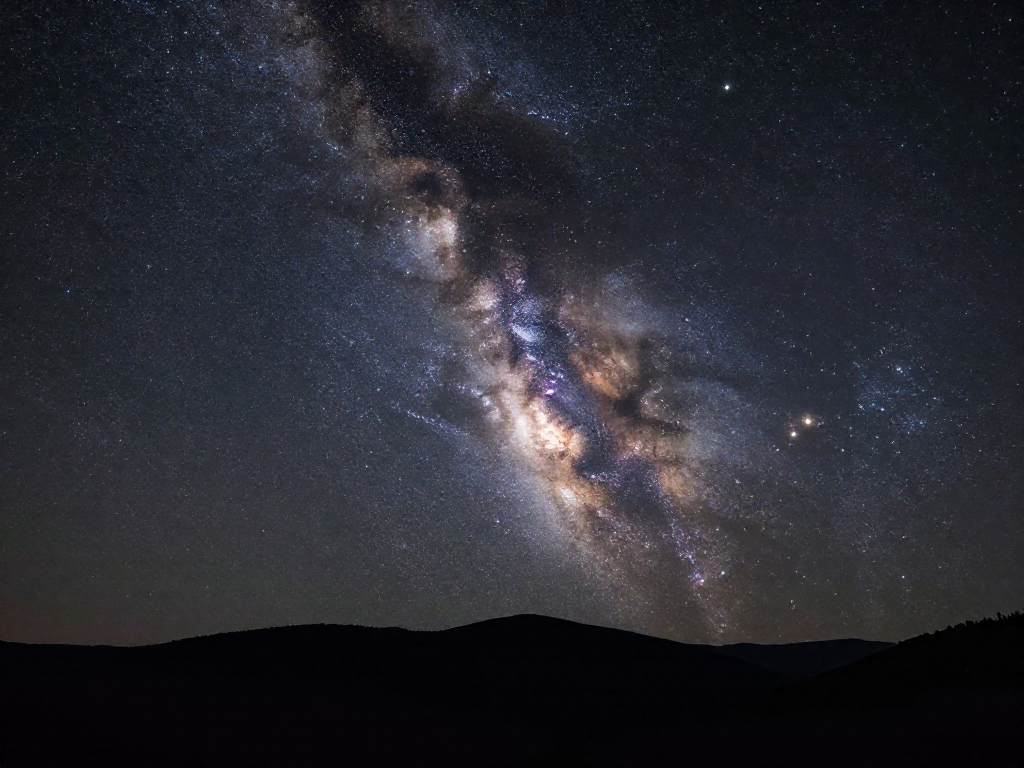
Here's the part you can see for yourself. On a truly dark night, far from city lights, you may notice a faint, milky band of light stretching across the sky. That glowing stripe is the Milky Way—you're looking edgewise through the flat disk of our own galaxy, seeing the combined light of countless distant stars blurred into a soft glow.
Quick takeaway: We live in the Milky Way, a barred spiral galaxy of 100–400 billion stars. Our Sun sits about two-thirds of the way out in the Orion Arm, and that misty band in the night sky is our galaxy seen from the inside.
Our Cosmic Neighborhood Beyond the Milky Way
Our galaxy doesn't float alone. The Milky Way belongs to a small gathering of about 80 galaxies called the Local Group — think of it as our cosmic neighborhood, a cluster of homes sharing the same patch of space. The biggest house on the block besides us is Andromeda, a spiral galaxy so vast you can spot it with the naked eye on a dark night, even though its light takes about 2.5 million years to reach you (NASA).
Zoom out further and neighborhoods join into cities. Galaxies gather into galaxy clusters (hundreds or thousands bound together by gravity), and clusters group into superclusters — the largest known structures in the universe. Our Local Group sits on the edge of the Virgo Supercluster, itself part of an even grander structure astronomers call Laniakea.
How many galaxies are out there in total? Estimates from Hubble and other surveys suggest there are at least hundreds of billions in the observable universe, possibly up to two trillion (NASA/ESA). Each one holds millions to billions of stars.
Here's the wild part: Andromeda and the Milky Way are slowly drifting toward each other and are expected to merge in roughly 4.5 billion years (NASA). This is well-established science, not speculation.
Quick takeaway: Galaxies cluster into ever-larger groups, the universe holds hundreds of billions of them, and our own is on a slow-motion collision course with Andromeda.
How We Know All This
It's fair to wonder: if galaxies are unimaginably far away, how can anyone study them? The answer comes down to light and the powerful instruments built to catch it.
Telescopes are our main tool. The Hubble Space Telescope, run by NASA and ESA, has spent decades photographing galaxies in stunning detail. Its successor, the James Webb Space Telescope, sees in infrared light—a kind of light just beyond what our eyes can detect—letting it peer through cosmic dust and spot some of the earliest galaxies ever formed.
Here's the mind-bending part: light travels fast, but space is so vast that it still takes millions or billions of years to reach us. So when we look at a distant galaxy, we're seeing it as it was long ago, not as it is today. In a real sense, telescopes are time machines.
That's why studying galaxies tells us the story of the universe itself—how it grew from young, scattered clumps of stars into the grand structures we see now.
Quick takeaway: Telescopes catch ancient light, so looking deep into space means looking back in time.
FAQ
How many galaxies are there in the universe?
Astronomers estimate there are roughly 100 billion to 200 billion galaxies in the observable universe (the part we can actually see), though some studies suggest the true number could be even higher. To picture that scale: if every galaxy were a single grain of sand, you'd have enough to fill many beaches. Each of those galaxies is itself home to millions or even billions of stars. The exact count keeps shifting as telescopes like NASA's James Webb Space Telescope peer deeper into space and reveal galaxies too faint to spot before.
Is the Milky Way the biggest galaxy?
No. Our home galaxy, the Milky Way, is large but fairly average. It stretches about 100,000 light-years across (a light-year is the distance light travels in one year, roughly 6 trillion miles), yet some galaxies dwarf it. Giant galaxies like IC 1101 can span millions of light-years, making them tens of times wider than the Milky Way. So while the Milky Way feels enormous to us, it's more of a typical neighborhood than the biggest house on the block.
What is the difference between a galaxy and a solar system?
Think of it as a difference of scale, like comparing a single house to an entire city. A solar system is a star with everything orbiting it: planets, moons, asteroids, and comets. Our solar system has one star (the Sun) and eight planets. A galaxy is far bigger, a vast collection of hundreds of billions of stars, all bound together by gravity, with many of those stars hosting their own solar systems. In short, our solar system is just one tiny part of the much larger Milky Way galaxy.
Can we see other galaxies without a telescope?
Yes, a few. On a clear, dark night away from city lights, you can spot the Andromeda Galaxy with just your eyes, appearing as a faint smudge of light. It's the most distant object visible to the naked eye, sitting about 2.5 million light-years away, which means the light you're seeing left Andromeda 2.5 million years ago. From the Southern Hemisphere, you can also see the Large and Small Magellanic Clouds, two smaller companion galaxies near the Milky Way. Beyond these few, you'll need binoculars or a telescope.
Will the Milky Way and Andromeda really collide?
Most likely, yes, and this is well-supported science, not just speculation. NASA and ESA observations show the Andromeda Galaxy is heading toward us and is expected to merge with the Milky Way in about 4 to 5 billion years. But don't worry: a galactic collision isn't a violent crash. Galaxies are mostly empty space, so individual stars almost never hit each other. Instead, the two galaxies will gradually blend over hundreds of millions of years into one larger galaxy. (Recent studies note some uncertainty in the exact timing and outcome, so the details may be refined as measurements improve.)
See also
- What Is the Milky Way? A Beginner's Guide
- What Is a Solar System? The Basics Explained
- What Is a Black Hole? A Simple Explanation
- What Is a Nebula? Where Stars Are Born
- The Observable Universe: How Big Is It Really?
Related articles
Neutron Stars: The Densest Things in the Universe
What is a neutron star? Discover how a teaspoon can weigh a billion tons, how these cosmic objects form, and why they're the densest things we know of.
Jun 29, 2026 · 8 min read
Will the Universe Ever End? Possible Cosmic Futures
Will the universe ever end? Explore the Big Freeze, Big Rip, Big Crunch, and other possible cosmic fates explained simply for beginners—no equations needed.
Jun 29, 2026 · 9 min read
The Colors of Stars: What Red, Blue, and White Tell Us
Why are stars different colors? Discover how red, blue, and white reveal a star's temperature—explained in plain, jargon-free language for beginners.
Jun 29, 2026 · 6 min read