A Beginner's Guide to the Milky Way, Our Home Galaxy
What is the Milky Way and where are we in it?
On this page
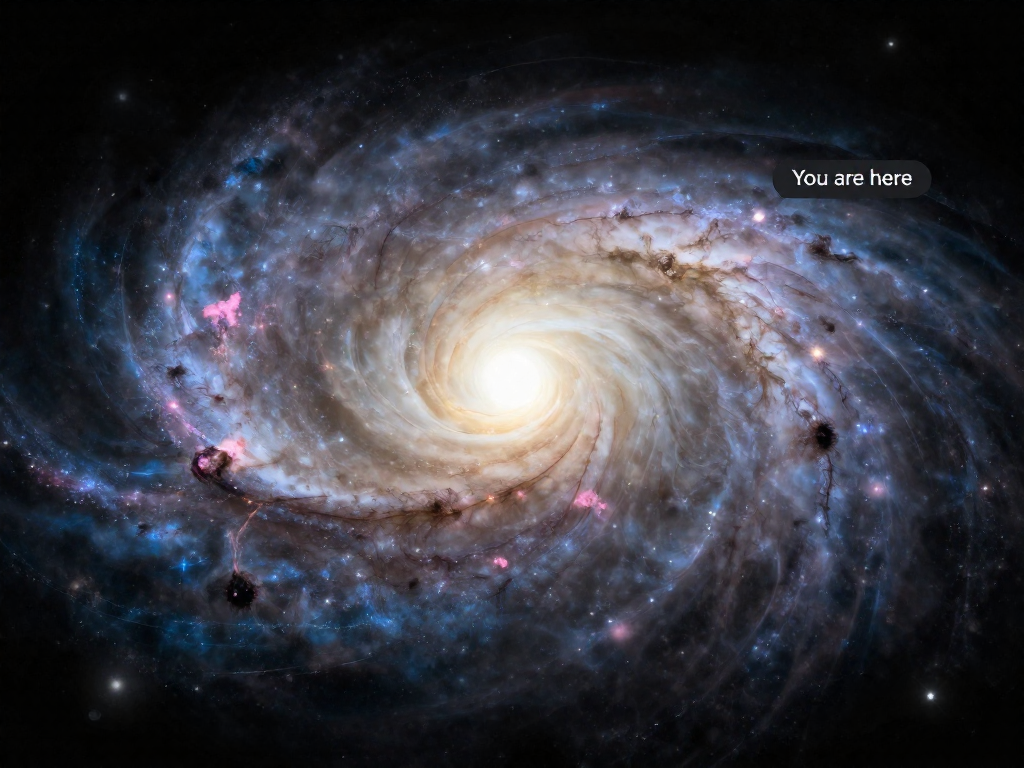
What Is the Milky Way, Really?
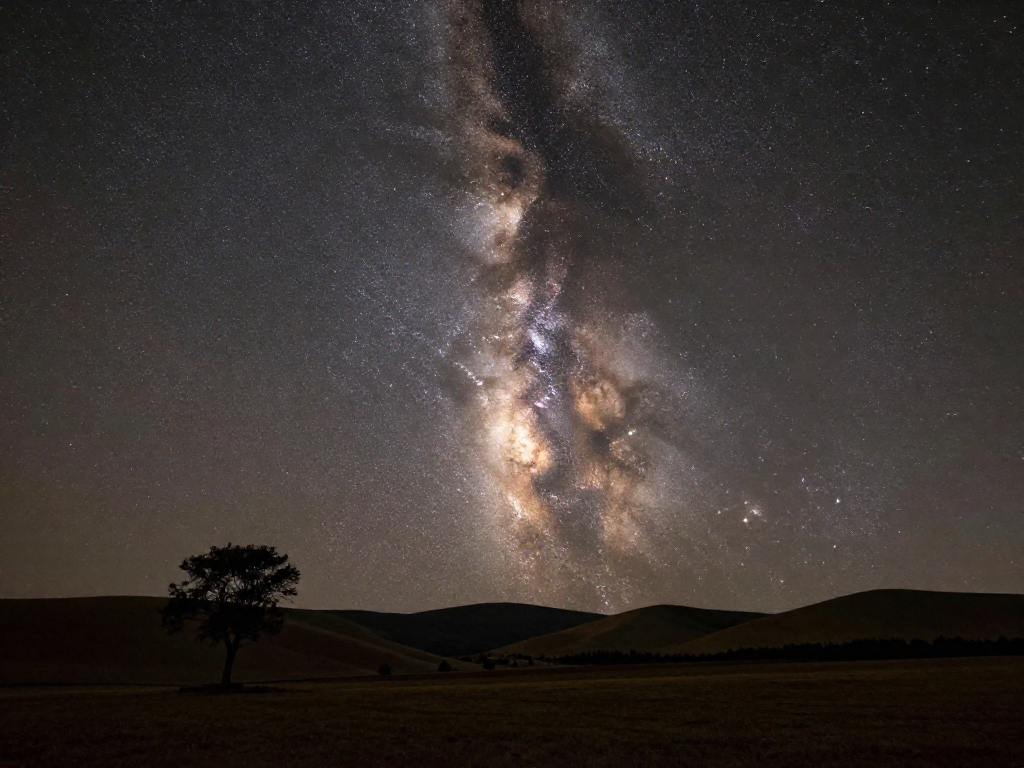
Let's start with the big picture—literally. The Milky Way is a galaxy, which is just a fancy word for a giant, gravity-bound family of stars, gas, dust, and a mysterious ingredient called dark matter (invisible stuff we can't see directly, but whose gravity holds everything together). Picture a vast cosmic city where hundreds of billions of stars are the residents, all held in place by gravity instead of streets and sidewalks.
So where do we fit in? The Milky Way is the specific galaxy that our Sun calls home. Our Sun, the Earth, and every other planet in the Solar System are just a tiny neighborhood tucked inside this enormous starry city. According to NASA, the Milky Way holds somewhere between 100 and 400 billion stars—and our Sun is only one of them.
Here's a point that trips up almost everyone: there are two things people call "the Milky Way."
- The galaxy — the entire collection of stars we live inside (what this article is about).
- The hazy band of light — that faint, milky stripe you can see arcing across a truly dark night sky.
That glowing band is actually our view from inside the galaxy, looking toward its crowded center. We're seeing the combined light of countless distant stars blurred together into a soft glow.
And that's exactly where the name comes from. To ancient skywatchers, that pale streak looked like a spilled splash of milk across the heavens.
Quick takeaway: The Milky Way is the galaxy we live in—a huge, gravity-held collection of stars—and it's named after the milky glow we see when we look out at it from the inside.
How Big Is It? Size, Shape, and Star Count
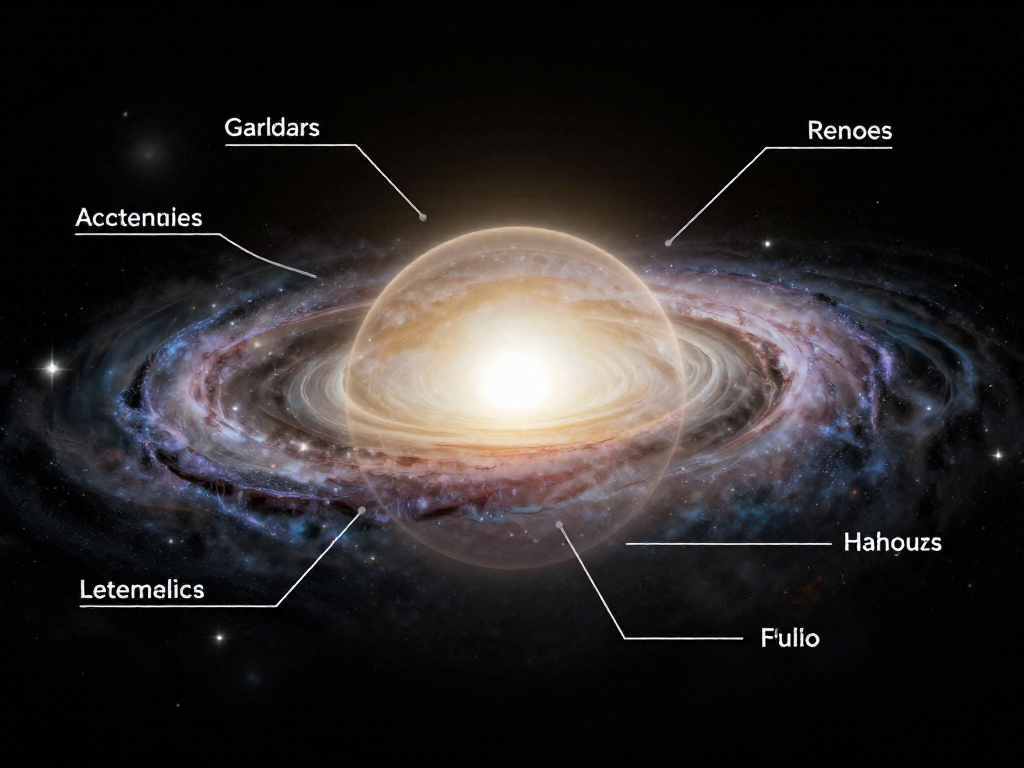
Picture a colossal pinwheel of stars, frozen mid-spin. That's the basic shape of the Milky Way: a flat, rotating disk with sweeping spiral arms curling out from a bright, crowded core called the central bulge. If you could float far above it and look down, you'd see something a lot like a glowing whirlpool.
Now for the size. The Milky Way is about 100,000 light-years across. A light-year isn't a measure of time—it's the distance light travels in one year. Since light is the fastest thing in the universe, that distance is staggering: roughly 6 trillion miles. So 100,000 of them stacked end to end is a number too big for our brains to truly feel.
Here's an analogy that helps. Imagine shrinking the entire galaxy down to the size of a continent like the United States. On that scale, our Sun—and everything we've ever explored—would be smaller than a grain of sand. The nearest neighboring star would still be miles away. Space is mostly, well, space.
And how many stars call this place home? Astronomers at NASA estimate somewhere between 100 and 400 billion stars. The wide range exists because most stars are too faint or too distant to count directly, so scientists estimate based on the galaxy's mass. Sprinkled among them are planets, vast clouds of gas, and fine cosmic dust—the raw material for future stars.
Quick takeaway: The Milky Way is a spiral disk about 100,000 light-years wide, holding 100–400 billion stars plus countless planets, gas, and dust.
The Parts of Our Galaxy: A Quick Tour
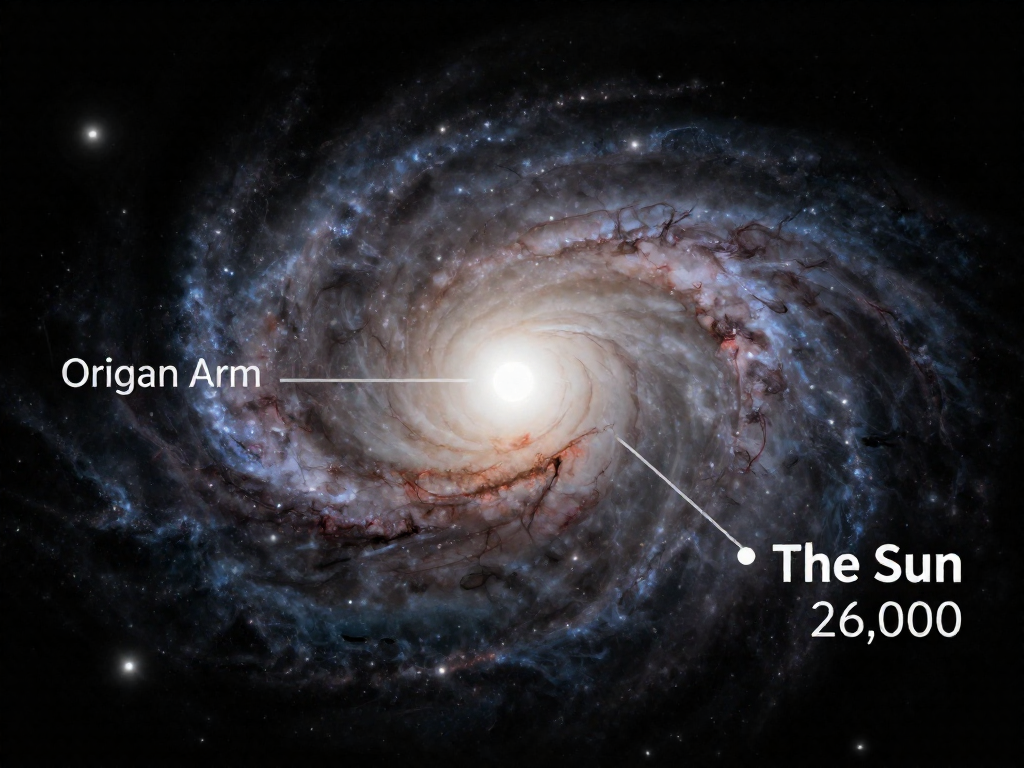
Picture the Milky Way as a giant pinwheel of stars. It has a few distinct neighborhoods, and once you can name them, the whole galaxy snaps into focus.
The core. At the very center sits a supermassive black hole called Sagittarius A* (astronomers say "Sagittarius A-star"). A black hole is a region where gravity is so strong that not even light escapes. This one weighs as much as about 4 million Suns, yet it stays quietly tucked in the middle, with stars swirling around it like water circling a drain (NASA).
The spiral arms. Reaching out from the center are sweeping, curved lanes of stars and gas called spiral arms. These are the galaxy's nurseries, where clouds of gas collapse and new stars are born. Our own Sun lives in a smaller arm, well away from the crowded center.
The disk, bulge, and halo. The flat, pancake-shaped layer holding the arms is the disk. The puffed-up center is the bulge. Surrounding everything is a vast spherical halo, sprinkled with globular clusters—tight, ancient balls packed with hundreds of thousands of old stars.
The invisible glue. All of this spins faster than ordinary matter alone can explain. Scientists think an unseen substance called dark matter provides the extra gravity holding the galaxy together. We can't see it directly—we only notice its pull—so it remains one of astronomy's biggest open questions (ESA).
Quick takeaway: core, arms, disk, bulge, halo, plus a hidden web of dark matter—that's the whole galaxy in one breath.
Where Are We in the Milky Way?
Picture the Milky Way as a giant, slowly spinning pinwheel of stars. If you're wondering where we fit into that picture, here's the short answer: we live in the cosmic suburbs, comfortably far from both the crowded downtown and the lonely outskirts.
Our address: the Orion Arm. Our Sun sits inside a smaller spiral arm called the Orion Arm (sometimes called the Orion Spur). A "spiral arm" is just one of the curving streams of stars, gas, and dust that make up the pinwheel's shape. The Orion Arm is a minor arm tucked between two larger neighbors, so think of it as a quiet side street rather than a major highway.
How far from the center? We're roughly 26,000 light-years from the galactic center, according to NASA. A light-year is the distance light travels in one year—about 6 trillion miles—so this is a number too big to truly picture. The key takeaway: we're neither at the bright, busy core nor out at the faint edge. We're about halfway out.
Why "suburban" is good for life. Living away from the galactic center is actually lucky for us. The core is packed with stars, intense radiation, and other hazards. Out in our calmer neighborhood, things are more spread out and stable—a more peaceful place for a planet like Earth to thrive over billions of years.
We're always moving. Even sitting still, you're racing around the galaxy. Our Sun takes about 225–250 million years to complete one full orbit of the galactic center. Astronomers call this a galactic year. The last time we were in this spot, dinosaurs were just beginning to appear on Earth.
Quick takeaway: We live in the Orion Arm, about 26,000 light-years from the Milky Way's center—a calm, stable spot, looping the galaxy once every ~225–250 million years.
How to See the Milky Way With Your Own Eyes
Here's the best news for beginners: you don't need a telescope to see our home galaxy. On a clear, dark night, the Milky Way appears as a soft, hazy band of light arching across the sky—like someone smudged a faint cloud of glowing dust from horizon to horizon. Here's how to catch it.
-
Escape the city lights. The single biggest factor is light pollution—the artificial glow from streetlights, buildings, and signs that washes out faint stars. Drive at least an hour away from any city to a rural area, park, or designated dark-sky site. The darker your surroundings, the more spectacular the view.
-
Pick the right season. From the United States and similar northern latitudes, the bright, dramatic center (or "core") of the galaxy is best seen on summer nights, roughly June through August, after midnight. Aim for a few nights around the new moon, when there's no bright moonlight to drown out the stars.
-
Let your eyes adjust. Give yourself at least 20 minutes in the dark without looking at your phone. Your eyes slowly become far more sensitive in darkness. If you need light, use a red flashlight—red light preserves your night vision.
-
Know what you're seeing. That glowing band isn't a cloud at all. It's the combined light of billions of stars too far away to see individually, blending into one soft river of light (NASA).
Quick takeaway: Dark skies, a summer night near the new moon, and 20 minutes of patience are all you need to see billions of stars at once.
Our Galactic Neighborhood and Future
Our galaxy doesn't drift through space alone. The Milky Way belongs to a small cluster of galaxies called the Local Group — basically our cosmic neighborhood, a collection of dozens of galaxies bound together by gravity.
The biggest house on our block is Andromeda, the largest galaxy near us. It's a spiral galaxy much like our own, and on a very dark night you can even spot it as a faint smudge of light — the most distant object most people can see with the naked eye.
Here's the headline-grabbing part: Andromeda and the Milky Way are slowly moving toward each other and will eventually merge into one larger galaxy. Astronomers expect this to happen in roughly 4 billion years (NASA/ESA Hubble observations).
If that sounds alarming, relax. Galaxies are mostly empty space, so stars almost never collide — the two will gracefully blend rather than crash. And 4 billion years is so far off it's hard to even imagine.
Quick takeaway: We live in a galactic neighborhood called the Local Group, and our galaxy is on a slow, gentle path to one day join with Andromeda — nothing to lose sleep over.
See also
- What Is a Light-Year? A Simple Explanation
- A Beginner's Guide to Galaxies and How They Form
- What Is a Black Hole? Sagittarius A* Explained
- How to Stargaze for Beginners: A Starter Guide
- Our Solar System Explained for Beginners
Related articles
Neutron Stars: The Densest Things in the Universe
What is a neutron star? Discover how a teaspoon can weigh a billion tons, how these cosmic objects form, and why they're the densest things we know of.
Jun 29, 2026 · 8 min read
Will the Universe Ever End? Possible Cosmic Futures
Will the universe ever end? Explore the Big Freeze, Big Rip, Big Crunch, and other possible cosmic fates explained simply for beginners—no equations needed.
Jun 29, 2026 · 9 min read
The Colors of Stars: What Red, Blue, and White Tell Us
Why are stars different colors? Discover how red, blue, and white reveal a star's temperature—explained in plain, jargon-free language for beginners.
Jun 29, 2026 · 6 min read