Are We Alone? How Scientists Search for Life Beyond Earth
How do scientists look for alien life?
On this page
Why Scientists Think Life Could Exist Elsewhere
When astronomers wonder whether we're alone, they're not chasing flying saucers. They're asking a serious scientific question—and the universe gives them some compelling reasons to ask it.
Start with the numbers. Our galaxy, the Milky Way, holds hundreds of billions of stars. Beyond it lie an estimated two trillion more galaxies, each packed with its own billions of stars (NASA). Most of those stars have planets. When you have that many cosmic "lottery tickets," it feels strange to assume Earth drew the only winning one.
Life showed up fast and clings on tight. Earth is about 4.5 billion years old, and the earliest signs of life appear surprisingly soon after the planet cooled enough to host it. Life also turns out to be remarkably stubborn. We've found extremophiles—organisms that thrive in places that should be deadly—in boiling deep-sea vents, acidic lakes, and Antarctic ice. If life grips so hard here, maybe it can grip elsewhere too.
The ingredients aren't rare. The building blocks we associate with life—carbon, water, and organic molecules (carbon-based compounds, the chemical "Lego bricks" of living things)—are scattered across the cosmos. Astronomers detect water and organic molecules in distant gas clouds, comets, and on other worlds in our own solar system.
One important distinction: "alien life" usually doesn't mean little green people. Scientists separate the search for intelligent life from the search for any life at all—even single-celled microbes. Finding pond scum on another world would be one of the biggest discoveries in history.
Quick takeaway: Vast numbers of planets, life's fast and tough debut on Earth, and life's common ingredients make "Are we alone?" a real scientific question—not just science fiction.
Step One: Finding Other Worlds (Exoplanets)
Before we can ask whether anyone is out there, we first have to find places for them to live. That means hunting for exoplanets — planets that orbit stars other than our Sun. The first one around a Sun-like star was confirmed in 1995, and since then astronomers have catalogued more than 5,800 of them, with thousands more candidates waiting to be confirmed (NASA Exoplanet Archive, 2024). Just a generation ago, we knew of exactly zero. Now we know our galaxy is brimming with worlds.
But here's the puzzle: planets don't shine on their own, and they're absurdly far away. Spotting one is like trying to see a firefly sitting next to a stadium floodlight from across a continent. So scientists got clever and look for the planet's effects on its star instead.
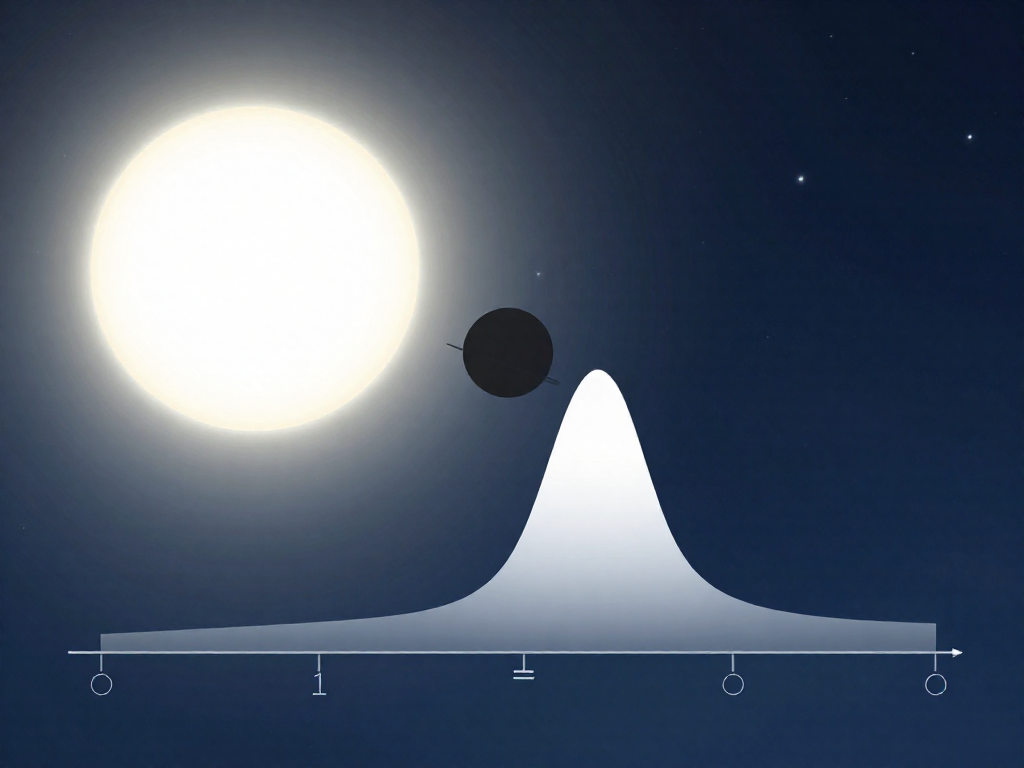
The transit method is the most productive trick. When a planet passes directly in front of its star from our point of view, it blocks a tiny sliver of light — a miniature eclipse. The star dims by a fraction of a percent, then brightens again. Measure that dip's size and rhythm, and you can work out the planet's width and how long its "year" is.
The wobble method (formally called radial velocity) watches the star itself. A planet's gravity tugs on its star, making the star rock back and forth ever so slightly, the way a dog on a leash pulls its walker. That wobble reveals the planet's mass even when we can't see it directly.
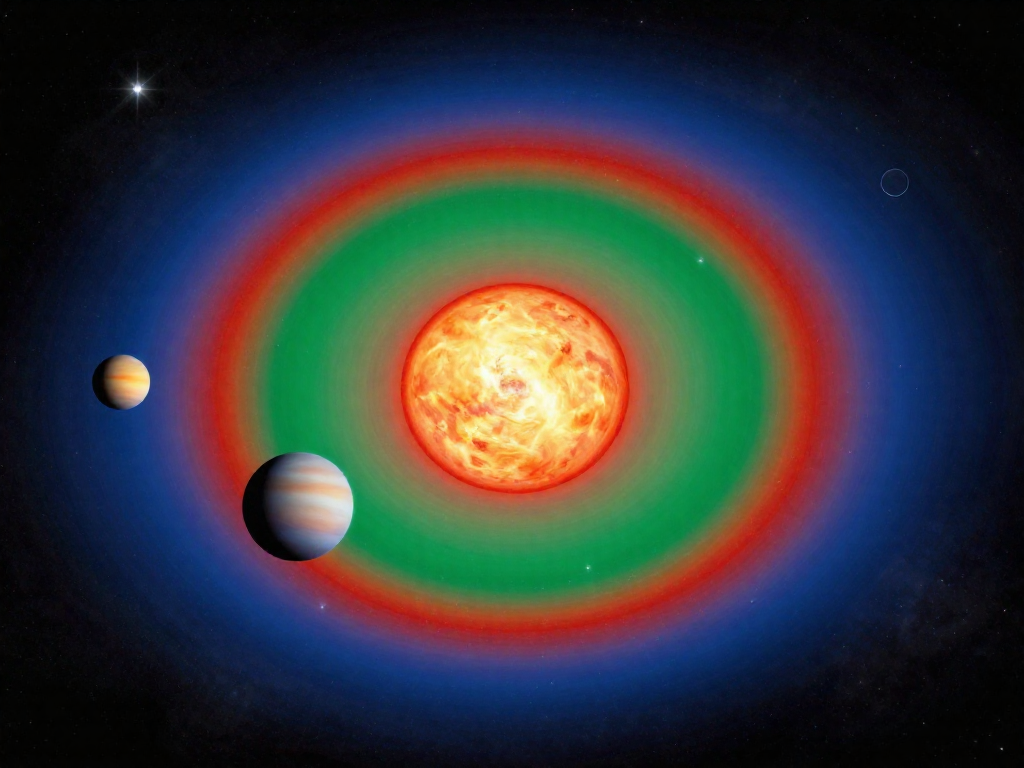
Finding a planet is one thing; finding a promising one is another. Scientists look for worlds in the habitable zone, nicknamed the "Goldilocks zone" — the orbital band that's not too hot and not too cold, where water could stay liquid on the surface. Liquid water is our best bet for life as we know it.
Three telescopes do the heavy lifting: NASA's Kepler (which proved planets are everywhere), TESS (scanning the whole sky for nearby ones), and the James Webb Space Telescope, which can now sniff out what those planets' atmospheres are made of.
Quick takeaway: We can't usually see exoplanets directly, so we detect them by the way they dim their stars (transits) or tug on them (wobbles) — then zero in on the ones sitting in the water-friendly Goldilocks zone.
Step Two: Looking for Biosignatures
Once scientists find a distant world (more on that in Step One), the next question is the big one: could anything be living there? Since we can't fly out and take a sample, researchers hunt for biosignatures—chemical clues in a planet's air that hint at the presence of living things.
Reading a planet's air from light-years away
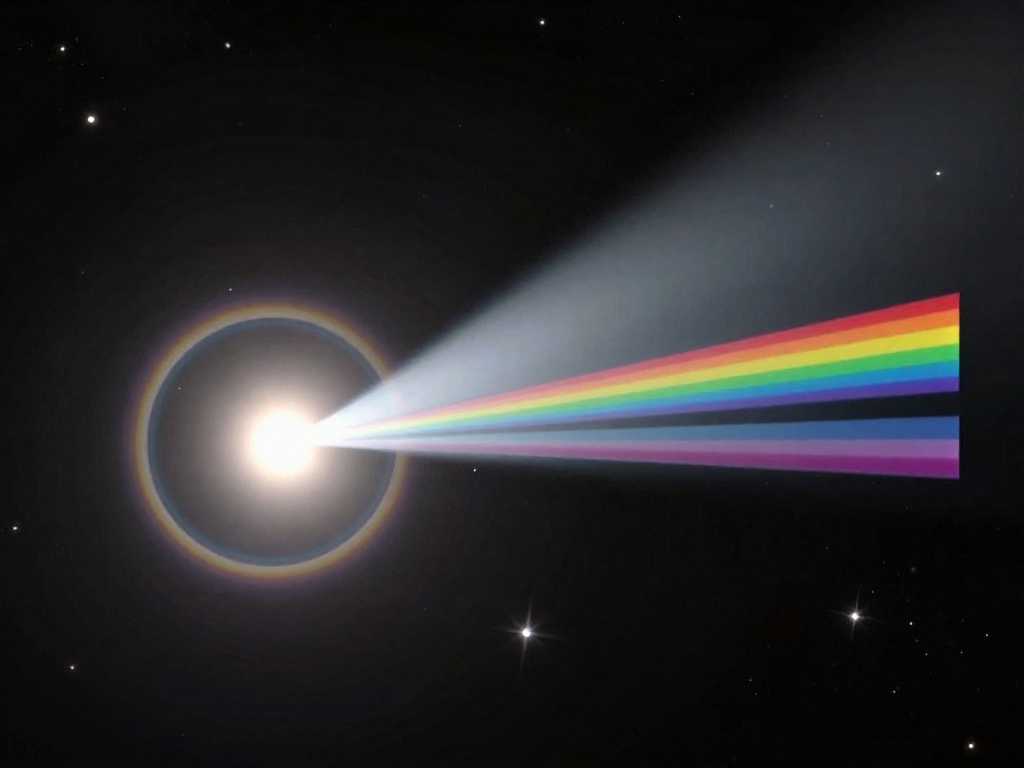
Here's the clever part. When a planet passes in front of its star, a sliver of starlight filters through the planet's atmosphere on its way to us. Different gases absorb different colors of that light, leaving tiny gaps—like a barcode stamped onto the starlight. Scientists call the technique spectroscopy, but you can think of it as reading the atmosphere's fingerprint in a rainbow. By studying which colors go missing, they can work out which gases are present, even from trillions of miles away. NASA's James Webb Space Telescope was built partly to do exactly this.
Gases that might whisper "life"
A few gases get astronomers especially excited:
- Oxygen — On Earth, plants and tiny organisms constantly refill our air with it, so lots of oxygen could be a sign of life.
- Methane — Produced by living things like microbes (and cattle), it can also hint at biology.
- Phosphine — A gas linked to life on Earth; a disputed 2020 claim of detecting it in Venus's clouds sparked huge debate.
Why one signal is never enough
Here's the catch: nature can fake these clues. Oxygen can build up without life when starlight splits water vapor apart. Methane can leak from volcanoes. These misleading clues are called false positives, and they're why scientists stay cautious.
That's why the real goal is finding several gases together that are hard to explain without life—and confirming them more than once. A single odd reading is a reason to look harder, not a reason to celebrate.
Quick takeaway: Biosignatures are chemical hints of life read from starlight passing through a planet's air. Gases like oxygen and methane are promising, but because nature can mimic them, scientists need multiple, repeated clues before claiming anything.
Step Three: Listening for Signals (SETI)
The first two steps hunt for life of any kind—even pond-scum microbes. This step asks a bolder question: is anyone out there smart enough to send us a message?
That's the goal of SETI, short for the Search for Extraterrestrial Intelligence. Instead of sniffing planets for chemistry, SETI scientists point giant radio telescopes (and sometimes light-sensitive ones) at the sky and listen. The idea is simple: a technological civilization might leak radio waves the way our own TV and radar do, or even beam a deliberate signal. We just have to catch it.
The "Wow! Signal"
In 1977, astronomer Jerry Ehman was reviewing data from an Ohio telescope when he spotted a burst so strong and so unlike normal space noise that he scribbled "Wow!" in the margin. The signal lasted 72 seconds and never repeated. Despite decades of searching, no one has explained it or heard it again—making it SETI's most tantalizing unsolved mystery. To be clear: it has not been confirmed as alien. It's simply unexplained.
Modern Listening Efforts
Today the biggest project is Breakthrough Listen, launched in 2015. It's scanning a million nearby stars and 100 galaxies using some of the world's most powerful telescopes—a far wider net than anything before.
Where Is Everybody?
Here's the puzzle. If the universe is so vast and life seems possible, our galaxy should be buzzing with civilizations. So why total silence? Physicist Enrico Fermi summed it up in one question now called the Fermi Paradox: "Where is everybody?" Nobody has a confirmed answer—the possibilities range from "we're alone" to "we just haven't looked long enough."
Quick takeaway: SETI listens for signals from intelligent aliens. We've found one haunting clue (the Wow! signal) but no proof—yet.
Searching Closer to Home: Our Own Solar System
When we picture the hunt for alien life, we often imagine telescopes peering at stars trillions of miles away. But some of the most exciting targets are right in our cosmic backyard.
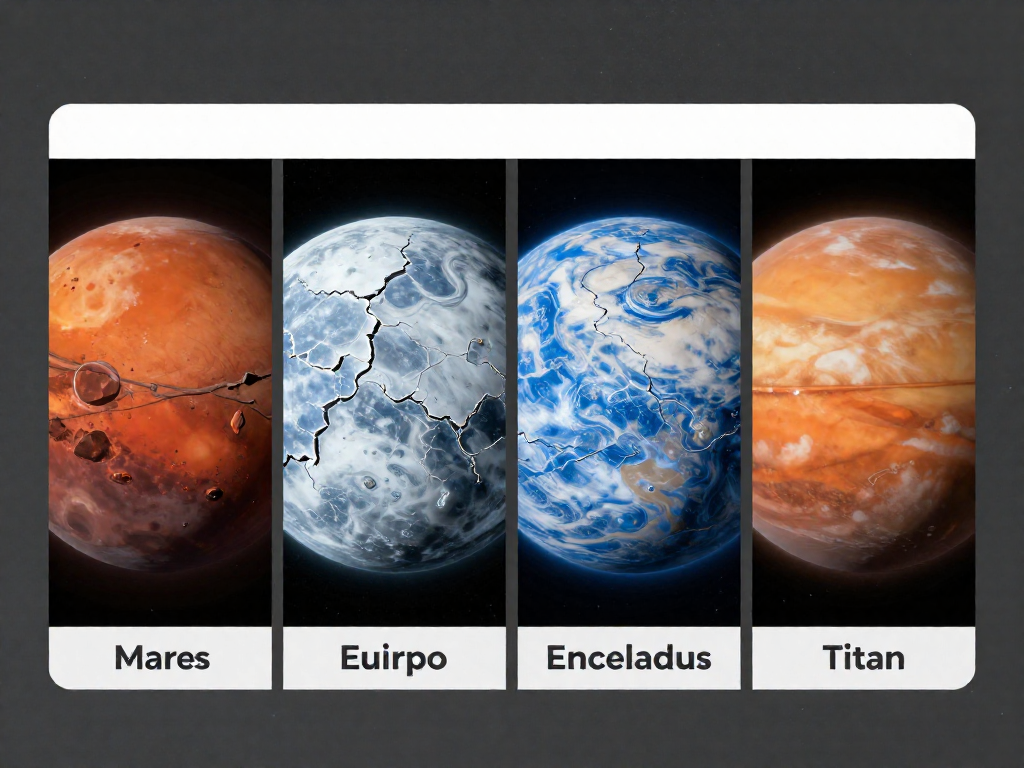
Mars is the classic example. We know from NASA's rovers, like Perseverance, that liquid water once flowed across its surface, carving riverbeds and filling lakes billions of years ago. Today the planet is cold and dry, but scientists are searching its rocks for biosignatures—chemical "fingerprints" that living things might leave behind. The goal isn't little green men, but evidence of ancient microbes (tiny single-celled life too small to see).
Even more tantalizing are a few icy moons. Europa (orbiting Jupiter) and Enceladus (orbiting Saturn) appear to hide vast saltwater oceans beneath their frozen crusts—more water than all of Earth's oceans combined. On Earth, wherever there's liquid water, we find life, which makes these hidden seas prime suspects.
Then there's Titan, Saturn's largest moon. It's the only other place we know of with stable liquid on its surface—but instead of water, it has lakes of liquid methane (the same gas in your kitchen stove). It's a strange, alien chemistry that could rewrite what we think life needs.
To investigate, NASA's Europa Clipper (launched in 2024) will make repeated close flybys to study whether Europa's ocean could support life.
Quick takeaway: We don't have to leave the Solar System to search for life—Mars and several icy moons are promising, reachable worlds being explored right now.
So, Are We Alone? What the Science Says Today
Quick takeaway: We haven't found life beyond Earth yet—but the search has barely started, and the next decade could be a turning point.
Here's the honest answer: as of today, scientists have found no confirmed sign of life anywhere except Earth. That's the established science, not a hunch.
But "we haven't found it" is very different from "it isn't there." Imagine scooping a single glass of water from the ocean, finding no fish, and concluding the ocean is empty. That's roughly how much of the universe we've actually checked. The cosmos is staggeringly large, and our search has only sampled a tiny corner of it.
The good news? Our tools are getting dramatically better. Powerful new telescopes like NASA and ESA's James Webb can now study the air of distant planets, and upcoming missions will explore icy moons like Jupiter's Europa, thought to hide oceans beneath their frozen shells.
Whatever we eventually learn carries weight. Finding life would tell us we're not alone. Finding none, despite a thorough search, would make our small blue planet feel rarer—and more precious—than ever.
See also
- What Is the Habitable Zone? The Goldilocks Rule Explained
- How Telescopes Like James Webb See the Universe
- A Beginner's Tour of the Solar System's Moons
- What Are Exoplanets and How Do We Find Them?
- The Mars Missions: What Rovers Have Discovered So Far
Related articles
Neutron Stars: The Densest Things in the Universe
What is a neutron star? Discover how a teaspoon can weigh a billion tons, how these cosmic objects form, and why they're the densest things we know of.
Jun 29, 2026 · 8 min read
Will the Universe Ever End? Possible Cosmic Futures
Will the universe ever end? Explore the Big Freeze, Big Rip, Big Crunch, and other possible cosmic fates explained simply for beginners—no equations needed.
Jun 29, 2026 · 9 min read
The Colors of Stars: What Red, Blue, and White Tell Us
Why are stars different colors? Discover how red, blue, and white reveal a star's temperature—explained in plain, jargon-free language for beginners.
Jun 29, 2026 · 6 min read