Space-Time Explained Without the Math
What does 'space-time' actually mean?
On this page

Wait, What Even Is Space-Time?
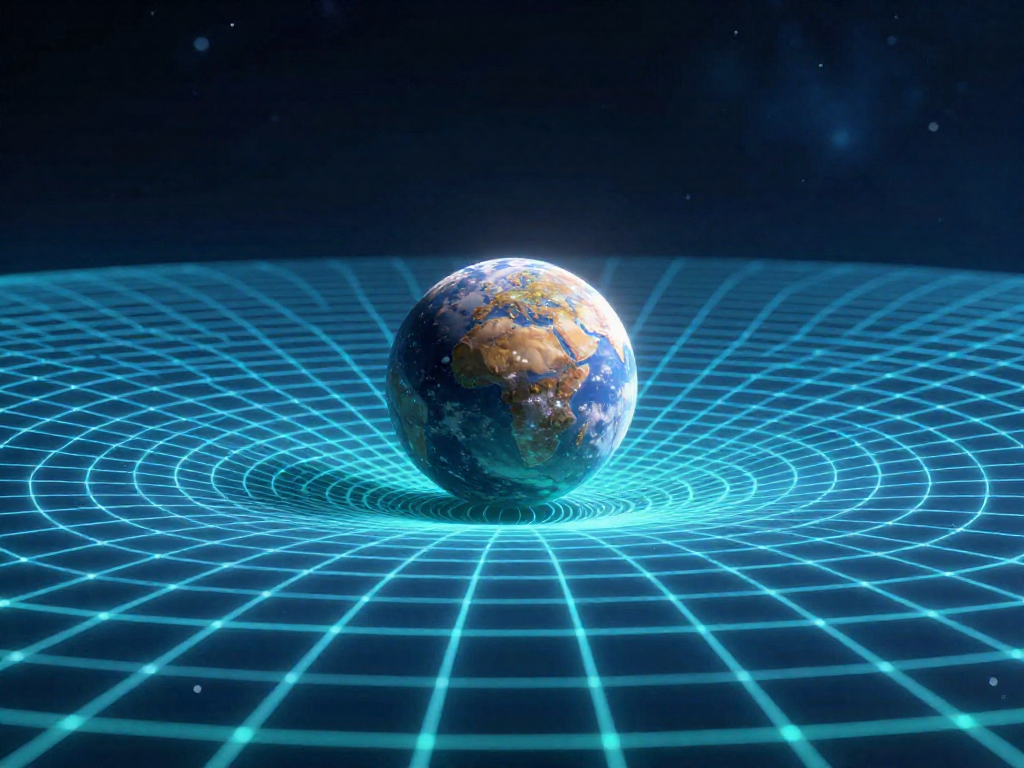
Here's the payoff in one sentence: space-time is the idea that space and time aren't two separate things, but a single, connected "fabric" that everything in the universe sits inside.
That's it. If that sentence already sparked a little "huh, neat" feeling, you're exactly where you need to be.
Let's unpack it gently. You already live in three dimensions of space every single day:
- Left and right (when you slide a coffee cup across a table)
- Forward and back (when you walk down a hallway)
- Up and down (when you climb a flight of stairs)
Those three directions are enough to point at anything around you. But to actually meet a friend, three directions aren't enough. You also need to agree on when — say, 6 p.m. on Friday. That "when" is the fourth dimension: time.
Stitch those four together — three of space, one of time — and you get the four-dimensional fabric scientists call space-time.
Quick takeaway: Space-time is just space and time treated as one combined thing, instead of two unrelated ones.
And don't worry — there's no math or physics background needed here. Not a single equation. In the sections ahead, we'll lean on everyday pictures instead: a stretchy trampoline, a bowling ball, and a rolling marble that together explain why this "fabric" idea is one of the most beautiful ideas in all of science.
Why We Used to Think Space and Time Were Separate
For most of human history, the idea that space and time were two completely different things felt like plain common sense. And honestly? It still feels that way today.
Picture the world the way you experience it every morning. Space is the stage—the empty room your life happens in, with up, down, left, and right. Time is the steady tick of a clock, marching forward at the same pace whether you're rushing to work or napping on the couch. The stage holds still; the clock keeps time. They seemed to have nothing to do with each other.
This was also the view of physics for centuries. Isaac Newton, the scientist who figured out gravity and the laws of motion in the 1680s, imagined the universe as a giant, reliable machine—a kind of cosmic clockwork. In Newton's picture, space was a fixed, unchanging container, and time flowed evenly everywhere in the universe at once. One universal second on Earth was the same second on the Moon, or in a distant galaxy.
It's an intuitive idea, and for everyday life it works beautifully. The catch? It turns out to be incomplete. As we'll see, time doesn't actually tick the same everywhere—and that single discovery rewired our entire view of reality.
Quick takeaway: Before Einstein, space was seen as a fixed stage and time as a universal clock ticking the same for everyone. It feels obvious—but it's not the whole story.
Einstein's Big Idea: They're Actually One Thing
For centuries, people pictured space as the empty stage and time as the clock ticking in the background—two completely separate things. Then, in 1905, a young physicist named Albert Einstein looked at the universe and said something startling: space and time aren't separate at all. They're woven together into a single fabric, which we now call space-time (the combined "where" and "when" of everything that happens).
Here's the shift in thinking. You already move through space every day—walking to the kitchen, driving across town. What Einstein realized is that you're also always moving through time, traveling steadily into the future. And here's the twist: those two kinds of motion are connected, like a budget you have to split.
Think of it like a fixed speed limit you can never break. Imagine you have a set amount of "motion" to spend, and you can pour it into moving through space or moving through time. Stand perfectly still, and nearly all of it goes into moving through time—you age normally. Start racing through space at enormous speeds, and you have to borrow from your time budget to pay for it. The result?
The faster you move through space, the slower you move through time.
This isn't science fiction or a hypothesis—it's well-established physics, confirmed by countless experiments. Atomic clocks flown on fast-moving jets, for example, really do tick a tiny bit slower than identical clocks left on the ground (NASA).
The numbers only get dramatic near the speed of light, which is why you don't notice it on your commute. But the principle is always at work, quietly linking your journey through space to your journey through time.
Quick takeaway: Space and time are one connected thing. Speeding up through space literally slows down your passage through time.
The Trampoline Analogy: How Gravity Bends Space-Time
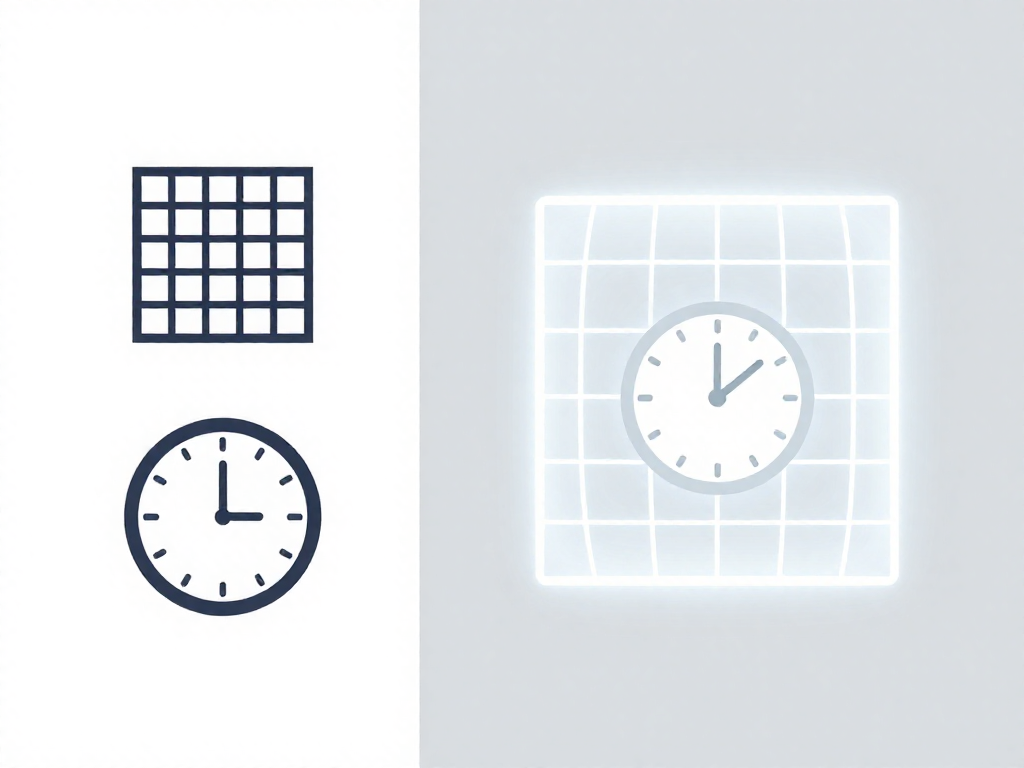
Here's the mental picture that has helped millions of people finally "get" gravity.
Imagine a trampoline, or a stretchy bedsheet pulled tight by friends at each corner. Now place a heavy bowling ball in the middle. What happens? The sheet sags, dipping deeply where the ball sits. The heavier the ball, the deeper the dip.
In this picture, the stretchy sheet is space-time, and the bowling ball is something massive, like the Sun. Mass (the amount of "stuff" in an object) warps the fabric around it, creating a kind of valley.
Now roll a small marble across the sheet. It won't travel in a straight line. Instead, it curves toward the bowling ball, spiraling into the dip. That marble is like a planet, a moon, or even a beam of light—objects moving through the curved space around a massive body.
Here's the mind-bending part. We usually think of gravity as a "pull," like an invisible rope yanking the Earth toward the Sun. But Einstein's view flips that idea. Nothing is being pulled. Objects are simply following the natural curves in space-time, the same way the marble just rolls along the dip the bowling ball made. Gravity isn't a force tugging at you—it's the shape of space-time itself, guiding how things move.
An honest caveat: this analogy isn't perfect. A real trampoline only bends in two dimensions and actually relies on Earth's gravity to make the dip. Space-time bends in all directions at once, which is impossible to fully picture. But the core idea holds: mass curves space-time, and that curvature is what we feel as gravity.
Quick takeaway: Gravity isn't a pull. Massive objects dent the fabric of space-time, and everything else just rolls along those dents.
Time Bends Too: Everyday Proof You Can Relate To
Here's the part that sounds like science fiction but isn't: time itself can speed up or slow down. Not how time feels, but how fast it actually ticks. Scientists call this time dilation—a fancy phrase that just means "time running at different rates in different places."
You're relying on this right now if you've ever used a map app.
Your GPS would be useless without it
GPS satellites orbit about 20,000 km above Earth, where gravity is weaker and they're zipping along fast. Up there, time runs slightly faster than it does for us on the ground—by about 38 millionths of a second per day. Tiny, right? But GPS pinpoints your location by timing signals down to the nanosecond. Left uncorrected, that mismatch would throw your position off by roughly 10 kilometers a day. So engineers program satellites to account for it. The science is built into the device in your pocket (NASA).
Strong gravity = slower time
Near a heavy object, time runs a hair slower. This is gravitational time dilation. A clock at sea level ticks ever-so-slightly slower than one on a mountaintop, because it's deeper in Earth's gravity. The effect is real and has been measured with ultra-precise atomic clocks.
The twin paradox, simply
Imagine twins. One blasts off on a near-light-speed trip through space; the other stays home. When the traveler returns, they've aged less than the twin who stayed. They were both alive the whole time—the traveler simply experienced less time passing.
Quick takeaway: Time isn't fixed. It bends with speed and gravity. The effects are far too small to notice in everyday life—but they're real, measured, and quietly keeping your GPS honest.
What Space-Time Tells Us About the Universe
Once you picture space-time as a stretchy "fabric" that bends around heavy objects, the universe's strangest features suddenly start to make sense.
Black holes are the most extreme example. Imagine pressing so much mass into one spot that the fabric doesn't just dip—it punctures, forming a pit so steep that not even light can climb back out. That's a black hole: a place where space-time is bent to its breaking point.
Gravitational waves are ripples in that same fabric. When two black holes crash together, they send out waves like a stone dropped in a pond. In 2015, the LIGO observatory detected these ripples for the first time, confirming a prediction Einstein made a century earlier (NASA).
Space-time also shapes the universe as a whole. The fabric isn't sitting still—it's stretching, carrying galaxies farther apart over time. This is what scientists mean when they say the universe is expanding (ESA).
Why did this idea change astronomy forever? Before space-time, gravity was a mysterious "pull." Afterward, gravity became something we could see, map, and even hear as ripples. It turned the cosmos from a flat backdrop into a living, bending stage.
Quick takeaway: Space-time isn't just a concept—it's the fabric that explains black holes, gravitational waves, and the growing universe itself.
The Takeaway: You Already Understand Space-Time
Here's the wonderful secret: you've understood space-time all along. Let's pull it together.
Quick takeaway:
- Space and time are one fabric. Instead of "space over here" and "time over there," picture a single stretchy sheet that holds both together.
- Mass bends that fabric. Anything with weight—a planet, a star, even you—creates a dip, like a bowling ball resting on a trampoline.
- Gravity is just that curve. When something falls or orbits, it's simply following the bend in the sheet. No mysterious pulling force required.
That's the whole big idea. No equations needed.
So tonight, step outside and look up. The Moon circling Earth, the planets tracing their paths—they're all rolling along the gentle curves of space-time.
Curious for more? Try our pieces on black holes, the expanding universe, and why light takes years to reach us. The cosmos is yours to explore.
See also
- What Are Black Holes? A Beginner's Guide
- How Gravity Actually Works
- Einstein's Theory of Relativity Explained Simply
- What Are Gravitational Waves?
- Is the Universe Really Expanding?
Related articles
Neutron Stars: The Densest Things in the Universe
What is a neutron star? Discover how a teaspoon can weigh a billion tons, how these cosmic objects form, and why they're the densest things we know of.
Jun 29, 2026 · 8 min read
Will the Universe Ever End? Possible Cosmic Futures
Will the universe ever end? Explore the Big Freeze, Big Rip, Big Crunch, and other possible cosmic fates explained simply for beginners—no equations needed.
Jun 29, 2026 · 9 min read
The Colors of Stars: What Red, Blue, and White Tell Us
Why are stars different colors? Discover how red, blue, and white reveal a star's temperature—explained in plain, jargon-free language for beginners.
Jun 29, 2026 · 6 min read