Solar vs. Lunar Eclipses: What's the Difference and How to Watch
How do solar and lunar eclipses differ?
On this page
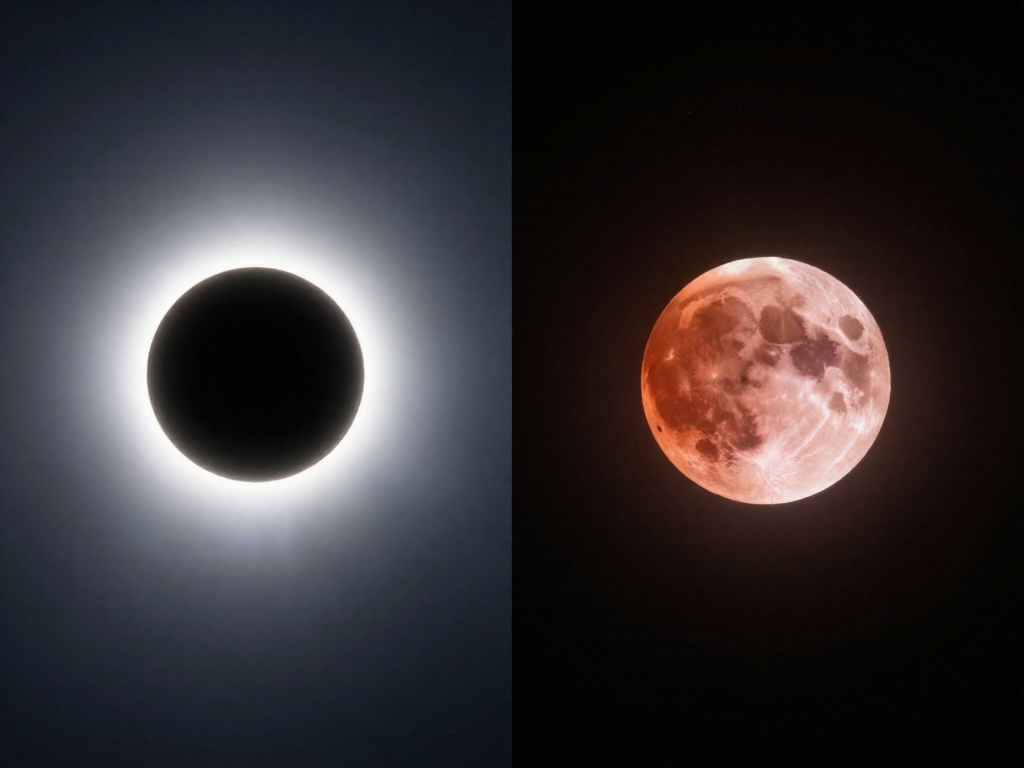
The Quick Answer: Solar vs. Lunar Eclipses at a Glance
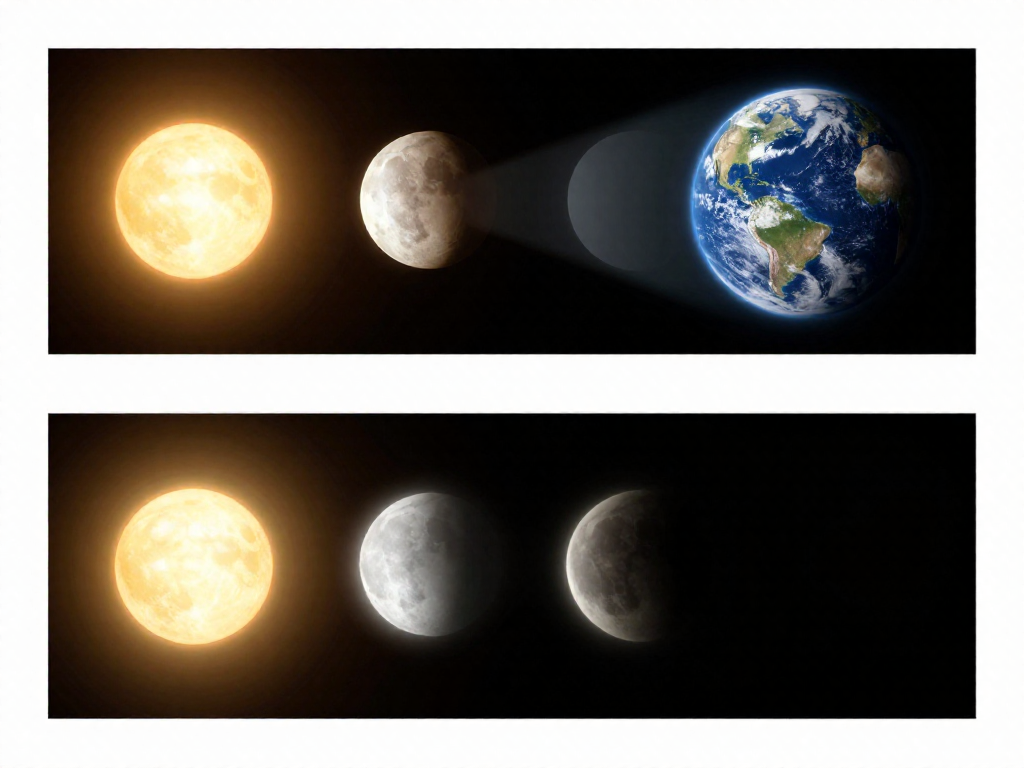
Short on time? Here's the heart of it: an eclipse simply means one space object's shadow falls on another, briefly hiding it from view.
- Solar eclipse — The Moon slips directly between the Sun and Earth, blocking the Sun's light. It happens during the day, at a new moon (when the Moon's lit side faces away from us).
- Lunar eclipse — The Earth moves between the Sun and the Moon, casting its own shadow onto the Moon. It happens at night, at a full moon.
Memory trick: Solar hides the Sun, Lunar darkens the Moon.
Side-by-Side at a Glance
| Solar Eclipse | Lunar Eclipse | |
|---|---|---|
| When | Daytime, new moon | Nighttime, full moon |
| What you see | Sun partly or fully covered; sky dims | Moon turns dim, often reddish ("blood moon") |
| How often | A few times a year, but only visible from a narrow path on Earth | A few times a year, visible to everyone on the night side of Earth |
| Safety | Never look directly without proper solar filters | Completely safe to view with naked eyes |
The biggest practical difference: a lunar eclipse is safe and easy to enjoy, while a solar eclipse needs eye protection and a bit of luck with location.
Quick takeaway: Solar = Moon hides the Sun by day; Lunar = Earth shadows the Moon by night.
Sources: NASA Eclipse resources; ESA.
What Causes a Solar Eclipse
Picture three things lining up like beads on a string: the Sun, the Moon, and Earth. A solar eclipse happens when the Moon slips directly between Earth and the Sun, casting its shadow onto our planet. For a few minutes, the Moon blocks the Sun's light and turns day into an eerie twilight.
There are three main types, and the difference comes down to how much of the Sun gets covered:
- Total eclipse — The Moon completely hides the Sun, revealing its glowing outer atmosphere (the corona, a faint halo of light).
- Partial eclipse — The Moon covers only part of the Sun, leaving a bite-shaped sliver of light.
- Annular eclipse — The Moon is a little farther away in its orbit, so it looks slightly too small to cover the Sun entirely. The result is a bright "ring of fire" around the Moon's edge.
Here's the catch: a solar eclipse is only visible from a narrow path on Earth, sometimes just 100 miles wide. The Moon's shadow is small, so only places it sweeps across see the full show.
You might wonder why this doesn't happen every new moon. The reason is that the Moon's orbit is tilted by about 5 degrees, so it usually passes a bit above or below the Sun. Only when the alignment is just right do we get an eclipse (NASA).
Quick takeaway: Solar eclipse = Moon between Earth and Sun, visible only along a narrow path.
What Causes a Lunar Eclipse
A lunar eclipse is the mirror image of a solar one. Instead of the Moon blocking the Sun, Earth slips directly between the Sun and a full Moon (the phase when the Moon's face is fully lit). When that happens, our planet casts its shadow across the Moon, dimming and coloring it.
There are three kinds, from most to least dramatic:
- Total – The Moon passes fully into Earth's deep, dark inner shadow (the umbra) and turns a coppery red.
- Partial – Only part of the Moon dips into the dark shadow, so it looks like a bite has been taken out of it.
- Penumbral – The Moon drifts through Earth's faint outer shadow (the penumbra), causing a subtle dimming that's easy to miss.
Why the "blood moon"? During totality, the Moon isn't completely dark because sunlight bends as it passes through Earth's atmosphere—the same effect that paints sunsets red. Our air filters out blue light and lets red light through, which then falls on the Moon. In a sense, you're seeing the glow of every sunrise and sunset on Earth at once (NASA).
Quick takeaway: Because Earth's shadow is huge and points away from the Sun, a lunar eclipse is visible to everyone on the night side of the planet—roughly half the world at the same time. No special glasses needed, either.
Key Differences Side by Side
Here's the whole comparison in one glance. Pin it, screenshot it, or keep it handy the next time an eclipse is on the way.
| Feature | Solar Eclipse | Lunar Eclipse |
|---|---|---|
| When it happens | During the daytime | At night |
| Moon phase | New moon (the Moon sits between Earth and the Sun) | Full moon (Earth sits between the Sun and the Moon) |
| Who can see it | Only people inside a narrow path, often just a few dozen miles wide | Anyone on the night side of Earth—roughly half the planet at once |
| How long it lasts | Brief—totality lasts only a few minutes | Long—the Moon can stay shaded for an hour or more |
| Is it safe to watch? | No—never look directly without certified eclipse glasses | Yes—completely safe with your bare eyes |
A quick way to remember it: a solar eclipse is the Moon hiding the Sun, so it happens in the day and you must protect your eyes. A lunar eclipse is Earth's shadow falling on the Moon, so it happens at night and is totally safe to enjoy.
The biggest practical takeaways are visibility and safety. Because a solar eclipse's shadow only touches a slim strip of the planet, catching totality often means traveling. A lunar eclipse, by contrast, simply rewards anyone who looks up at the right time—no special gear, no travel, no risk.
Quick takeaway: Solar = daytime, rare view, eye protection required. Lunar = nighttime, widely visible, safe for everyone.
(Source: NASA, "Eclipses" overview.)
How to Watch a Solar Eclipse Safely
Watching a solar eclipse is one of the most jaw-dropping things you'll ever see in the sky—but it comes with one hard rule: never look directly at the Sun without proper protection. Even when the Moon covers most of it, the sliver of sunlight that remains is intense enough to permanently damage your eyes, often without you feeling any pain. So before you look up, get the gear and the technique right.
Quick takeaway: Use certified eclipse glasses or a projector. The Sun is safe to view with bare eyes only during the brief moment of totality—when the Moon completely blocks it.
Here's how to do it safely:
-
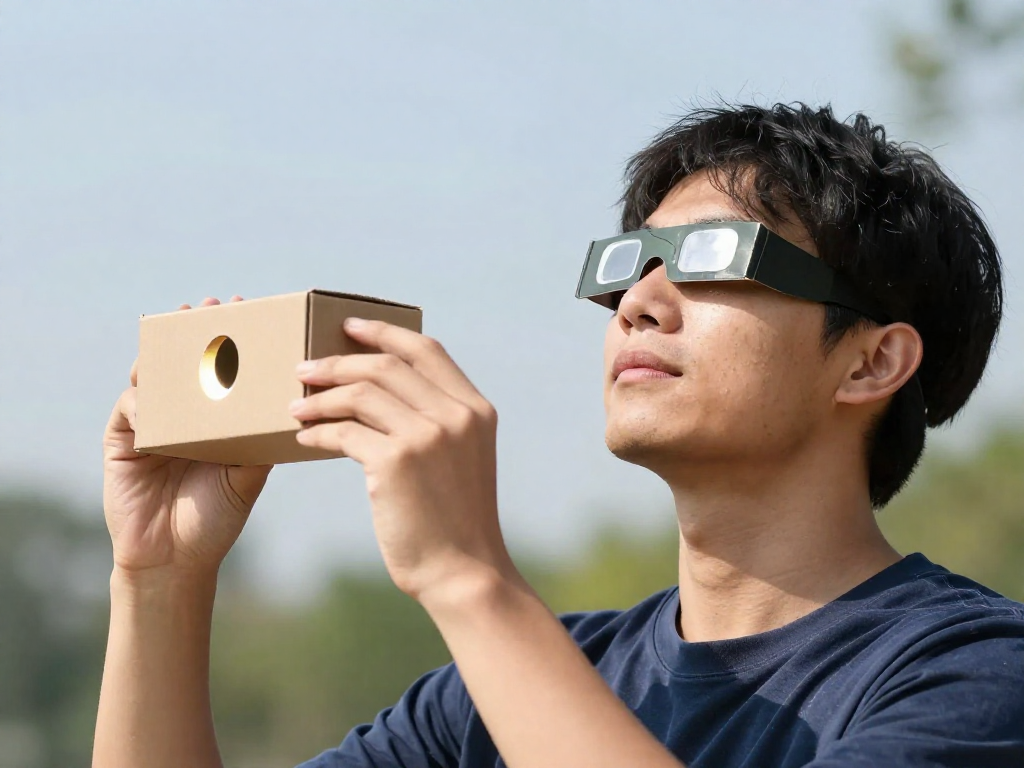
Wear certified eclipse glasses. Look for the label ISO 12312-2, an international safety standard for eclipse viewing. Regular sunglasses—even very dark ones—are thousands of times too weak and won't protect you. NASA recommends eclipse glasses or handheld solar viewers for all partial phases.
-
Try a pinhole projector. This is the easy, free, no-risk option. Poke a small hole in a piece of card, hold it up, and let sunlight pass through onto a second surface below. You'll see a tiny projected image of the eclipsed Sun—no looking up required.
-
Know the one bare-eye exception. During totality, when the Sun's bright face is fully hidden, it's safe to look directly and admire the glowing outer atmosphere (the corona). The instant the Sun begins to reappear, glasses go back on.
-
Protect your gear too. Cameras, binoculars, and telescopes need dedicated solar filters fitted over the front. Pointing them at the Sun unfiltered can damage the device—and your eyes if you look through them.
How to Watch a Lunar Eclipse
Here's the good news: watching a lunar eclipse is about as easy as stargazing gets. Unlike a solar eclipse, you don't need special glasses or any equipment at all. The Moon is simply reflecting sunlight, so looking at it is completely safe—just step outside and look up.
A few tips to make the most of it:
- Escape the city glow. Light pollution from streetlights and buildings washes out the night sky. A backyard, park, or rural spot away from bright lights will give you a richer view.
- Grab binoculars if you have them. You don't need them, but even a cheap pair (or a small telescope) makes the Moon's eerie red color "pop" and reveals more detail.
- Aim for totality. This is the phase when Earth's shadow fully covers the Moon and it glows a coppery red—often called a "Blood Moon." It's the showstopper, and it can last over an hour.
Quick takeaway: No gear, no risk—just find a dark spot, look up, and wait for the red.
When Can You See the Next Eclipse?
Ready to turn that curiosity into a real plan? Here's how to find your next eclipse.
- Check the date and your location. Whether an eclipse is visible depends on where you stand on Earth. NASA's eclipse website lists upcoming dates and shows which regions can see each one.
- Know about the "path of totality." This is the narrow strip of land—often just 100 miles or so wide—where a total solar eclipse turns day briefly to twilight. Outside that ribbon, you'll only see a partial eclipse. Seeing totality often means traveling to be in the right place.
- Use free tools. Apps and sites like NASA's eclipse pages, timeanddate.com, and stargazing apps such as Stellarium let you type in your city and see exactly when to look up.
Quick takeaway: Mark your calendar early. A total solar eclipse returns to any single spot on Earth only once every few hundred years, so when one comes near you, don't miss it.
See also
- What Is a Blood Moon and Why Does It Happen?
- Beginner's Guide to the Phases of the Moon
- How to Stargaze Without a Telescope
- What Is the Path of Totality?
- Upcoming Cosmic Events to Watch This Year
Related articles
How to Photograph the Night Sky With Just a Phone
Yes, you can take stunning night sky photos with just a phone. Learn beginner-friendly settings, gear, and tricks to capture stars, the Moon, and the Milky Way.
Jun 29, 2026 · 11 min read
What Causes the Northern Lights, and Can Beginners See Them?
Curious about the Northern Lights? Learn what causes auroras in plain language, where and when to see them, and realistic tips for total beginners.
Jun 29, 2026 · 8 min read
A Beginner's Sky-Watching Calendar: Events Worth Looking Up For
A simple year-round sky-watching calendar for beginners. Discover meteor showers, eclipses, and planet sightings worth looking up for—no telescope needed.
Jun 29, 2026 · 5 min read